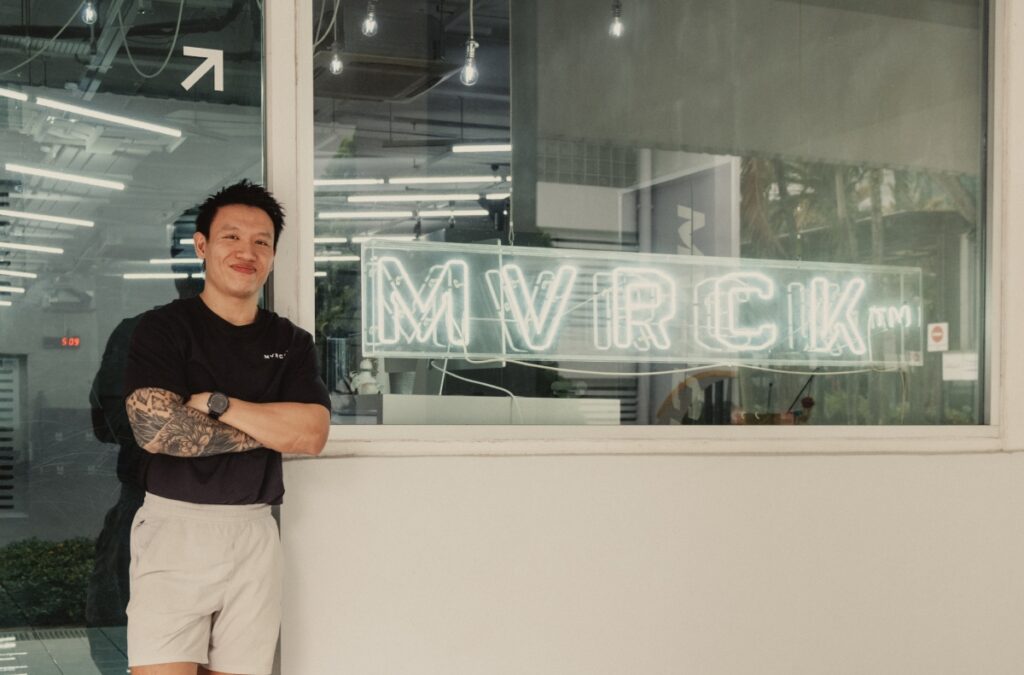
Wyl Ng built strength and conditioning gym MVRCK from scratch
For fitness entrepreneur Wyl Ng, his gym is more than just a workplace—it’s become a second home. Wly is the founder of MVRCK (pronounced “maverick”), a strength and conditioning studio that he has nurtured from the ground up.
Over eight years, he has built MVRCK through grit, improvisation, and sheer stubborn belief—growing it into a business nearing S$1 million in total revenue. But getting there was far from easy.
We sat down with him to understand what it takes to build and run a Singapore-born gym in an increasingly saturated fitness landscape dominated by foreign franchises.
Leaving his job to pursue his passion
At 35, Wyl may be a seasoned business owner, but he still carries a disarmingly youthful presence. His easy-going energy masks the long, exhausting grind that went into building MVRCK.
When asked where the idea for the business came from, he took me back eleven years, to a time when he was working in the service industry and unsure of what was going to come next.

Fitness, however, had always been constant—he was active since secondary school and began bodybuilding while in polytechnic in 2008. That passion planted a quiet ambition: to one day build his own fitness business, train people, and watch them progress.
Hence, in 2015, he left his service-industry job to pursue something he truly loved: full-time personal training. While coaching, he saved diligently and gained the hands-on experience he knew would be crucial for building his own gym.
The same year, at age 24, Wyl also stumbled upon CrossFit.
Back then, CrossFit was still new in Singapore. Without formal guidance, Wyl built his foundation through YouTube tutorials and by experimenting in gyms like Anytime Fitness and Fitness First, often entering through trial passes from friends to save money. These were traditional, machine-based gyms—nothing like the modular, open-floor CrossFit-style facilities he dreamed of.
“In a traditional gym, my friends and I would jump from one machine to another consecutively due to the nature of the workouts,” said Wyl.
“We had to experiment a lot because CrossFit was still fairly new. People were probably wondering what kind of weird movements we were doing, burpees were never seen in gyms 10 years ago.”
These experiments sparked a deep passion for the sport—Wyl had even gone on to participate in several CrossFit competitions over the years, earning both first- and second-place finishes. They also planted the seed for MVRCK: a space where people could train with high-intensity functional movements in a community-focused environment.
Starting with the bare minimum
To launch MVRCK, Wyl invested S$80,000, drawn from his personal training savings, and also tapped into the funds from a childhood life insurance plan his parents had set aside for him.
At 27, he opened the gym’s first 2,600 sq ft space at Alexandra in Apr 2018—leaving just 20 cents in his bank account. So, he was meticulous with branding and equipment procurement, starting with only the bare minimum: two bikes, dumbbells, and 15 barbells.
If MVRCK failed, I had nothing left. So there was no giving up.
Wyl Ng, founder of MVRCK

MVRCK runs daily group classes alongside a flexible open-gym space, designed to accommodate unpredictable functional movements. Every client starts with a consultation to set personal goals, after which coaches create a customised training plan and class recommendations.
This is unlike traditional gyms, which mostly cater to beginners and intermediate users in large classes, making it difficult to teach complex skills like handstand walks or muscle-ups.
For the opening week, over 100 people attended Wyl’s classes, but sadly, once the trial ended, no one signed up. Wyl acknowledged that this is a challenge many local, non-franchise startup gyms face—when consumers tend to associate credibility with bigger, foreign brands, while feeling apprehensive to homegrown ones.
With rent due and barely anything left in his bank account, Wyl faced the harsh reality of launching a startup with little financial cushion—until a breakthrough came just days later.
He worked & slept at the gym
A few days before the payment deadline, three expats walked in, curious about why his gym looked so different from typical machine-filled gyms.
Wyl explained that he was a local founder running a strength and conditioning gym with a similar layout to a CrossFit Box—a rarity then.
At close to S$300 a month, MVRCK’s pricing was (and still is) considered premium—compared to the S$90 average for traditional gyms. Still, Wyl believed firmly in the value his classes offered. He presented the trio an impromptu offer: if they paid upfront for six months, he’d give them a discount. They agreed, covering his rent.
“They asked me: what if you close down after a month? I told them that would be unlucky, but they had to trust me,” Wyl recounted.

After surviving Apr, the following month, 20 members signed up—despite the Alexandra location’s low footfall. Word of mouth, MVRCK’s online presence, and a “polished look” that appealed to the younger generation slowly increased awareness of the gym’s offerings.
Moreover, Wyl’s background as a trainer and his accolades in CrossFit competitions strengthened his credibility and drew new members. The trio who essentially saved his first month even went on to train with him for four years before relocating.
For the first 1.5 years, Wyl worked and slept at the gym. His last class ended at 10PM, and the first began at 6:30AM. In between, he cleaned the space and slept there to save on cab fares. He went home so rarely that he joked he could count the visits on one hand.
He wore every hat—cleaner, logistics coordinator, marketer, finance manager. At that time, he couldn’t afford staff and refused to hire until he could pay them well. Eventually, he had enough to bring on his first coach: a responsible, eager intern from a previous gym. “The first month, I took my salary and gave it to him,” he recalled.
Despite the pandemic, Wyl persevered, breaking even by mid-2022. Over time, he hired two more coaches, each of whom underwent a rigorous three-month training program.
Personalised training, even in a group or individual setting
At MVRCK, programming is planned one month in advance—unlike franchise gyms, where workouts are dictated by headquarters—allowing MVRCK to tailor content to member demand. This flexibility means they can add specialised classes like Hyrox or even consider stretching or mobility regimes if interest grows.
The gym cycles through over 70 exercise variations—from thrusters to weightlifting techniques—designed to build CrossFit readiness and overall conditioning.

MVRCK’s programmes are curated by skill level—beginner, intermediate, and advanced—mapped across three pillars: Move, Train, and Perform. And for each session, progress for each client is logged in a third-party app, where both trainers and clients can visually track improvements.
Beyond group classes, the busineess also offers personal training, which Wyl believes accelerates learning by up to 50% due to hands-on, intensive coaching. He acknowledges that not everyone is self-motivated; trainers provide accountability and help clients form healthier habits. PT clients also receive “homework” via another app to practise between sessions.
Over the years, the gym has managed to build a loyal base of around 200 members. The four coaches (including Wyl) know every client by name—many have trained with them for years. Its member base is uniquely diverse—from millennials to seniors, including an 85-year-old who trains to play golf, and ER nurses maintaining stamina for grueling shifts.
Building on this growth, MVRCK opened a second 3,500 sq ft outlet on Macpherson Road in 2023, a year after breaking even. The community continues to thrive through small-group classes of 10, social events, and training for Hyrox and CrossFit competitions, fostering strong connections between trainers and members.
There is “enough pie for everyone” in the fitness market

Over the years, MVRCK had to raise prices slightly due to rising rental costs. Still, Wyl remains firm on maintaining premium pricing and rarely offers promotions or trials. He wants to value his coaches’ time and expertise—a stance most of his clients understand.
This approach does make it harder to stand out in a market dominated by large brands that frequently run aggressive promotions. Still, Wyl believes there is “enough pie for everyone” in Singapore’s crowded fitness scene and trusts in the strength of his offerings.
“There are quite a few drop-in clients, and many of them are likely to convert once they see the value of the classes,” he noted.
Rising fitness trends like Hyrox have also made it easier to convey MVRCK’s training philosophy. “Last time, I had to convince people what this was. Now, people already know the different regimes out there and understand that our gym prepares them for everything imaginable.”
With his journey, he hopes to challenge the perception that being a fitness trainer is merely a side gig. MVRCK’s sustainable growth—and the way he fairly compensates his coaches—demonstrates that coaching can be a viable full-time career.
Almost hitting S$1 million in total revenue is a “pretty cool milestone,” though he’ll continue pushing at his own pace. What matters most to Wyl now is balance—“the lives we’ve managed to change over eight years”—and carving out more time for life outside the gym he once called home.
- Learn more about MVRCK here.
- Read more stories we’ve written on Singaporean businesses here.