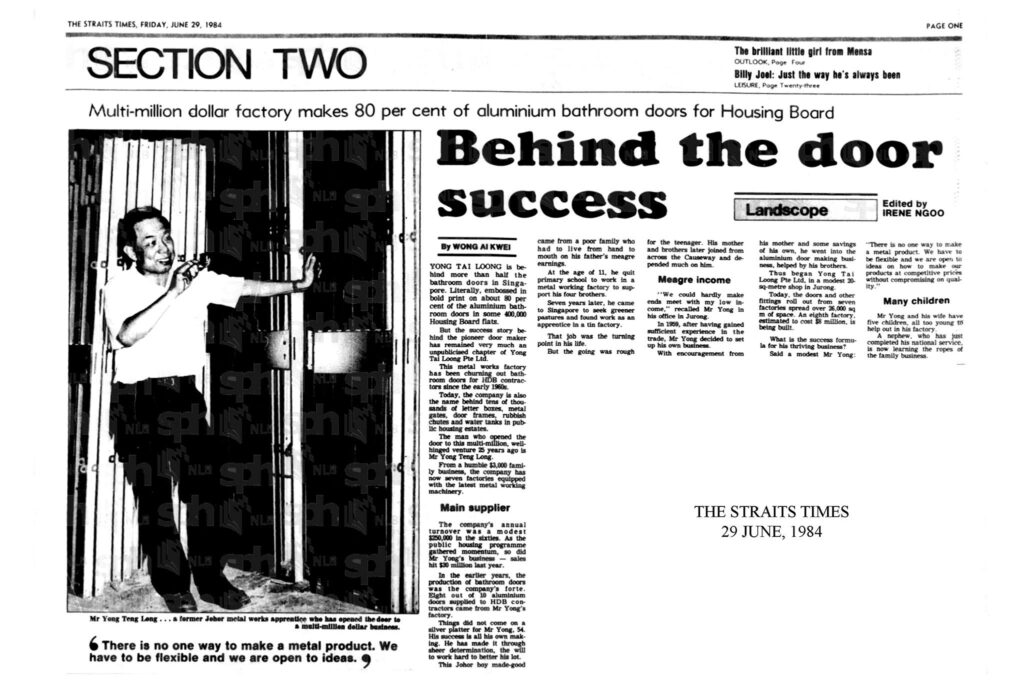
Yong Tai Loong is behind the doors, gates, letterboxes & fixtures found in countless HDB flats
If you live in a Singapore HDB flat, chances are you’ve touched a product made by Yong Tai Loong—whether it’s your bathroom door, letterbox, metal gate, refuse chute, or even the blast-resistant door protecting your household shelter.
Yet, despite being behind some of the most ubiquitous fixtures in public housing for over six decades, Yong Tai Loong arguably remains one of Singapore’s least publicly known manufacturing success stories.
From a humble S$3,000 family business started by a former tin factory apprentice, the company has grown into a multi-factory operation supplying over 100 construction companies and playing a foundational role in shaping Singapore’s built environment.
Here’s the story behind Yong Tai Loong, the 60-plus-year-old company that has helped build Singapore’s homes.
Its founder grew up in poverty

Sources differ on the exact year the business was founded, citing either 1958 or 1959, but what is clear is that Yong Tai Loong was started by Yong Teng Long, a Johor-born metal worker who left school at 11 to help support his family. Raised in poverty, he began working in a factory before moving to Singapore as a teenager to take up an apprenticeship at a tin works.
His mother and brothers later joined him across the Causeway, relying heavily on his earnings. “We could hardly make ends meet with my low income,” Teng Long recalled in a 1984 interview with The Straits Times.
Despite low earnings, that apprenticeship proved pivotal. After gaining several years of experience, he struck out on his own, establishing what would become Yong Tai Loong.
With encouragement from his mother, his own modest savings, and help from his brothers, Teng Long opened a small 20-square-metre workshop, producing copper urns and metal products along Jalan Sultan before pivoting into aluminium door manufacturing.
Growing alongside Singapore’s public housing boom

The company’s fortunes became closely tied to Singapore’s public housing programme. By 1960, the Singapore Improvement Trust (SIT), established in 1927 to oversee the island’s infrastructure and housing, had built only about 24,000 dwelling units, leaving the housing shortage increasingly critical.
That same year, the Housing & Development Board was formed to tackle the crisis, focusing on providing affordable homes for the less well-off. With the expansion of public housing, Yong Tai Loong, which was already producing aluminium bathroom doors for SIT flats, found new opportunities in large-scale projects.
In the 1970s, Singapore saw the public housing programme shift from addressing a basic housing shortage to improving quality of life and catering to a growing middle class, with over 240,000 units constructed throughout the decade.
As HDB construction accelerated, demand for standardised, durable, mass-produced building components surged. Yong Tai Loong expanded rapidly to meet this need. With financing support from EDB and DBS, the company relocated to Jurong, investing in larger premises and automated machinery. By the mid-1980s, it operated seven factories across 26,000 square metres.

At its peak in that era, a whopping eight out of every 10 aluminium bathroom doors supplied to HDB contractors came from Yong Tai Loong’s factories. Its product range expanded beyond doors to include letterboxes, metal gates, refuse chutes, water tanks, and door frames—components that would become fixtures in hundreds of thousands of HDB flats.
From annual revenues of about S$250,000 in the 1960s, sales had also reached S$30 million by the early 1980s.
Continuously innovating
Over the years, Yong Tai Loong has stayed relevant by continuously innovating. One example is its 3-way letterbox system, which allows residents to block junk mail while still receiving important notices, letters, and parcels.
This focus on flexibility and problem-solving has been a guiding philosophy since the company’s early days. As the modest Teng Long said in the 1984 interview: “There is no one way to make a metal product. We have to be flexible and we are open to ideas on how to make our products at competitive prices without compromising on quality.”
Today, Yong Tai Loong continues its business, though it seems like the company has consolidated operations to three locations, at least according to its website. Its product catalogue has also expanded far beyond bathroom doors and letterboxes, and the company now also takes on projects for private housing.

In addition, it is also one of only four authorised suppliers for HDB bomb shelters, ensuring the business is still relevant to this day.
Yong Tai Loong’s story shows that some of Singapore’s most enduring businesses aren’t just flashy startups or multinational brands—even traditional industries can be impactful, shaping everyday life and driving the nation’s growth.
- Find out more about Yong Tai Loong here.
- Read other articles we’ve written on Singaporean businesses here.
Featured Image Credit: Yong Tai Loong/ Darren Soh via Facebook