Disclaimer: Unless otherwise stated, any opinions expressed below belong solely to the author. Survey conducted by ManpowerGroup as a part of its Global Talent Barometer 2026.
In another labour market release for 2026, today we’re looking at ManpowerGroup’s Global Talent Barometer, a survey of almost 14,000 workers from 19 countries (including Singapore), comparing their perceptions of their jobs and their respective markets.
The number of questions asked is quite extensive, and you can download the full document for free using the links above, but I would like to draw your attention to the perspectives on job security in Singapore, which appear to vary quite significantly depending on the industry you’re in.
While domestic unemployment is at pre-pandemic levels and remains stable at around 3% for citizens and residents alike, the volatility of your employment situation is dependent largely on the business you’re in. Some are going up, some are facing stagnation, and workers may have completely different experiences regarding job security over the next few months.
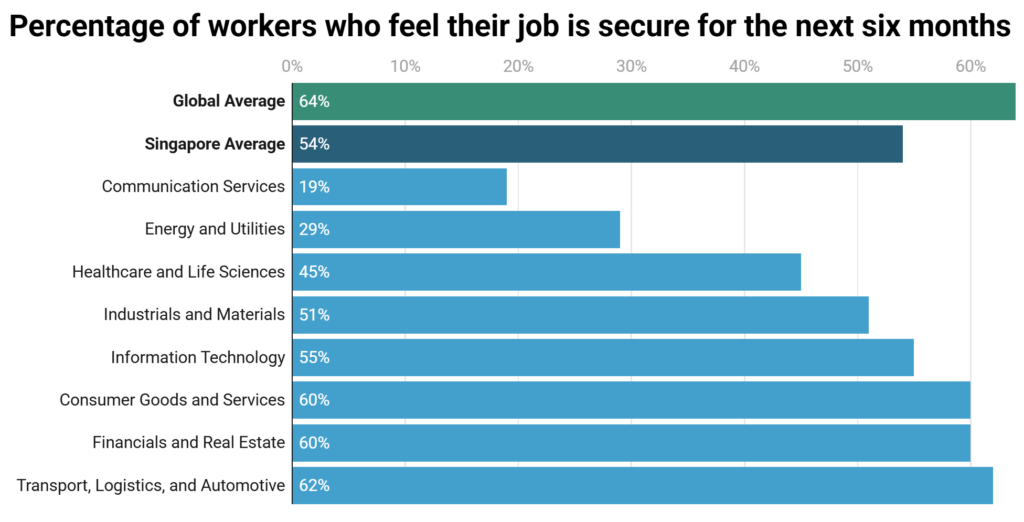
Among all workers polled across 19 countries, 64% feel secure in their jobs for the next six months. In Singapore, it’s 54%, but the percentages look quite a lot different across the eight industry groupings provided by ManpowerGroup:

As you can see, people in Communication Services feel most uncertain about their immediate future in the job they have now. However, a record 90% also believe they could find a new employer in six months if necessary.

Fortunately, then, lower stability doesn’t necessarily mean poor job prospects, but it may force you to become more adaptable.
Curiously, stability and volatility appear to also depend on the type of role you’re in, with lower-level workers exhibiting higher confidence in keeping their jobs than senior management—but those directors are sure confident in finding a new employer if they have to leave the current one:


On-site feels more stable, remote brings opportunities
Unsurprisingly, there are statistical differences recorded in the perceived job security depending on where you physically work. Despite the popularity of hybrid and remote work arrangements, it’s clear that carrying out your duties at the company makes you the most confident in your ability to keep your job.
What may be interesting is that confidence is highest among people who have no choice but to work on-site.

It decreases the further away you are from work, with the majority of fully or mostly remote workers in Singapore reporting uncertainty about their employment in the next six months.
The good news is that, at the same time, your confidence in being able to find a new job goes up. The percentages are almost exactly flipped in this case, with two thirds of remote workers confident they wouldn’t have a problem securing a replacement job if need be.

What we can gather from these numbers is that the higher you go and the more freedom you want, the less stability you can expect. But since ambition usually drives people to climb the ladder and seek independence, perhaps that’s exactly what they’ve wanted anyway.
Most of the rest can feel fortunate that their job provides a sense of security for as long as they just carry out their duties diligently—with the exception of two industries: Communications and Energy & Utilities, where Singaporeans currently feel the least confident about their employment in the early months of 2026.
- Read more stories we’ve written on the latest job trends here.
Featured Image Credit: efired/ depositphoto