This post, the third part of my series on ASUS’s AiMesh, will walk you through specific steps to set up an AiMesh network and offer tips on optimizing and maintaining it, including how to arrange the hardware, manage signal handoff, and more.
If you have other AiMesh-related questions, check the link in the Related Stories box below.
Dong’s note: I first published this post on February 11, 2022, and last updated it on January 15, 2026, with the latest information.
Getting an AiMesh system of your own: The hardware arrangement
We generally arrange the physical hardware after logically linking the units mesh system—as described in the detailed step-by-step guide below—but it’s a good idea to have an overview of the system before getting our hands dirty. With that, here goes:
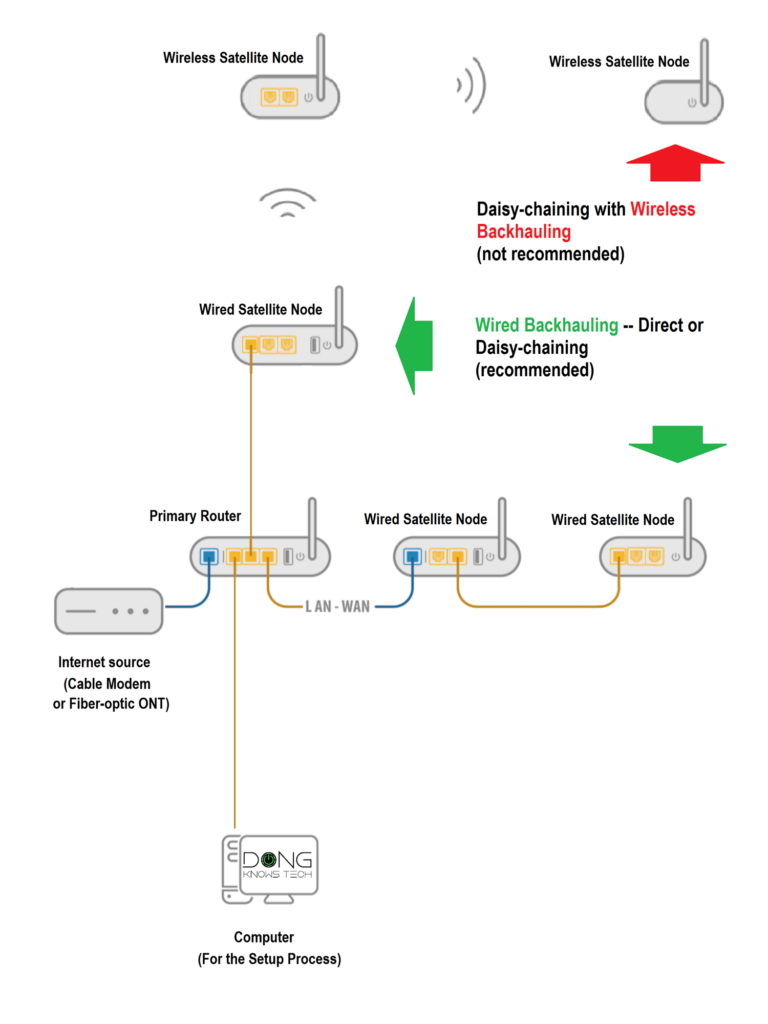
We need at least two routers to create an AiMesh system. No matter what hardware combo you have, the setup process is generally the same. Here’s the diagram (schema) of hardware arrangement in an AiMesh system:
Internet source -> Primary AiMesh router -> [optional unmanaged switch(es)] -> AiMesh satellite nodes.
Specifically, here’s the quick summary:
- Connect the primary router’s WAN port directly to your Internet terminal device—often a Cable modem or a fiber ONT. (If there’s another device between the primary router and the terminal device, or if you have a gateway in place of the modem, you’d have to think of double-NAT, or something is wrong.)
- Add your AiMesh satellite unit (node) to the system. Repeat this step to add more satellite nodes.
- Arrange the satellite node(s) around your home to get the best coverage and performance:
- In a wireless setup: it’s best to place these satellites around the primary router (primary node) in a star topology, allowing them to connect directly to the primary router. That, plus a proper distance are the only thing you need to keep in mind in a fully wireless setup.
- In a wired setup: it’s OK to daisy-chain the satellite units. In most cases, use the satellite unit’s WAN port for the uplink.
Using network cables as the backhaul link gives you the best performance and flexibility in hardware configuration. It also offers more hardware scenarios. Let’s continue with the details.
AiMesh with wired backhauling: How to connect the hardware units
When you choose wired backhauling, there are two hardware arrangement scenarios: Standard mode and mesh AP mode.
Standard scenario: Primary AiMesh router + AiMesh wired satellite nodes.
This configuration is generally recommended, and it works best.
In this case, the way you link the hardware units together follows the same rules as that of a standard router, specifically:
- The router unit: This is the system’s primary unit and must be the first device on your local network, with the satellite nodes behind it. This is the hardware that decides the features and settings of your network.
- The satellite node: This unit only extends the network. So, if you use a router in this role, its features (such as QoS, gaming-related, and everything else) are no longer in effect. Two things to note in terms of the uplink port:
- If you use a router as a satellite node, connect it to the existing network via its WAN port, typically to a LAN port on the router, a switch, or another node. (In many cases, you can use a LAN port of a node for this uplink connection, but it’s best to use the WAN to be safe, especially during the setup process.)
- If you use an AiMesh access point, then use any of its LAN ports for the uplink.
Let’s say you have a mesh of one primary router and two nodes. Here’s how you use network cables to link the hardware units:
- Hook the router’s WAN port to the Internet source (modem/ONT/gateway)
- Connect the satellite nodes to the router by:
- Link each satellite’s WAN port to a router LAN port. OR
- Connect the 1st satellite node’s WAN port to the router’s LAN port, then connect the 2nd satellite node’s WAN port to the 1st’s LAN port. Or
- Place an unmanaged switch (or two) in between them(1). This switch can be between the router and the satellite node(s) or between the satellites themselves. But it also must be behind the router.
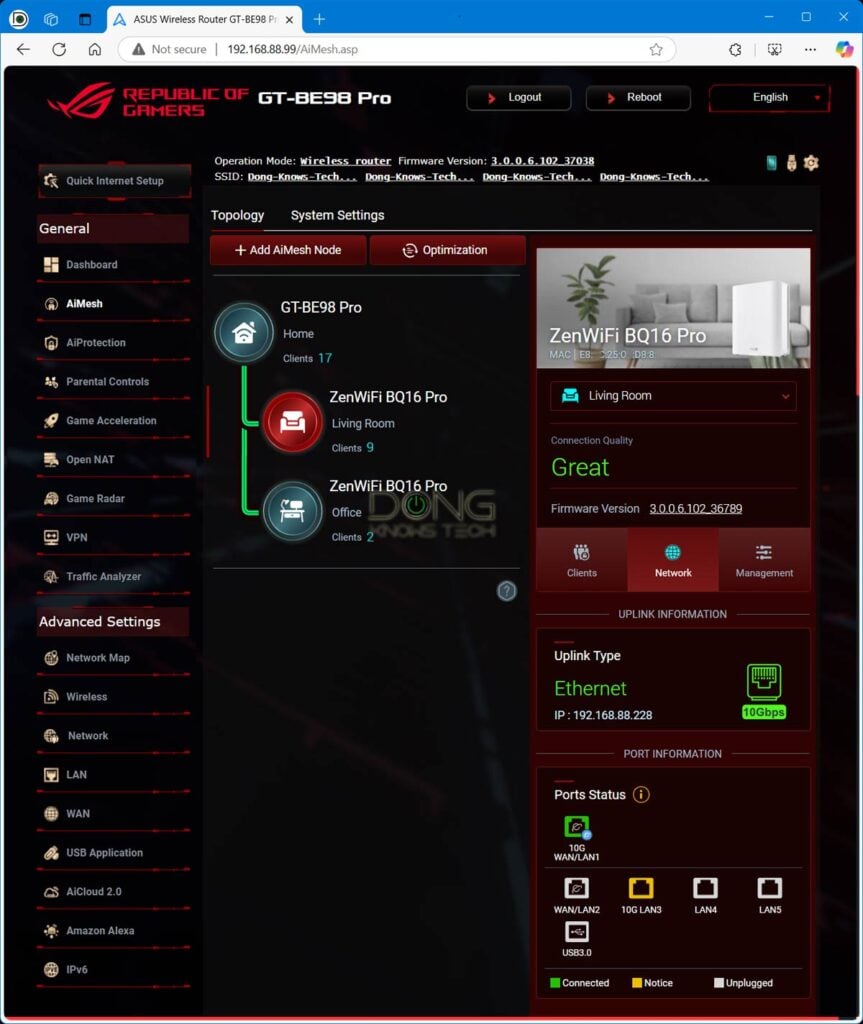
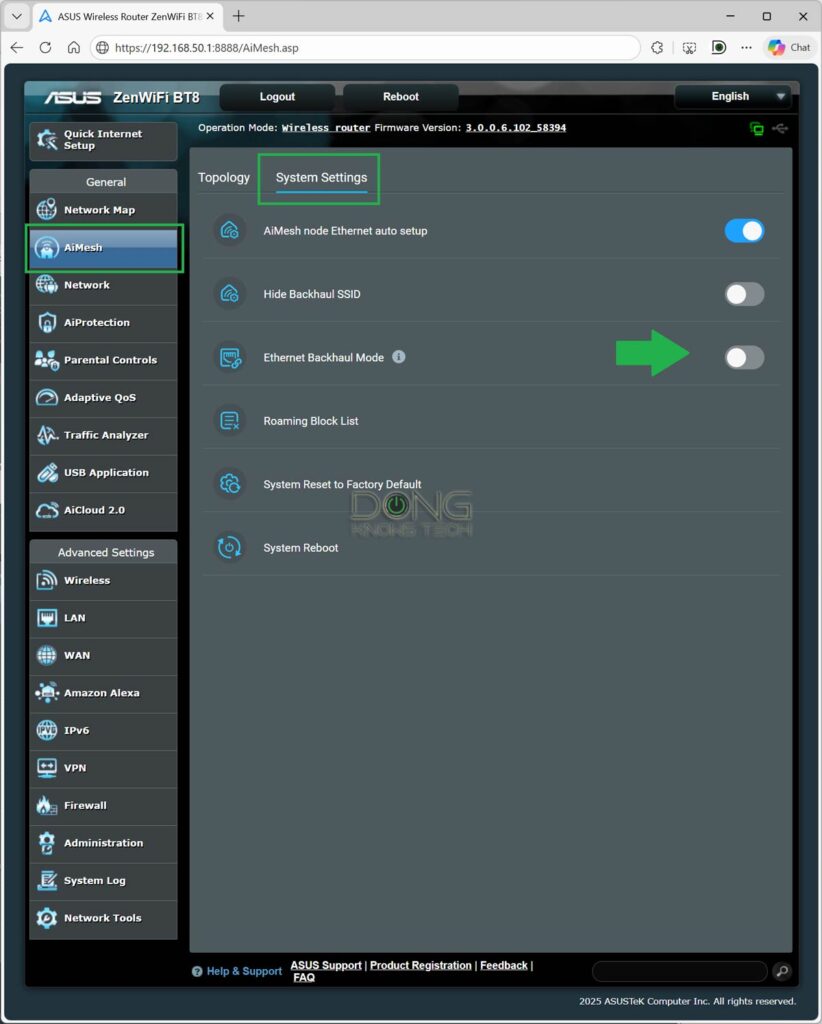
In a fully wired backhaul setup, you should explicitly use Ethernet Backhaul Mode via the AiMesh section of the router’s web interface.
If the Internet source is a gateway, you can also change the AiMesh router and, consequently, the entire system to Access Point mode. That brings us to the second scenario.
AiMesh system in AP mode scenario: An existing (AiMesh or not) router + wired AiMesh nodes
This configuration applies when you already have a router (such as an ISP-provided gateway) and want to avoid double-NAT. Or if you want to use mixed hardware in general, such as when using AiMesh routers of different Wi-Fi standards or AiMesh router(s) on top of a third-party router.
In this case, you can arrange the hardware as in the standard configuration above. Or you can also connect each AiMesh satellite directly to the existing router. In other words, all AiMesh units (primary and satellite) can be at the same level.
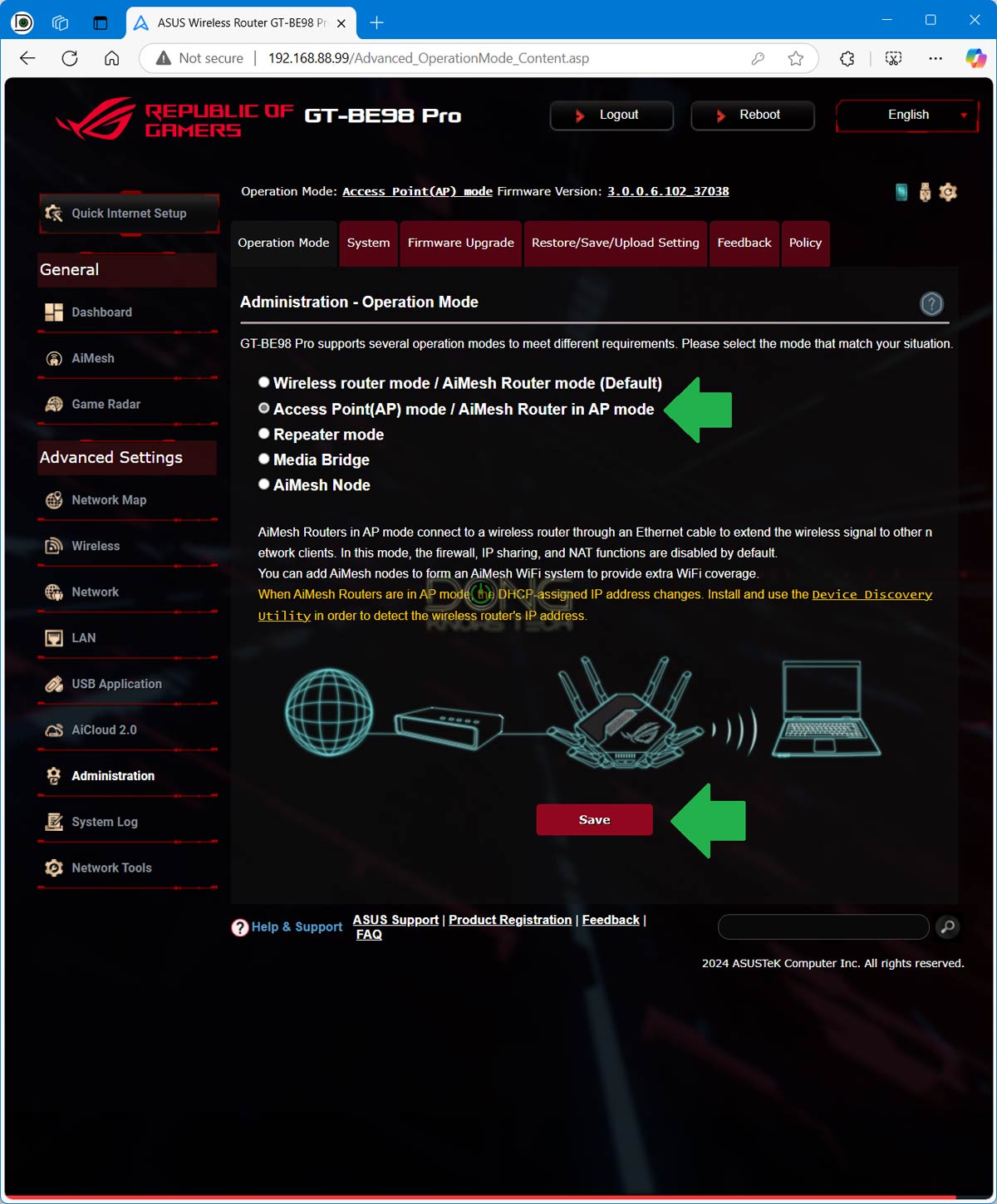
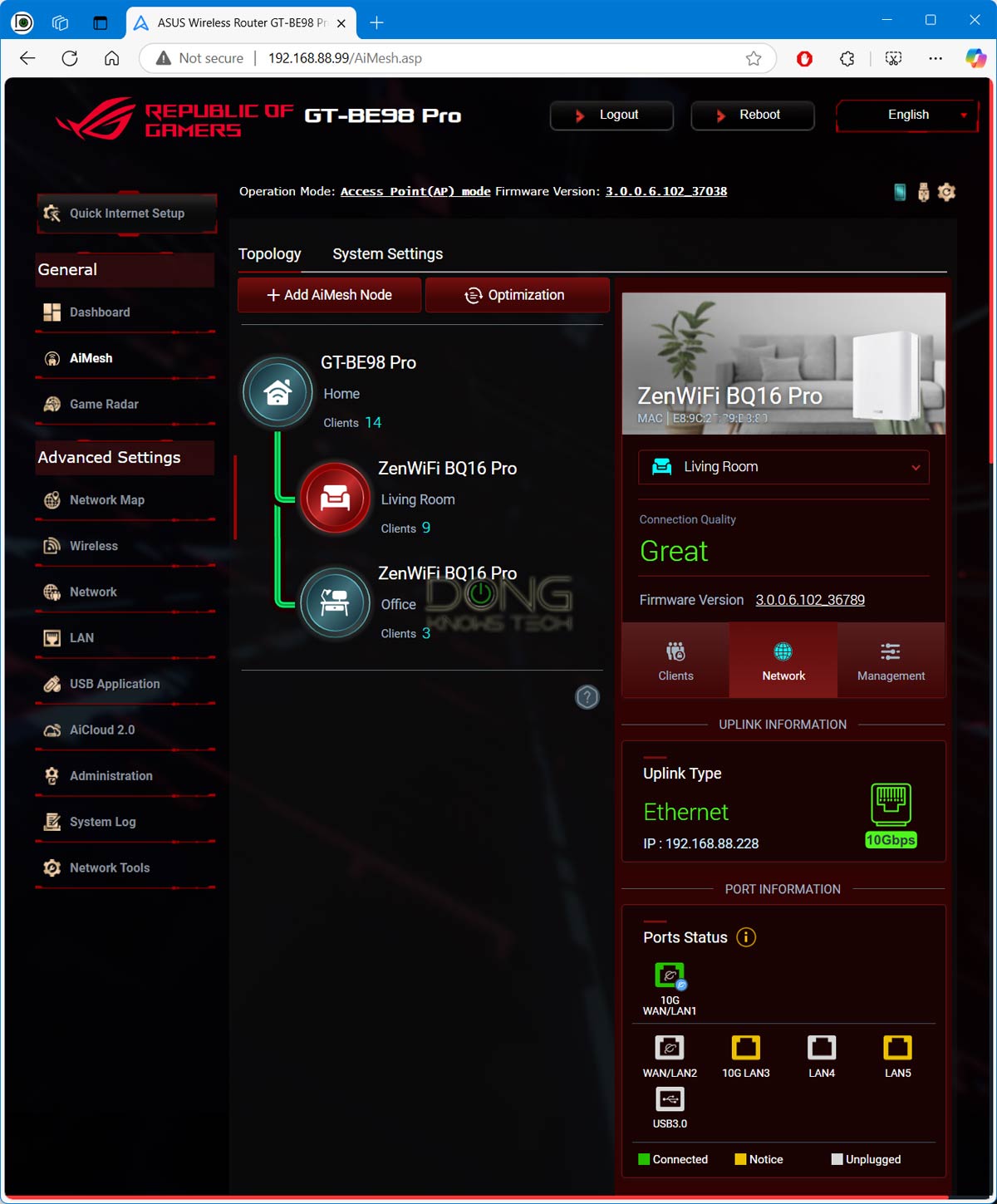
Switching an AiMesh router between router (default) and access point modes will not reset it, and the settings for each mode will remain. However, if you select any other operation mode, the hardware will automatically reset to factory defaults.
Let’s say you have an existing (third-party) router and three AiMesh nodes. Here are the steps to switch the system into the access point mode:
- Set up the AiMesh system the standard way—you’ll have a double NAT since the AiMesh router unit is on top of another router, the third-party one.
- Log in to the web user interface of the AiMesh router and change its Operation Mode to “Access Point (AP) mode”. Then click “Save” and wait for the change to apply—the system will restart. (Repeat this step when you want to get out of the AP mode.)
- Now you can optionally connect all AiMesh units (the primary router and satellite node) directly to the third-party router’s LAN ports (or those of a network switch). In other words, they can be at the same level.
Note that you need to re-arrange the hardware unit—placing the satellite AiMesh nodes behind the primary AiMesh router—before getting it out of access point mode and back to default router mode via step #2 above.
ASUS AiMesh setup: A step-by-step guide
As a rule, use the web user interface for these steps. While the ASUS Router mobile app is helpful for monitoring the router, it may cause inconsistencies or issues if you use it to make specific changes.
Tip
Avoid using the ASUS mobile app, at least for the setup process. The app is generic and lacks specifics applied to a particular Asus router. While this app might work in most cases and is convenient for monitoring your network, it can cause unknown and unexpected issues when used to set up new hardware or make specific changes to the system. If that’s your case, reset the hardware and set it up again using the web user interface before using the app if you can’t resist it.
Generally, AiMesh comes in different flavors. Again, there’s only one primary router in a system, and the rest of the units work as satellite nodes.
Note that the system doesn’t allow changing the primary node to a satellite node on the fly—you have to reset the entire system if you want to switch their roles. So, pick your primary router carefully.
Other than that, here are a few things to keep in mind:
- If you get a ZenWiFi or ExpertWiFi mesh set, such as a 2-pack or a 3-pack, the hardware units within a “pack” are often pre-synced. In this case, you only need to set up the router the way you would any standard router, and your mesh is ready when the rest of the units are plugged in and powered on—you won’t need to add them manually.
- The satellite-adding process is the same when you use multiple standalone routers or units from different packs. In the latter case, you only need to manually add the units of the set that doesn’t include the primary router unit.
- When adding multiple units of a ZenWiFi or ExpertWifi pack as satellite nodes to a system hosted by a primary router that’s not part of that pack, add one satellite unit at a time and ensure the others are turned off during the process (2).
There are three main A-B-C steps to setting up an AiMesh system. For the steps below, I used the GT-AX6000 mostly as the primary router and a few others as satellite nodes. However, the process is the same regardless of the combo you use.
A. Set up the primary router
This step applies when you set up a home network from scratch. If you’re already using an AiMesh-enabled router, you can jump to step B.
Again, you can set up an ASUS router using a web-based user interface, just like any standard router.
Here are the general steps:
- Connect the router’s default WAN port to the Internet source, be it a modem or a Fiber ONT. (You must use the default WAN port, which is often Blue. If you want to move the WAN function to a different port or use Dual-WAN, do that after the initial setup process.)
- Connect the computer to the router’s LAN port or its default Wi-Fi open network, which is “ASUS_xx”.
- Launch a browser (Chrome, Firefox, or Edge) on the connected computer and navigate to the router’s default IP address, which is 192.168.50.1 (or router.asus.com).
- Follow the onscreen wizard to set up the router as a standalone router or the AiMesh router role—the two are the same. Upgrade its firmware to the latest if prompted. You can also upload the settings backup from an older AiMesh router in most cases.
- Important: Set the router’s SSID to the default (Auto) setting for each Wi-Fi band. If you select a specific setting, such as forcing a 160MHz channel width or using a particular Wi-Fi standard, a non-supported satellite will be unable to connect to the mesh. Once a mesh is formed, you can adjust the Wi-Fi settings later.
The router will restart once or a few times during the setup process. Make sure you wait a few minutes after the final restart so it’s ready.
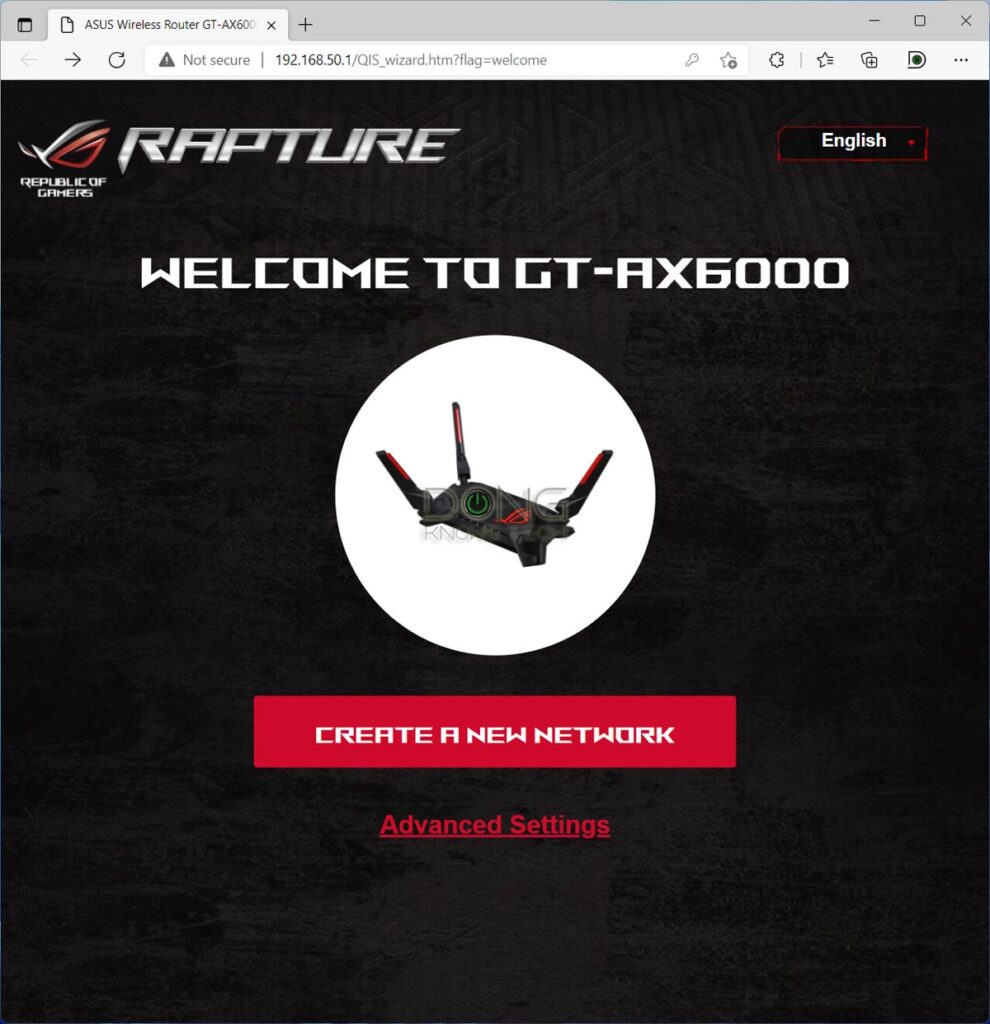
Create a new network: Pick this option to set up the device as a standalone router.
Advanced Settings: This option lets you choose different roles, including serving as an AiMesh router or satellite node. You can also upload the backup settings of another ASUS router.
Note: You can generally upgrade the router to the latest firmware if prompted. But in many cases, such as when you use mixed hardware units in the system, make sure you update their firmware appropriately, as described below. This applies to the satellite units, too.
Making the wrong decision about the firmware version will likely give you a lot of headaches.
B. Prepare the satellite node unit(s)
- Firmware update: While it’s not always necessary, it’s best to update the hardware to the latest available firmware before adding it to the router to form a system. So, if the process fails, consider updating the firmware first. In many cases, updating the firmware may require setting up the hardware as a standalone router first. Then, reset it.
- Reset: If you use hardware already set up as a router, you’ll need to reset it before you can use it as an AiMesh node. Changing the role from router to AiMesh node will also reset it. A brand-new unit is ready out of the box.
- Placement: Plug the node or nodes into power, and place them about 10 feet (3 meters) from the main router, or connect them to the router using a network cable (3).
As mentioned above, if you use a 2- or 3-pack of presynced hardware as satellite nodes for a primary router that’s not part of the pack, add one hardware unit at a time, with the others turned off.
C. Adding a satellite node to the main router to form the mesh
This step is entirely on the router unit’s web interface.
Note: When applicable, remove the main router from Ethernet Backhaul Mode for this step. You can put it back in this mode after you’ve added all nodes. Otherwise, the setup process might not work.
1. Search for satellite node(s)
On a connected computer, navigate to the main router’s web interface—as shown in step A.3 above.
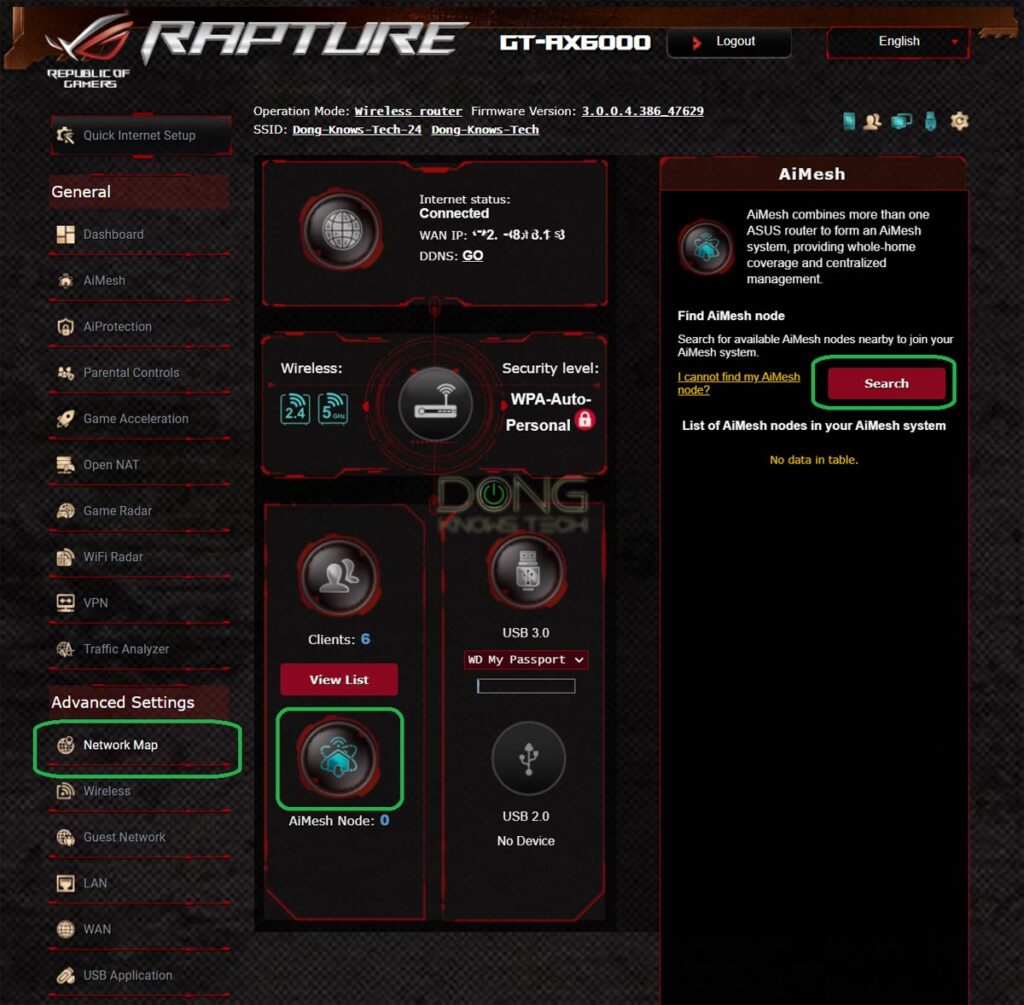
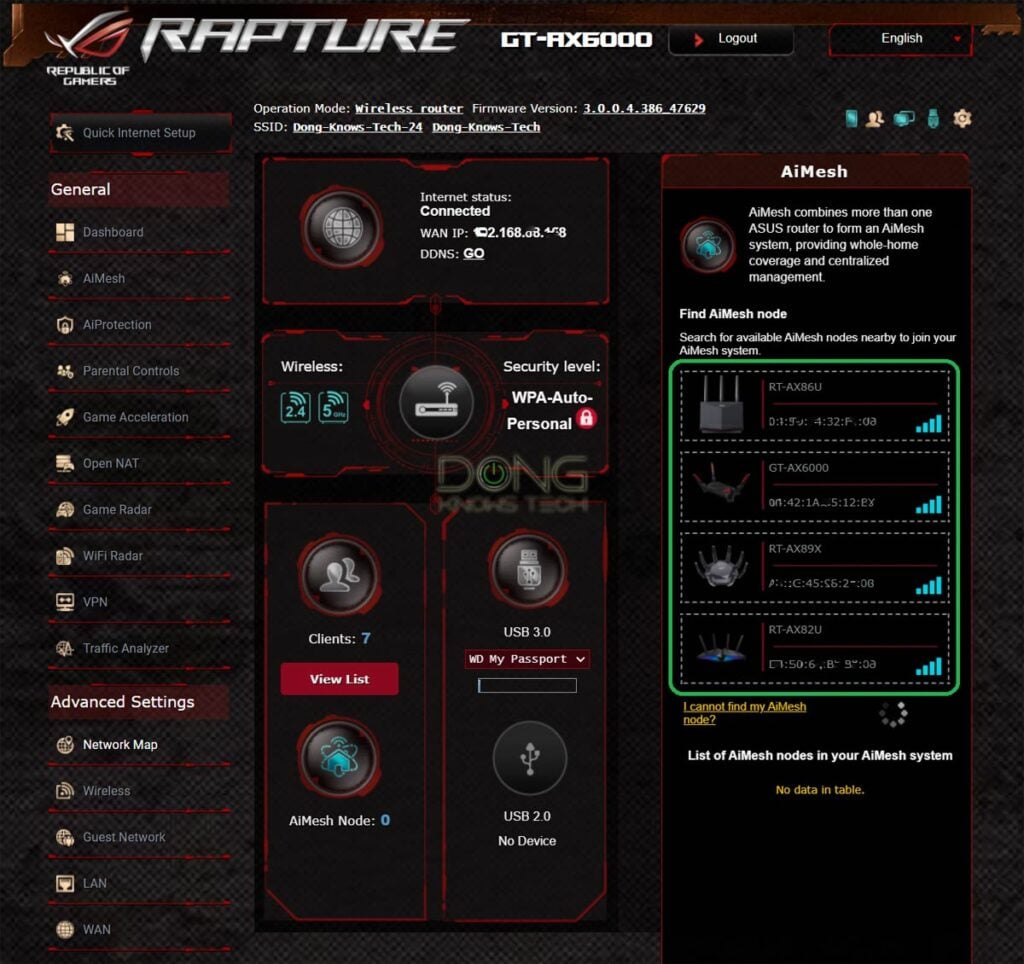
Click Network Map in the menu, then click the AiMesh icon. Now click on Search. After a few seconds, the node(s) will appear, as shown in the screenshot below.
2. Add a satellite node to the mesh
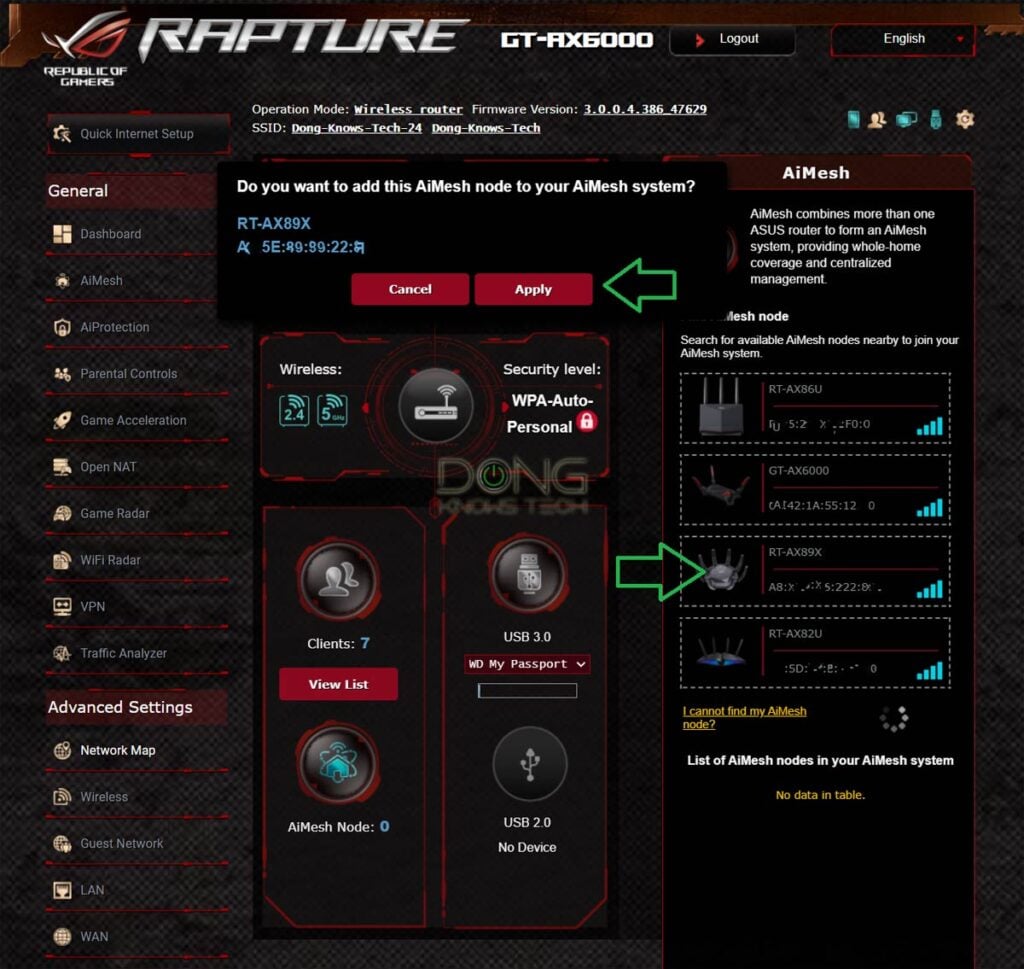
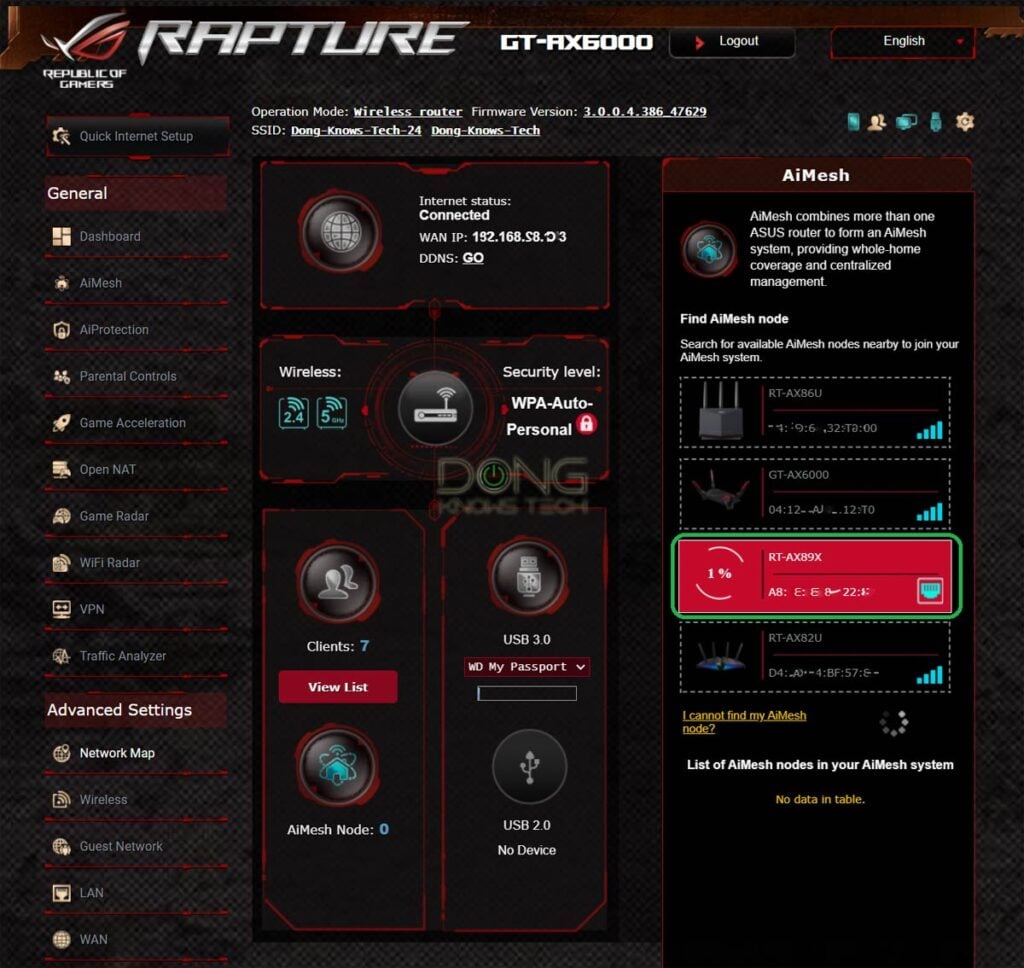
Click on a node, and a pop-up prompt will appear. Click on Apply to confirm. Now, wait about a minute for the adding process to complete. The progress of this step is shown in the three screenshots below.
Note: During this time, in my experience, you must not navigate to a different part of the web interface. Doing so might cause the setup to fail, and you’ll need to try again from step #2.
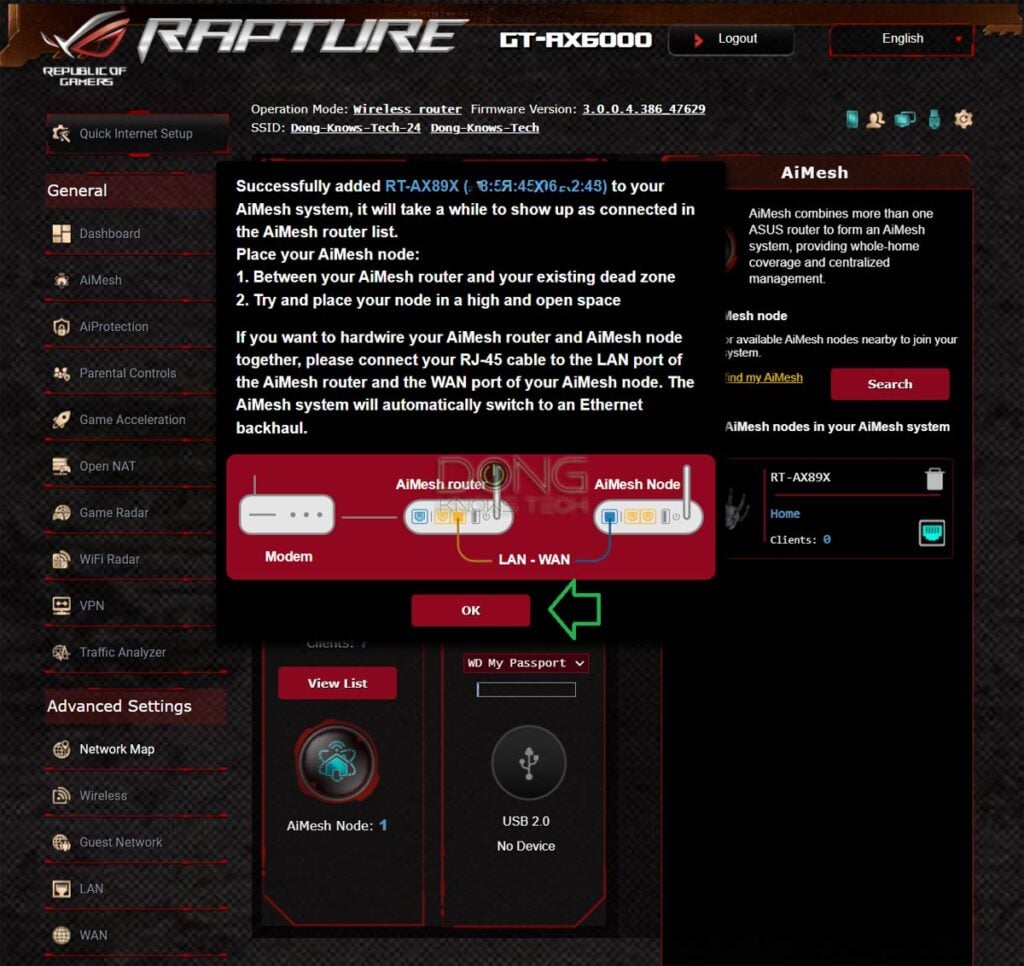
And that’s it! Repeat step #1 to add more nodes if need be. Otherwise, mission accomplished!
Tip
While not always necessary, it’s a good idea to manually restart the system after the initial setup and then wait a few minutes for it to start up.
When manually restarting an AiMesh system, always restart the primary router first and then the satellite(s).
All you have to do now is strategically place the satellite(s) around the house for the best coverage.
3. Rearrange the hardware
Once you’ve added all satellite nodes to the main router, it’s time to rearrange the hardware accordingly.
Specifically, to recap:
- In a wireless setup, place the satellites around the primary router.
- In a wired backhaul setup, connect the hardware to the network as needed. Generally, you want to use the satellite’s WAN port to connect it to the existing network, either to the router’s LAN port or to a switch that connects to the router. You can also daisy-chain the nodes.
- In a mix of wired and wireless backhaul setups, it’s best to connect the wireless satellites directly to a router or to a wired satellite.
After that, you might want to manage them properly as well.


AiMesh setup: Hardware management
Once you’ve got your system up and running, AiMesh offers several ways for users to manage satellite nodes.
Below are those you’ll find handy. Let’s start with what folks care about most: keeping devices connected to the closest (strongest) node, a.k.a. Roaming Assistance.
Understanding roaming assistance
As we move around the house, we generally want our phone (or laptop) to automatically connect to the closest Wi-Fi mesh node for the best connection speed, rather than the one farther away.
Generally, this’s called a handoff, or a seamless handoff, in a mesh Wi-Fi system. With AiMesh, that’s called roaming assistance.
Before continuing, remember that signal handoffs are complicated and almost always hit-or-miss, as I detailed in this mesh explainer. Another thing is that, most of the time, the default hand-off settings work well, and most canned systems don’t even allow you to change them.
Tip
Mesh hardware often uses connection speed as the basis for handoff.
Specifically, a client would consider switching to another broadcaster only when the connection speed between it and its current broadcaster is no longer fast enough to meet its general bandwidth needs.
Depending on the situation and on hardware or Wi-Fi standards, this threshold can be very low, such as 50 Mbps, because most clients generally don’t need more than that in real-world usage. That’s why, in certain situations, devices appear more clingy to a far mesh node—their connection speeds haven’t yet reached the threshold required for the jump.
Having the option to manage handoffs can be helpful, but it might lead to adverse outcomes if not done correctly. Remember that this part is optional, and you should tread lightly.
Step to adjust AiMesh’s roaming assistance
Like everything in an AiMesh system, you adjust this setting on the primary router unit.
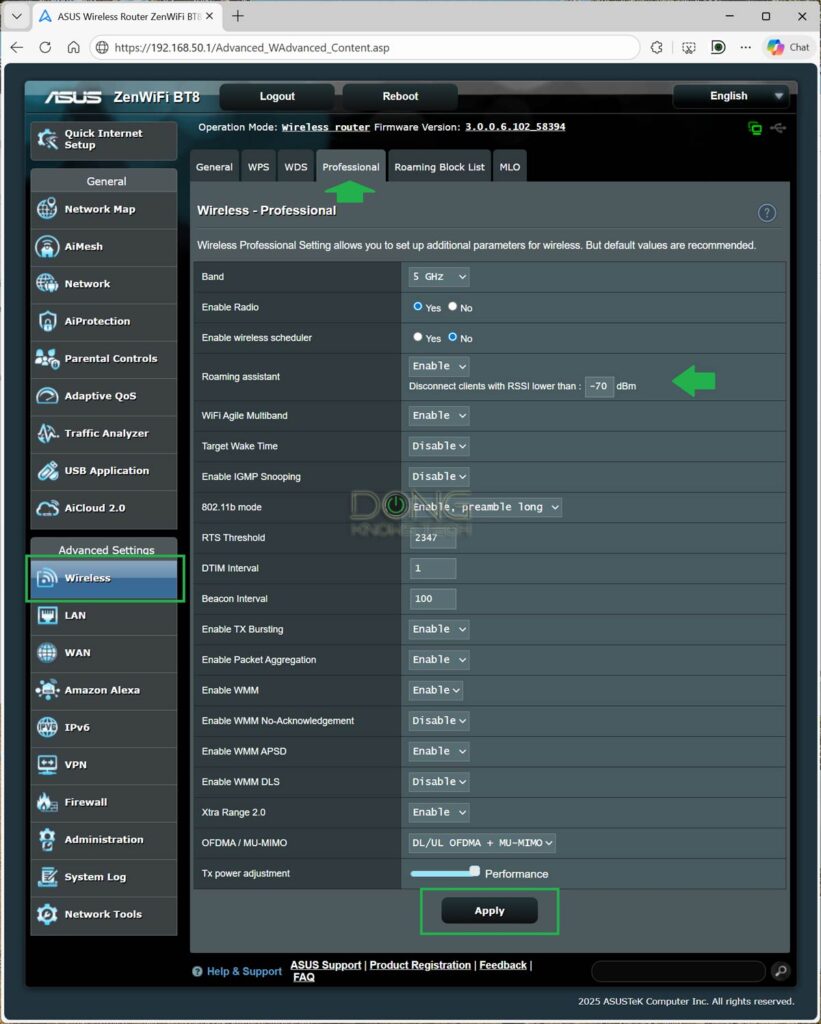
The screenshot above shows the steps in a ZenWiFi BT8, but the process is the same for any AiMesh router:
- Log in to the primary router’s interface, navigate to the Wireless section (under Advanced Settings), and then to the Professional tab.
- Pick the band you want to customize (2.4GHz, 5GHz, or 6GHz)
- Locate the Roaming assistant setting; you’ll see a default value already in place, such as -70 dBm.
- Change the value to a new number that fits your situation—more on this below—then click on Apply. Repeat step #2 for other Wi-Fi bands when applicable. After that, manually restart all hardware units, starting with the primary router, and give the system 5 to 10 minutes to start up.
To determine which dBm value works best, you first need to understand what dBm means. I explained it separately in this post about Wi-Fi signal strength.
However, generally, you should keep the dBm value between -60 (more sensitive; clients favor faster speeds and roam more) and -75 (less sensitive; clients tend to remain with the original mesh node). There’s no precise measure of Wi-Fi range or signal strength, as they vary widely depending on the environment.
Important note: If you make the roaming too sensitive, a device placed between two nodes with the same signal strength (or weakness) might have trouble staying connected—it might keep jumping between them.
Note that roaming is tricky since it depends more on the clients than the router. Networking vendors can’t test their products with all existing equipment. As a result, the success of seamless handoff is a matter of luck. When you need to ensure your device connects to the best mesh node, turn off and back on its Wi-Fi, or simply restart it.
Adding device to the Roaming Blocklist
The Roaming Block List is the opposite of the above: you want a device to remain connected to a specific node.
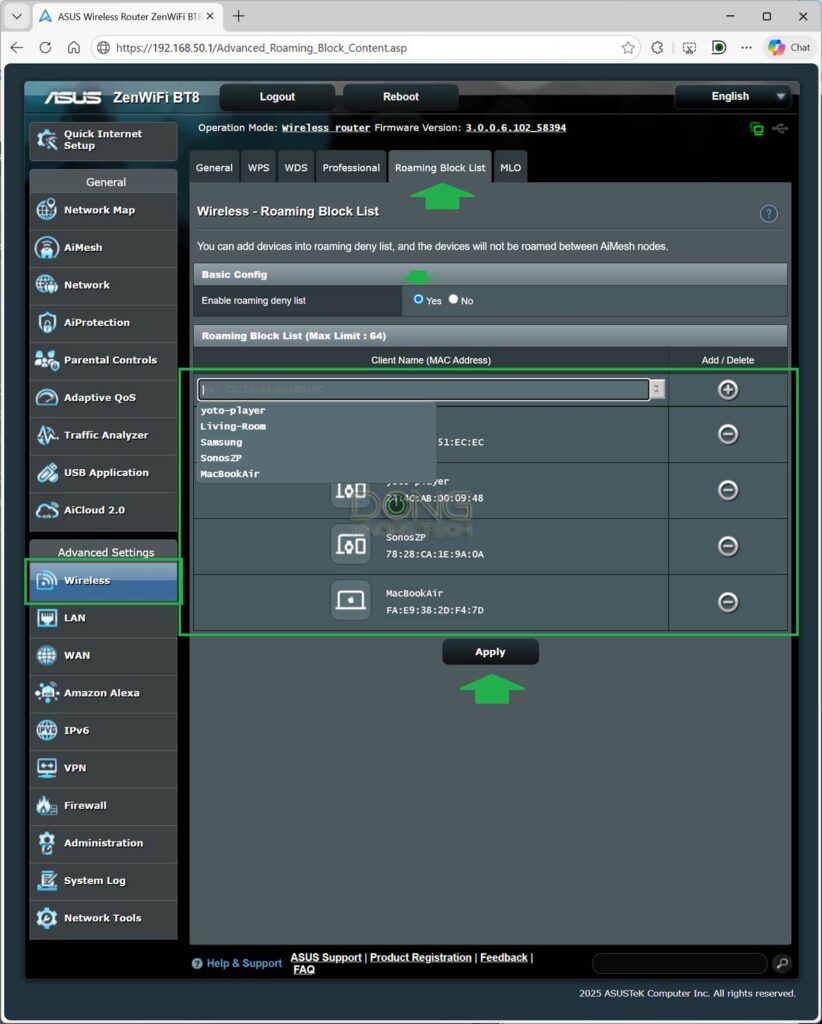
An example is a device located between two equally strong nodes that keeps jumping back and forth, causing unnecessary disconnections. Or you want to manually keep the load evenly distributed across different nodes.
Here are the steps:
- Log in to the primary router’s web interface and go to the AiMesh section to ensure the device is connected to the node you want.
- Go to the Wireless section, then click on the Roaming Block list tab
- Enter the device’s MAC address (or pick it from the list of connected clients) and click on the Plus sign (+). Repeat to add more devices.
- Hit Apply.
And that’s it. The device will now be locked to its current Wi-Fi node. To undo this, click on the trash icon and apply the changes.
Managing a node’s backhaul and additional settings
Each satellite node uses the Auto setting for the backhaul by default, which should work in almost all situations. But sometimes, you should adjust the settings of this backhaul connection.
Picking the best backhaul
There are a couple of instances where you might want to pick the backhaul manually.
One example is if you use a satellite node with a single Multi-Gig port (LAN or WAN)—such as the ZenWiFi XT8 (or ET8), RT-AX86U, or RT-AX89X—in a wired backhauling setup with another Multi-Gig router, you want to manually pick that port (instead of a Gigabit port) as the backhaul priority.
Another example: if you use a Wi-Fi 6E satellite node in a wireless configuration, you must choose the best band for backhaul. The 5GHz band is generally safer, while the 6GHz band is best if you can place the hardware near the router, within line of sight.
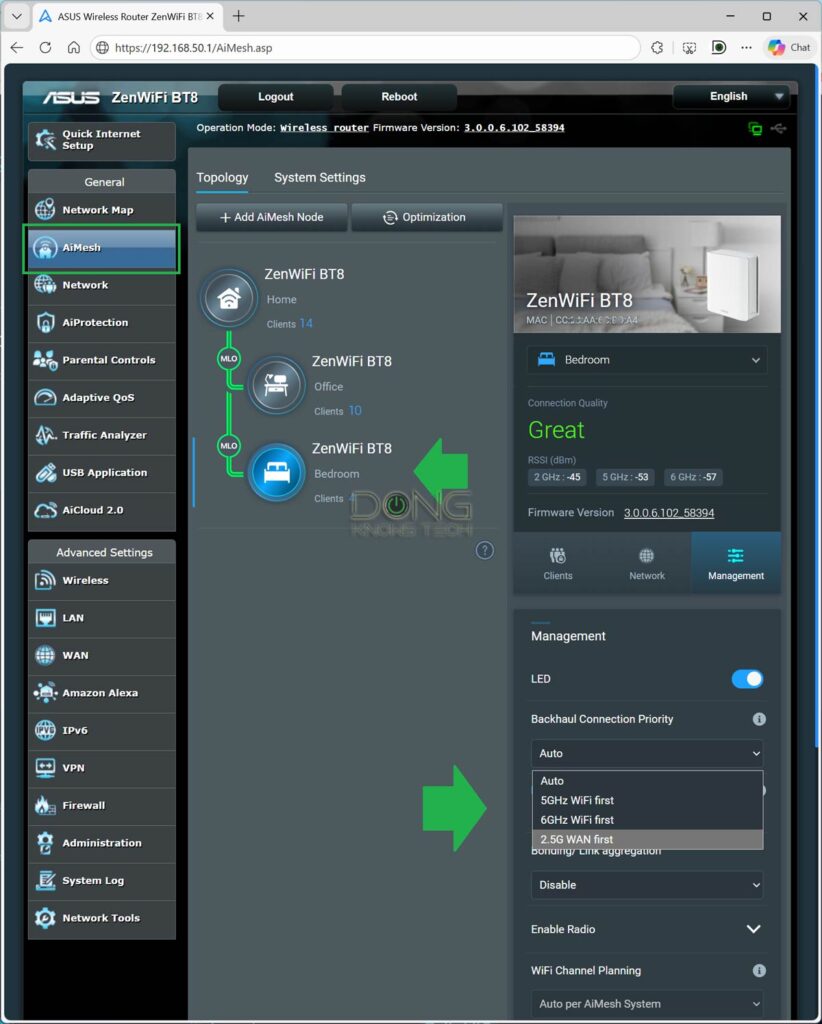
In any case, to manage the backhaul, go to the AiMesh section of the primary router’s web interface, pick the node in question, and change the setting accordingly. Here, you can also manage a few other aspects of the satellite, including its LAN ports, LEDs, and USB ports.
Disabling the use of DFS (when necessary)
When using the 5GHz band as the backhaul using Wi-Fi 6 or 6E hardware, there are two things to keep in mind:
- If you live in an area with frequent RADAR signals, you should disable DFS channels for this band (*). That’s always true unless:
- Your hardware supports UNII-4, like the case of the ZenWiFi Pro X12 and its alternatives. In this case, the use of 160MHz for backhauling won’t be affected by DFS.
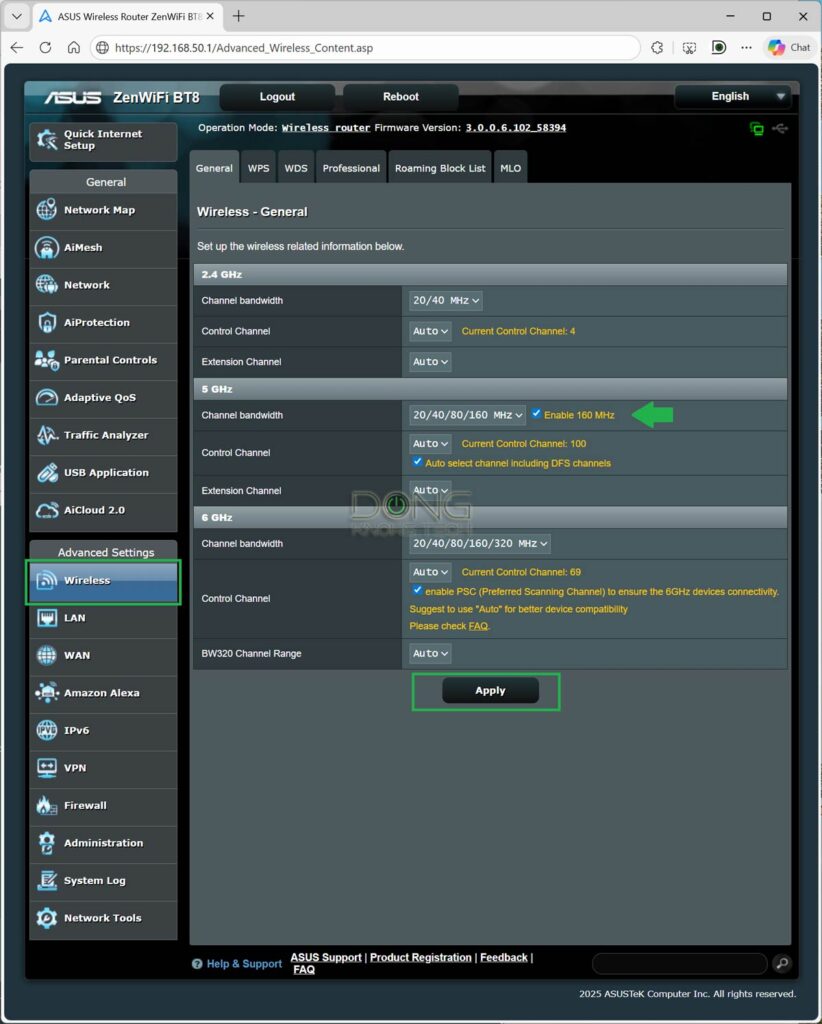
To manage the use of DFS channels, go to the Wireless section of the router’s web interface, select the band in question (5GHz or 5GHz-2), and uncheck the box labeled “Auto select channel using DFS channels,” as shown in the screenshot above.
Using the Ethernet Backhaul Mode (when applicable)
If you use a network cable to link the router and the satellites throughout—a pure wired backhaul setup—it’s best to explicitly select the Ethernet Backhaul Mode. In addition to much more reliable performance, an AiMesh system with wired backhauling allows users to configure the satellite’s channel width independently via the WiFi Channel Planning setting on a particular satellite unit. (In a wireless or mixed backhauling configuration, all units share the same channel settings of the primary router.)
Here are the steps:
- Log in to the router’s web interface.
- Go to the AiMesh section, then to System Settings.
- Move the slider of Ethernet Backhaul Mode (EBM) to the On position (right).
Depending on the router, you may be asked to set up the Wi-Fi network names (SSIDs)—selecting between Smart Connect and separate SSIDs—before you can enable EBM. In any case, you can always customize the SSIDs afterward. If you have a tri-band Wi-Fi 6 (or quad-band Wi-Fi 6E) router, it’s a good idea to unhide the 5GHz-2’s SSID and give it a meaningful name, different from the default.
The router will restart to apply the changes. After that, it’s a good idea to manually restart all hardware units in the system and allow them a few minutes to come back online.
This mode improves performance and makes it easier to manage the system’s Wi-Fi settings. If you use tri-band hardware, you can also combine all bands into a single SSID called Smart Connect.
Removing a node
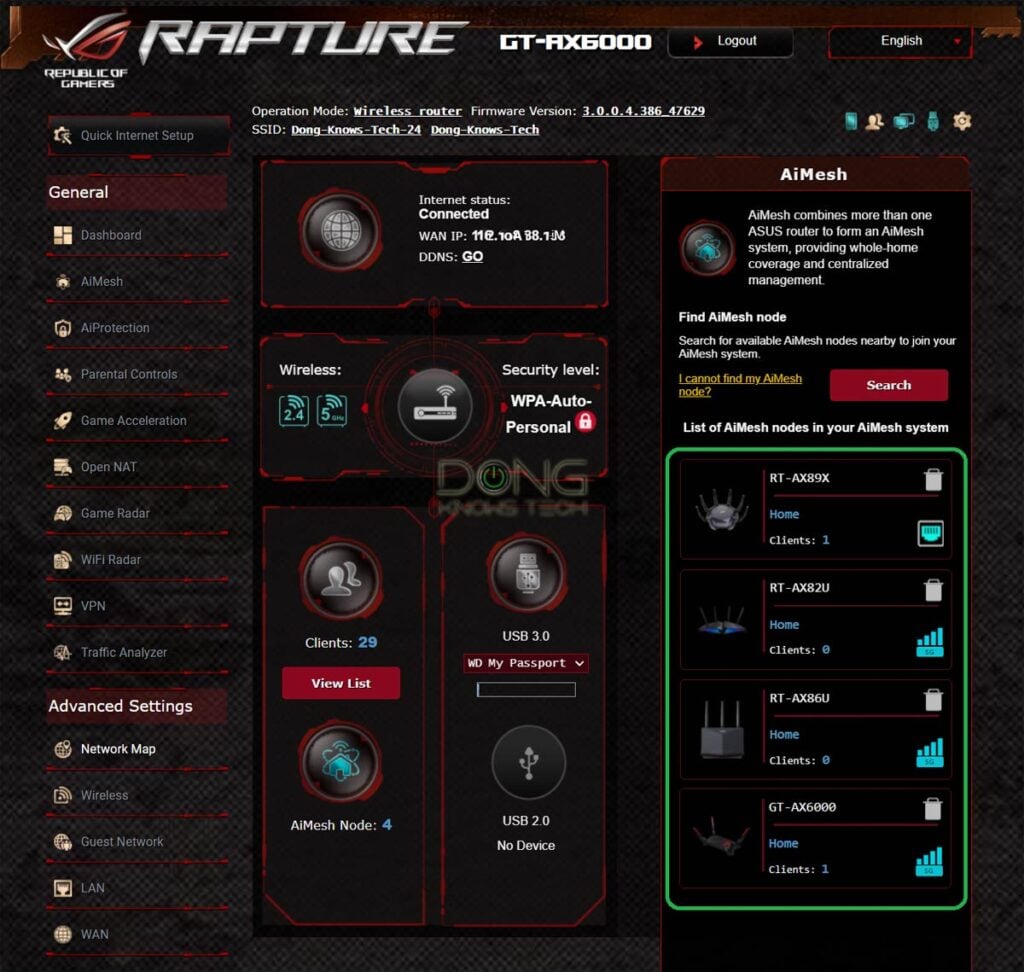
If you want to remove a satellite node from the system via the web interface, go to Network Maps, then click the AiMesh button. Click on the trash bin icon next to its name, as shown in the screenshots below.
That will also reset the node to factory default.
AiMesh firmware update
Managing firmware is one of the most important aspects of handling networking hardware.
Considering the vast number of hardware options—virtually all ASUS Wi-Fi 6 and newer routers support AiMesh, and you can theoretically combine any two or more of them into a Wi-Fi system—firmware updates have proven to be a tricky business.
Generally, it takes ASUS about 6 months to stabilize the software after a major release. When it comes to updating—especially in an AiMesh setup of mixed hardware units using wireless backhauling—keep the following three items in mind:
- Avoid the initial major release, which is the first firmware version of a model whose middle three digits change, such as from 384 to 386 or from 386 to 388, especially from 3.0.0.4 to 3.0.0.6. Generally, things start to be good with the first minor update to a major firmware release.
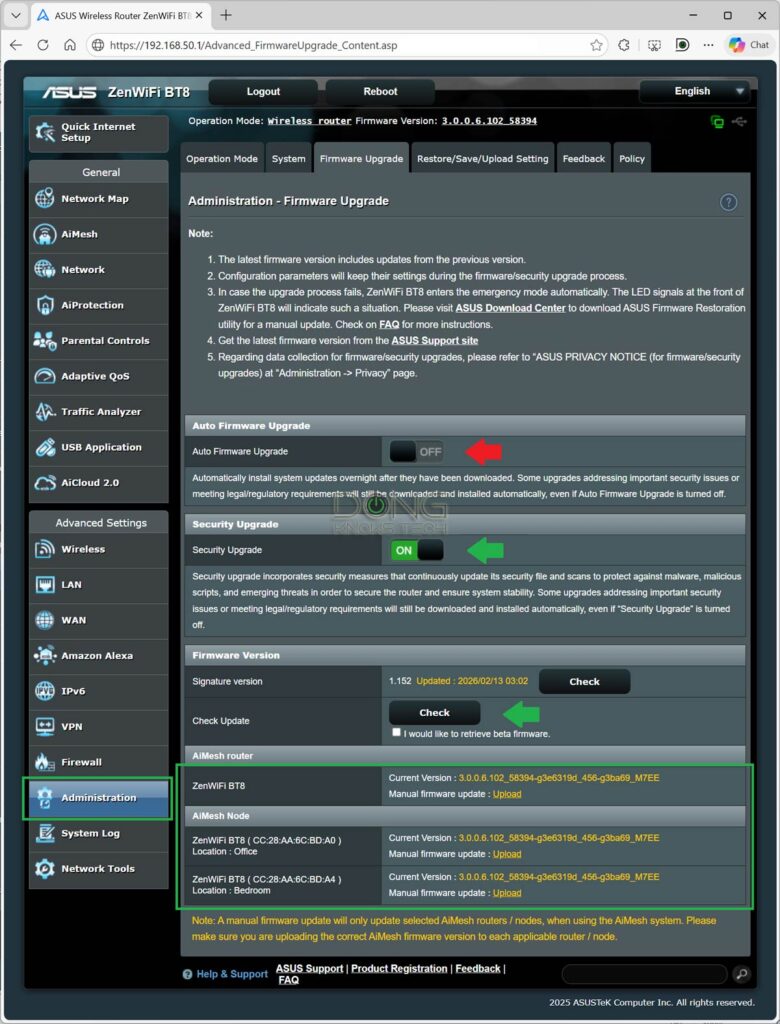
- Avoid using Auto-Update for firmware: Instead of letting the hardware update itself, you should update the firmware when you see fit. (It’s OK to choose Auto-Update for the security-only updates when that’s an option.)
- Version consistency (in a mesh system): Generally, it is best to use the firmware version of the same major release across all AiMesh members. (Mixing hardware of different major releases can produce mixed results, though things get better with version 388 and newer.)
- Reset and start anew: If, after a major update, things don’t seem right, it’s recommended that you back up your settings to a file, reset the hardware, and set it up from scratch. Then, if need be, restore the settings. Alternatively, go back to the previous (and issue-free) version and wait until a newer release.
The point is to tread lightly when upgrading firmware if your system has mixed hardware. The more differences in Wi-Fi standards and tiers within your combo, the more potential issues you might run into.
In any case, for firmware updates, go to the firmware section of the primary router. You can jump directly there by clicking the router’s firmware version at the top of the web interface.
ASUS also allows users to go back to an older firmware version. So, if new firmware breaks things, you can always manually revert to the previous version that works.
To return to a previous firmware version, download the desired version and upload it to the router. For detailed steps, check out this post on manual firmware updates.
Final thoughts
An AiMesh setup is not the easiest way to build a mesh system, compared to other canned alternatives like Orbi, TP-Link Deco, or Amazon’s eero.
However, that’s mostly because it offers many hardware options and settings. If you get the same hardware units throughout or go with a ZenWiFi/ExpertWiFi pre-built pack, things can be pretty manageable.
In any case, getting an AiMesh system done right will give you an excellent mesh network with little to no privacy risks, which is rare these days.