Disclaimer: Unless otherwise stated, any opinions expressed below belong solely to the author. All data sourced from the Labour Force in Singapore 2025 report, released by Singapore’s Ministry of Manpower last month.
We’re often told that the age of stable jobs where people would spend many years is long behind us and that the future will require flexibility and adaptability—including frequent changes of employment. Frankly speaking, I’ve been hearing this for the past 20 years myself.
And yet, the statistics released by the Ministry of Manpower show that this is hardly the case in Singapore. The city-state is often presented as one of the most modern, dynamic and advanced economies, so you’d be forgiven for thinking that local workers are leading the trends in job hopping.
As it turns out, the opposite is true.
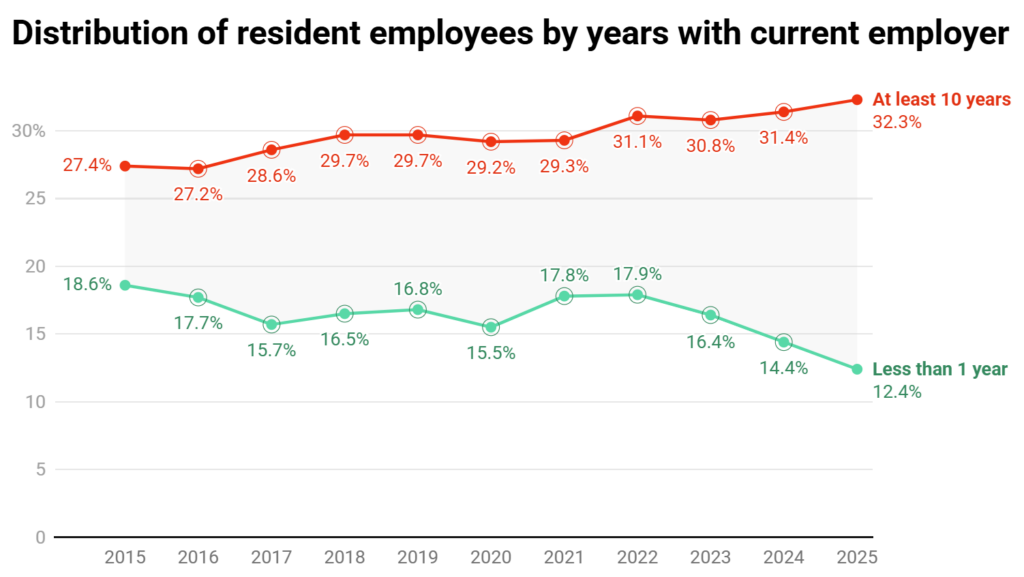
Over the past decade, the share of local, resident workers who have stayed with the same company for 10 years or more has gone up from a little over a quarter to a full one-third.

At the same time, the share of those who have either just entered the job market or changed their job in the past 12 months has shrunk from nearly 20% to just 12%, with the biggest drop recorded in the post-pandemic years.
Looking at the entire workforce, back in 2015, more than half of Singapore’s workers had stayed under five years in the same place. Today, the proportions have flipped, with the majority reporting 5 years or more with their employers.

Stability or stagnation?
The crucial question is whether these trends are a sign of unusual stability, whereby local workers enjoy secure jobs for many years, or if they simply lack better options and choose to stay put where they are.
While they aren’t mutually exclusive—after all, much depends on the company you work for—data suggests that the job market in Singapore is good for its workers. And getting better.
Since 2015, the median income from work has increased from S$3,949 to S$5,775 in 2025. That is 46.2% in nominal terms and 23.2% when accounting for inflation. This means local salaries can buy 1/4 more compared to a decade ago.
Meanwhile, the average number of weekly working hours for full-time employees has dropped from 47 to 43.8. That’s a cumulative decrease of over 166 hours per year, equivalent to 20 eight-hour workdays.
Singaporeans work less and earn more than ever, despite the fact that a growing number choose to stay with the same employer—or, perhaps, because of that.
Let’s not forget that, like much of the world, Singapore continues to face a persistent talent shortage, with 83% of local businesses reporting a deficit of capable employees.

Retaining good workers is a far better option than hiring new ones. Recruitment is expensive and unpredictable because it takes time to train a new hire, and there’s no guarantee they will turn out to be good team members.
Similarly, while job hoppers may hope to get a 10 to 20% raise each time they switch workplaces, the disruption it causes and the uncertainty about working conditions (expectations, flexibility, getting along with coworkers) add risks of their own.
Mutual understanding, that the company needs the people it already has and can rely on, and that those people are willing to stay if they are appreciated, could explain why Singapore seems to defy the predictions about an ever more dynamic job market of the future.
As it turns out, stability is highly valuable even to modern companies—and modern workers.
- Read other articles we’ve written on Singapore’s current affairs here.
Featured Image Credit: Stas_K/ depositphotos