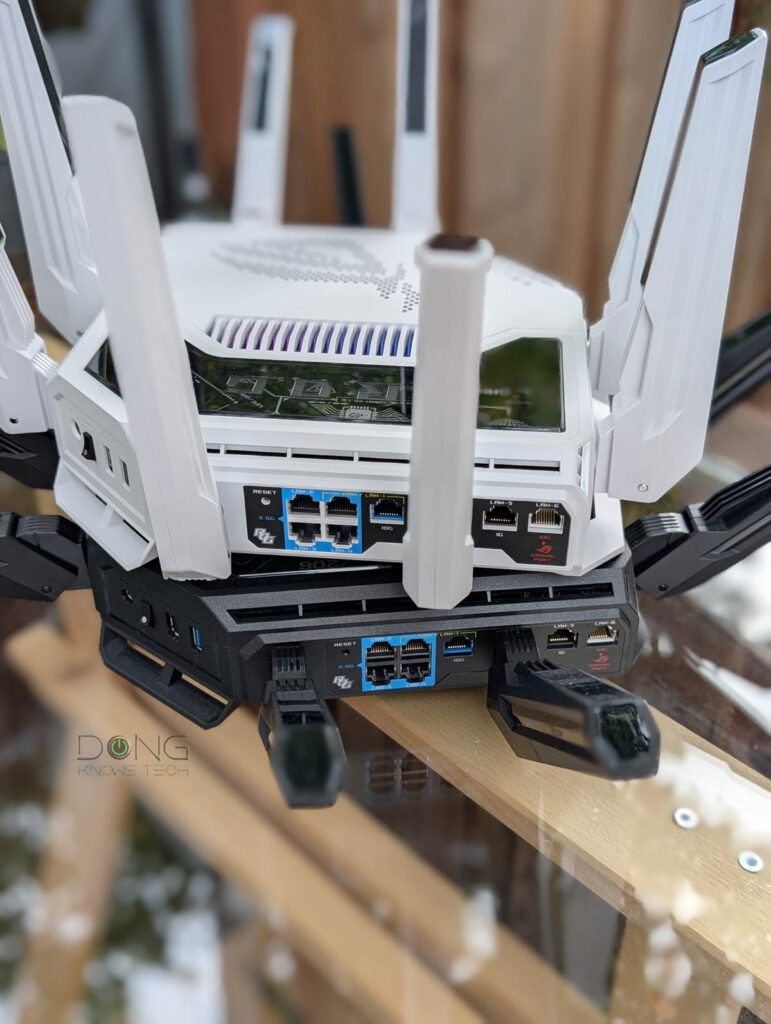
This post, the last in my series on ASUS-based Wi-Fi systems, helps you pick the best AiMesh combo to build a network with multi-Gigabit bandwidth, either the entry-level 2.5Gbps or the top-tier 10Gbps.
Before continuing, though, consider getting your home wired first—we’re mostly talking about wired networking here, especially if you live on a sprawling property.
Dong’s note: I first published this post on October 29, 2021, and last updated it on February 20, 2026, with the latest information.
AiMesh with multi-Gigabit bandwidth: Everything you need to know
The head says it. We’re talking about building a robust Wi-Fi system, capable of delivering multi-Gigabit bandwidth, using ASUS’ AiMesh-enabled routers, which is the case with virtually all ASUS routers since the RT-AC86U, which came out eight years ago.
The first thing to note is that you’ll likely need wired backhauling in this case. If you’re not familiar with “backhaul”, the cabinet below will help.
Fronthaul vs. backhaul in Wi-Fi mesh systems
When you use multiple Wi-Fi access points—in a mesh Wi-Fi system or a combo of a Wi-Fi router and an extender—there are two types of connections: fronthaul and backhaul.
Fronthaul is the Wi-Fi signals broadcast outward for clients or the local area network (LAN) ports for wired devices. It’s what we generally expect from a Wi-Fi broadcaster.
Backhaul (a.k.a. backbone), on the other hand, is the link between a Wi-Fi satellite unit and the network’s primary router, or between satellite units.
This link works behind the scenes to keep the hardware units together as a system. It also determines the ceiling bandwidth (and speed) of all devices connected to the particular Wi-Fi satellite unit.
- Hardware of Wi-Fi 6e, Wi-Fi 6, or Wi-Fi 5 standards uses one of its bands (2.4GHz, 5GHz, or 6GHz) for the uplink. In this case:
- When a Wi-Fi band handles backhaul and fronthaul simultaneously, only half its bandwidth is available to either end.
- When a Wi-Fi band functions solely for backhauling, often available traditional Tri-band hardware, it’s called the dedicated backhaul.
- Most Wi-Fi 7 satellite units can use multiple bands for the backhaul link thanks to the MLO feature.
For the best performance and reliability, network cables are recommended for backhauling—wired backhauling, which is an advantage of mesh Wi-Fi hardware with network ports. In this case, a Wi-Fi satellite unit can use its entire Wi-Fi bandwidth for the fronthaul.
Now, if you’re still wondering “why wired backhauling? Ain’t Wi-Fi 7 already faster than Gigabit?” you’re likely not alone.
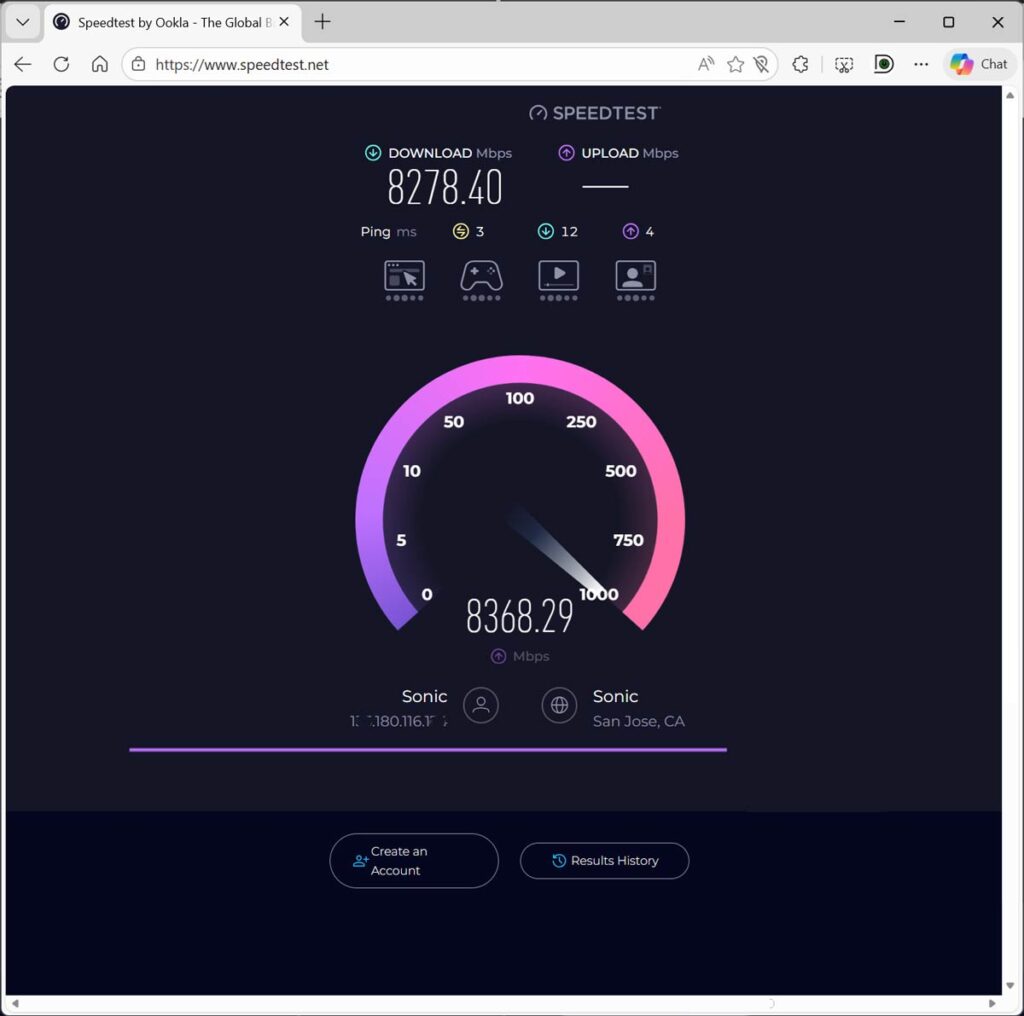
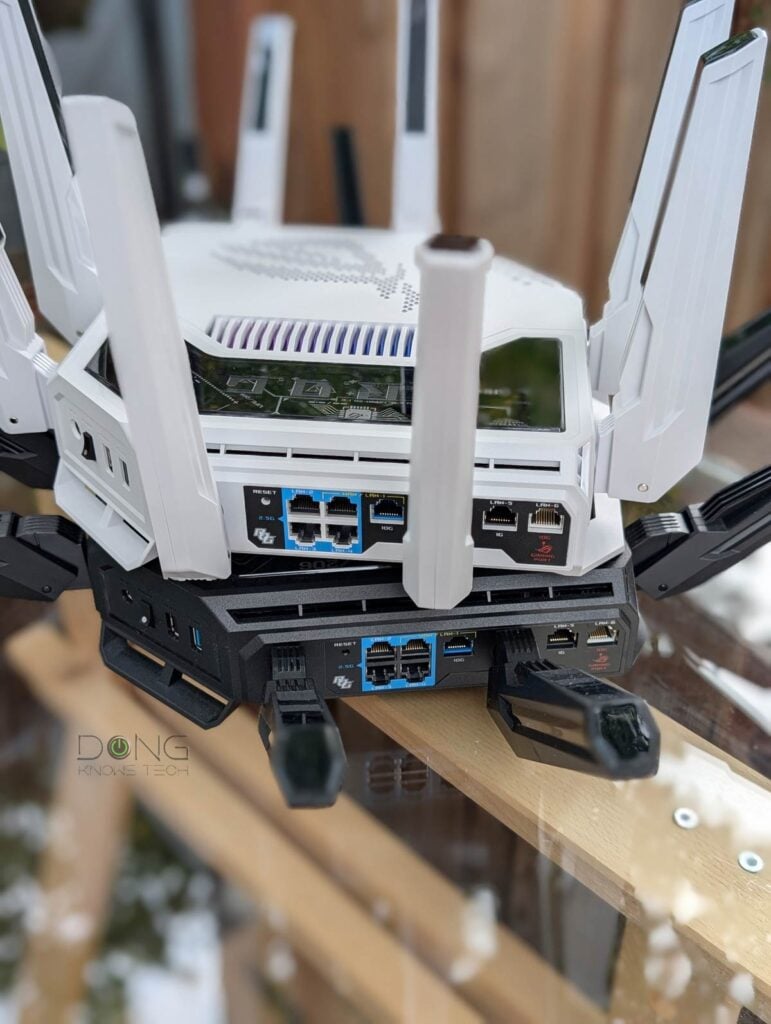
Multi-Gigabit AiMesh via wired backhauling: The why
While Wi-Fi 7 can deliver multi-Gigabit wireless performance in certain cases, especially via an MLO link, wireless backhauling is generally temperamental due to signal loss/degradation and the fact that Wi-Fi is always half-duplex.
Network connection: Wi-Fi vs. Wired
- Wi-Fi: Partial bandwidth and always half-duplex. Data moves in one direction at a time using a portion of a band (spectrum) called a channel. Half-duplex is similar to walkie-talkie voice communication.
- Wired (Ethernet):
- Networking cables: Full bandwidth and (generally) full-duplex. Data travels using the entire cable’s bandwidth and in both directions simultaneously. Full-duplex is similar to a phone call in voice communication.
- MoCA: Likely half-duplex, depending on the standard, but with comparable speed and reliability to network cables of the same port grade.
- Powerline: Always half-duplex with very slow real-world speed, heavily susceptible to interference by plugged-in appliances.
Wi-Fi is super convenient, but it’s only relevant when operating on top of a reliable and speedy wired connection via network cables. Within a reasonable distance, Wi-Fi is much better than Powerline.
That said, achieving multi-Gigabit speeds consistently across a large area is the only sure solution when using wired backhauling via Multi-Gig network ports.
Now, if you’re thinking you don’t need multi-Gigabit speeds, you’re probably not wrong. However, the only way to really experience or take advantage of faster-than-Gigabit broadband is via multi-Gigabit connections. On top of that, faster is always better, and hardware with Multi-Gig ports has been the norm in the past few years at relatively low costs. So, why not?
With that, let’s move on to how to pick the best AiMesh hardware combo with multi-Gigabit performance.
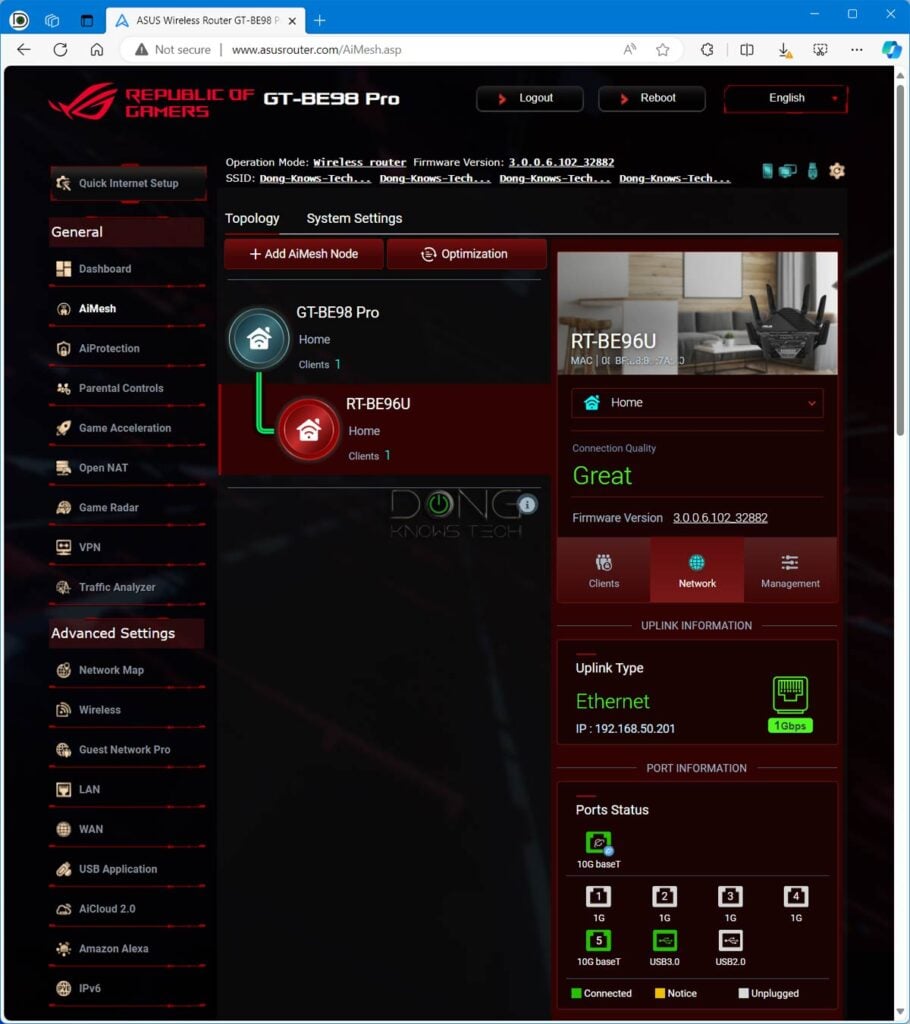
Multi-Gigabit AiMesh combo: The how
Picking an AiMesh hardware combination for multi-Gigabit performance follows the same rules as for other AiMesh combos.
First, keep the following in mind in terms of ports and wired connections:
- The router unit (the primary AiMesh node) must have at least two Multi-Gig ports: one for the WAN side and the other for the backhaul downlink to the satellite node.
- The satellite node unit only needs one Multi-Gig port, preferably of the same grade as the router’s, for the uplink connection. In most cases, this port is the WAN port. However, in a daisy-chain setup—that’s when it hosts another satellite node—it also needs a second Multi-Gig port for the downlink.
In any case, keep in mind that a satellite node’s uplink determines the bandwidth available to all its connected devices. That said, while you can have a system with mixed Gigabit and Multi-Gig backhauls, pick the port grade based on the bandwidth you need at a particular area.
Secondly, in terms of Wi-Fi specs, note the following:
- Avoid using routers of different numbers of bands (dual-band vs. tri-band vs. quad-band) or frequencies (5GHz vs. 6GHz). If you have to mix, use those with the most bands as the primary router.
- Avoid using hardware with a significantly different Wi-Fi standard, tier, or specs. If you have to mix, make sure you use the default (Auto) values for the Wi-Fi settings and avoid using specific virtual SSIDs such as Guest, IoT, etc.
- When you use Wi-Fi 7 hardware, it’s best to use the same routers throughout. That is the only way to have MLO for the front end. If you mix routers, it’s best to use those of the same Wi-Fi specs. If you mix a Wi-Fi 7 router with older Wi-Fi standards, make sure the Wi-Fi 7 unit is the primary router.
With that, let’s move on to the current viable hardware options.
Multi-Gigabit AiMesh: The available hardware and recommended combos
Below is the (almost) complete list of AiMesh-enabled routers that are capable of offering Multi-Gig backhaul uplink. Again, it’s safest to use multiple units of the same model, but the recommended satellites will likely work well with the specific router. Most of these combos have been tested for an extended period in real-world trials.
| Router (available Multi-Gig downlink speeds) |
Multi-Gig Ports | Wi-Fi Bandwidth | Recommended Satellites (available Multi-Gig backhaul uplink speeds) |
| Wi-Fi 7 options (MLO available only when the same models are used) |
|||
| GT-BE19000Ai (10Gbps or 2.5Gbps) |
2x 10Gbps, 1x 2.5Gbps |
Tri-band BE19000 | itself (10Gbps) RT-BE96U (10Gbps) ZenWiFi BT10 (10Gbps) |
| GT-BE98 Pro (10Gbps or 2.5Gbps) |
2x 10Gbps, 1x 2.5Gbps |
Quad-band BE30000 | itself (10Gbps) ZenWiFi BQ16 (10Gbps) |
| RT-BE96U (10Gbps) |
2x 10Gbps | Tri-band BE19000 | itself (10Gbps) ZenWiFi BT10 (10Gbps) |
| ZenWiFi BQ16 Pro (10Gbps) |
2x 10Gbps | Quad-band BE30000 | itself (10Gbps) |
| ZenWiFi BT10 (10Gbps) |
2x 10Gbps | Tri-band BE18000 | itself (10Gbps) |
| ZenWiFi BT8 (2.5Gbps) |
2x 2.5Gbps | Tri-band BE14000 | itself (2.5Gbps) |
| GS-BE18000 (2.5Gbps) |
8×2.5GbE | Tri-band BE18000 | itself (2.5Gbps) ZenWiFi BT6 (2.5Gbps) |
| TUF-BE9400 (2.5Gbps) |
4×2.5Gbps | Tri-band BE9400 | itself (2.5Gbps) ZenWiFi BT6 (2.5Gbps) TUF-BE6500 (2.5Gbps) |
| TUF-BE6500 (2.5gbps) |
4×2.5Gbps | Dual-band BE6500 | itself (2.5Gbps) ZenWiFi BT6 (2.5Gbps) |
| RT-BE92U (2.5Gbps) |
1x10Gbps 4x 2.5Gbps |
Tri-band BE9700 | itself (2.5Gbps) RT-BE86U (2.5Gbps) ZenWiFi BD5 (2.5Gbps) ZenWiFi BD4 (2.5Gbps) |
| RT-BE88U (10Gbps or 2.5Gbps) |
2x 10Gbps, 4x 2.5Gbps |
Dual-band BE7200 | itself (10Gbps) RT-BE86U (10Gbps) RT-BE92U (10Gbps) ZenWiFi BD5 (2.5Gbps) ZenWiFi BD4 (2.5Gbps) |
| RT-BE86U (2.5Gbps) |
1x10Gbps, 4x 2.5Gbps |
Dual-band BE6800 | itself (2.5Gbps) ZenWiFi BD5 (2.5Gbps) ZenWiFi BD4 (2.5Gbps) |
| ZenWiFi BD5 (2.5gbps) |
2x 2.5Gbps | Dual-band BE5000 | itself (2.5Gbps) ZenWiFi BD4 (2.5Gbps) |
| ZenWiFi BD4 (2.5gbps) |
2x 2.5Gbps | Dual-band BE3600 | itself (2.5Gbps) |
| Wi-Fi 6 and 6E options | |||
| RT-AX89X (*) (2.5Gbps or 10Gbps) |
1x 10Gbps 1x 10Gbps SFP+ |
Dual-band AX6000 | itself (10Gbps), RT-AX86U (2.5Gbps), GT-AX6000 (2.5Gbps), RT-AX88U Pro (2.5Gbps) |
| GT-AXE16000 (2.5Gbps or 10Gbps) |
2x 10Gbps, 1x 2.5Gbps |
Tri-band AXE16000 | itself (10Gbps), GT-AXE11000 (2.5Gbps), ZenWiFi Pro ET12 (2.5Gbps), ZenWiFi ET8 (2.5Gbps) |
| GT-AX6000 (2.5Gbps) |
2x 2.5Gbps | Dual-band AX6000 | itself (2.5Gbps) RT-AX88U Pro (2.5Gbps), RT-AX86U Pro (2.5Gbps) |
| ZenWiFi Pro ET12 (2.5Gbps) |
2x 2.5Gbps | Tri-band AXE11000 | itself (2.5Gbps) |
| ZenWiFi Pro XT12 (2.5Gbps) |
2x 2.5Gbps | Tri-band AX11000 | itself (2.5Gbps) |
| RT-AX88U Pro (2.5Gbps) |
2x 2.5Gbps | Dual-band AX6000 | itself (2.5Gbps) GT-AX6000 (2.5Gbps), RT-AX86U Pro (2.5Gbps), |
| GT-AX11000 Pro (2.5Gbps) |
1 x 10Gbps, 1x 2.5Gbps |
Tri-band AX11000 | itself (2.5Gbps) ZenWiFi Pro XT12 (2.5Gbps) |
(*) One of this router’s two 10Gbps is an SFP+ port. A converter or switch is needed for Multi-Gig backhauling if its 10GbE BaseT port is used for the WAN side.
Once you’ve picked the router and satellite(s) combo, follow the detailed setup guide linked below to build your system.

The takeaway
There you have it. Above all, practically all the possible options for true multi-Gigabit AiMesh systems have proven to work well in my extensive hands-on trials.
As time passes, there will be more hardware options—including the upcoming Wi-Fi 8 hardware—and I’ll update this post then. However, the principle remains: you generally want to use the same hardware model throughout, or mix them smartly so that the result won’t cause subsequent issues.