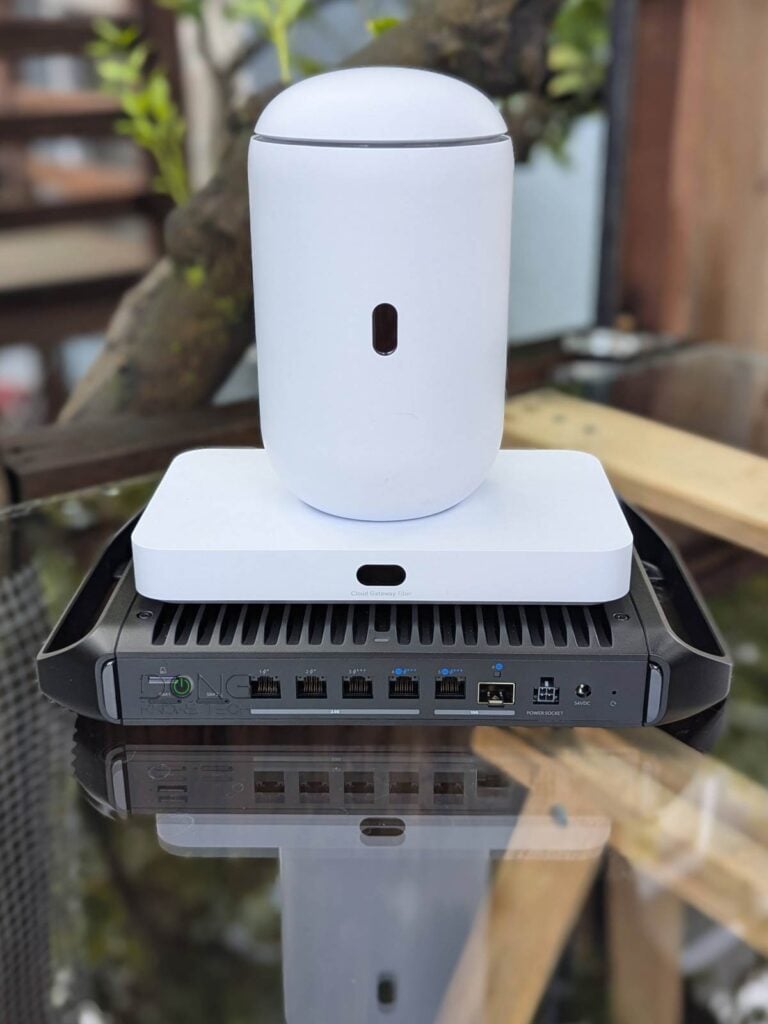
Since the beginning of 2025, Ubiquiti’s UniFi has become increasingly relevant for the home, in addition to the business and enterprise environments that were once its original sole focus.
This post includes the current five best UniFi Cloud Gateways, a.k.a. UniFi consoles or “routers” if you will, based on my real-world experience, for home users or SMBs. It will also include tips on which UniFi switches or access points to pair with them, depending on your broadband speed and whether your home is wired with network cables.
Let’s dig in!
Dong’s note: I first published this frequently revised roundup on April 26, 2025, and last updated it on February 21, 2026, with the latest, up-to-date picks.
The quick UniFi shopping tips and the five best Cloud Gateways
There is a long list of UniFi consoles, often called “UniFi Cloud Gateways” (UCGs).
However, if you start today, it’s best to go with one that has no Wi-Fi, a non-Wi-Fi router, or one with built-in Wi-Fi 7. With Wi-Fi 8 on the horizon, it makes less sense to get one with Wi-Fi 6 or older. However, it doesn’t hurt if you do, and you can always turn the Wi-Fi radios off to use the hardware as a non-Wi-Fi router.
Tip
A UniFi console always runs UniFi OS plus one or more UniFi applications, with Network being the most significant—the primary app.
However, not every UniFi console is equipped with this app, and those that do are called UniFi “Cloud Gateways” (UCGs), including the UniFi “Dream” series, such as Dream Machine (UDM) or Dream Wall (UDW)—they are all UniFi “routers” if you prefer to call them that way.
A few UCGs have just this Network app—they are Network-only UniFi consoles. Most UCGs can host additional applications to qualify as a multi-app, Network UniFi consoles.
All Network UniFi consoles share the same basic features and settings. However, their capacities—specifically the number, breadth, and depth of UniFi applications they can handle simultaneously—vary depending on the hardware specifications.
The following are the current UniFi applications, with the first six belonging to the original UniFi Application Suite:
- Network (primary): This application enables the hardware to function as an advanced router, thereby qualifying it as a “UniFi Cloud Gateway”. This app handles all network-related aspects, including security, firewall, access points, Wi-Fi system management, and much more. On a UCG, the Network app is the default and can’t be uninstalled.
- Protect: The support for IP cameras as an advanced surveillance system, including a built-in UniFi Network Video Recorder (UNVR) of a UniFi console. Protect is the default app of a standalone UNVR. Generally, a standalone UNVR is a multi-app, non-Network console that can also host the Access and InnerSpace applications, but it’s often classified as a “Protect-only UniFi console”.
- Talk: A locally hosted Voice-over-IP system.
- Access: A “platform designed for Access Control Systems”—per Ubiquiti. Examples include door-related security IoT devices such as doorbells, key fobs, and locks.
- Connect: Application that manages digital signage and EV Stations
- InnerSpace: A visualization tool that allows users to map out their UniFi network by uploading floor plans, drawing walls, etc., for the deployment of UniFi devices.
- Drive: The latest app that turns a UniFi console into a UniFi network-attached storage (NAS) server, known as a UNAS. Generally, a UNAS server is a single-app non-Network UniFi console—it’s a “Drive-only UniFi console”.
Each of these applications is a world in itself, with various in-depth customizations, and some require UniFi devices to function as intended.
Regardless of which one you choose, you can always add a UniFi access point to it to enhance or extend Wi-Fi coverage. On this front, here are a couple of tips:
- If your home is wired with network cables, it’s best to start with a non-Wi-Fi console and add one or more UniFi access point(s) to get the best coverage and flexibility. However, you can also opt for a Wi-Fi-ready unit, such as the UDR7, and an access point, like the UX7, to extend coverage if needed.
- If your home is not wired and you can’t run network cables yourself:
- If your home only requires a single Wi-Fi broadcaster, then get a single Wi-Fi-integrated console. In this case, it’s helpful to place the hardware at the optimal location for the best coverage.
- If your home requires more than one broadcaster, consider using a Wi-Fi-integrated console, such as the UDR7 (or UDR), and pair it with the UX7 (or UX) as a wireless mesh point.
Below are the top five best UniFi consoles (or Cloud Gateways) and why you should consider them. All of them are similar. While the numbers are based on their rating and my recommendation, any of these will work equally well as long as you pick the right one for your situation.
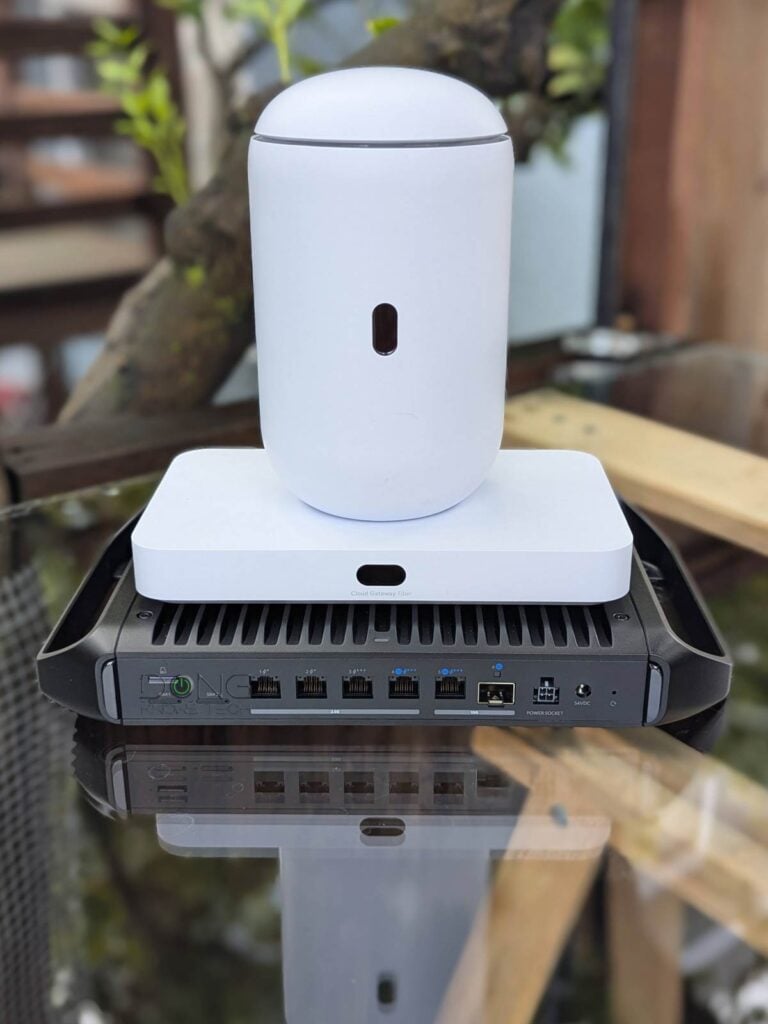
1. UniFi Cloud Gateway Fiber (UCG-Fiber): The best non-Wi-Fi router for a top-tier 10 Gbps network

The UCG-Fiber is currently the best compact console for a home or small office. It features three 10Gbps ports, five 2.5Gbps ports, and one PoE+-capable port. As a result, it’s a perfect non-Wi-Fi router that can host an access point right out of the box, preferably the U7 Pro Max, U7 Pro XG, or one of those that support PoE+ (or PoE).
The gateway comes with an integrated SSD slot for storage of its other features, including Protect, an advanced surveillance system.
If you need more 10Gbps ports for your network, the Switch Pro XG 8 PoE is the ideal choice to couple with the UCG-Fiber. In this case, thanks to the switch’s PoE++ support, you can also opt for higher-end UniFi access points, such as the U7 Pro XGS, U7 Pro Max, or even the ultimate E7.
Pros
Top-tier hardware with three 10Gbps ports, four 2.5GBASE-T ports, PoE+ support, and an NVMe slot for NVR
Excellent and reliable real-world performance; can handle lots of concurrent UniFi devices (Wi-Fi access points, cameras, IP phones, etc.) and end-users
Compact and aesthetically pleasing design with everything for all users, from home to enterprise-grade
Lots of valuable features, each with tons of customization, comparatively affordable
Cons
Only one PoE+ port, no PoE++ support; SFP+ ports are less practical than 10GBASE-T
A Ubiquiti login account is required for the built-in Remote Management, as well as some other useful features, to work
Runs a bit warm, no SSD caddy is included in the non-storage version; no USB port or network-attached storage features
2. UniFi Cloud Gateway Max (UCG-Max): The best non-Wi-Fi router for an entry-level multi-Gigabit (2.5Gbps) network

The UCG-Max is a tier lower than the UCG-Fiber above, but it’s still a formidable non-Wi-Fi router. In fact, it’s the best for those with 2.5Gbps or slower broadband. It, too, has a similar SSD slot for internal storage.
If you’re looking for a UniFi access point to pair with it, keep in mind you’ll need a PoE switch or an injector. In this case, get the switch that features the PoE standard of the AP you want. Considering the gateway has only a 2.5Gbps port, the Enterprise 8 PoE or any of these is a good choice. After that, the U7 Pro, U7 Pro Max, or U7 Pro XG, or any of these, is a great access point to match.
Pros
Excellent entry-level Multi-Gig (2.5Gbps) performance for a comparatively low cost
Compact and aesthetically pleasant design with powerful hardware to handle a home or small business network via multiple simultaneous enterprise-class applications
A complete set of useful networking features, including powerful security/web-filtering and WireGuard VPN; excellent web user interface; useful mobile apps
No subscription is required
Cons
No 10Gbps ports or built-in PoE
Extra features require a UI login account
Runs a bit warm, no SSD caddy is included in the non-storage version
3. UniFi Dream Router 7 (UDR7): A robust Wi-Fi-7 router for a multi-Gigabit network


The UDR7 is Ubiquiti’s first UniFi console with built-in Wi-Fi 7. It comes with plenty of 2.5Gbps ports and one 10Gbps port, making it suitable for a network with slightly faster than 2.5Gbps broadband. Additionally, the built-in PoE support and microSD slot for storage are also beneficial.
It’s worth noting that, in addition to hosting UniFi access points, you can also use the UDR7 with the UX7 (below) to form a wireless mesh network.
Pros
All Multi-Gig ports, support all of Ubiquiti’s business hardware segments, built-in PoE
Excellent throughput performance with excellent coverage (for the specs)
Tons of useful networking features, including a mesh controller, all via a comprehensive web user interface and an optional mobile app—neither requires a login account.
Compact and beautiful design
Comparatively affordable, quiet operator
Cons
No 2nd 10Gbps ports, single low-power PoE port
Not wall-mount-ready, internal fan, awkwardly placed microSD slot
2.4GHz band’s performance could be better
4. UniFi Cloud Gateway Industrial (UCG-Industrial): An all-in-one rugged UniFi console
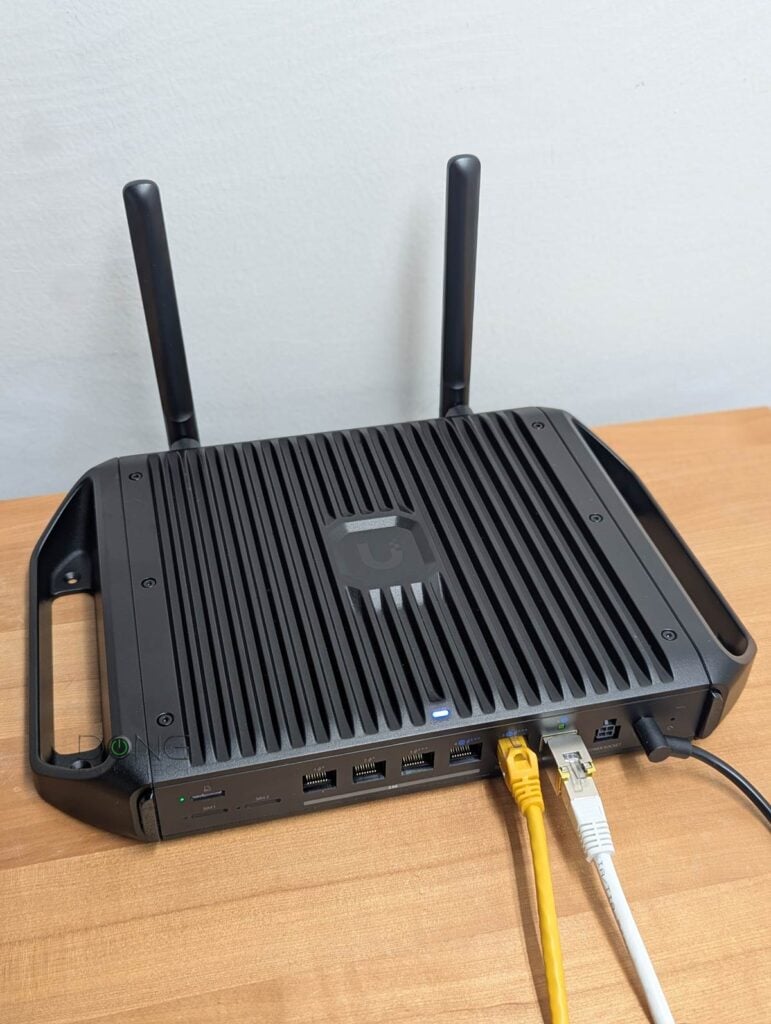
The Cloud Gateway Industrial (UCG-Industrial) is the latest 2026 hardware, and is somewhat a combination of the UDR7 and UCG-Fiber. As a result, it’s the most complete UniFi console with Wi-Fi 7, top PoE output, 10Gbps port grade, and even built-in SIM slots for Remote SIM configuration when hosting the UniFi 5G Max Outdoor.
Additionally, it features a modular, rugged design that fits any situation or environment. It’s a tough UniFi console that’s safe for any use case.
Pros
All-in-one UniFi console with 10Gbps capability, top PoE power output, built-in Wi-Fi 7, and SIM slots with Remote SIM support
Excellent wired and wireless performance (for the specs)
Tons of useful networking features, including a mesh controller and a UNVR, all via a comprehensive web user interface and an optional mobile app—neither requires a login account.
Practical, compact, and rugged design; runs cool and quiet
Cons
Only two 10Gbps ports, no built-in cellular modem, no NVMe or SATA drive support for storage
Modest dual-band Wi-Fi 7 specs
5. UniFi Express 7 (UX7): A flexible yet straightforward multi-Gigabit Wi-Fi 7 router
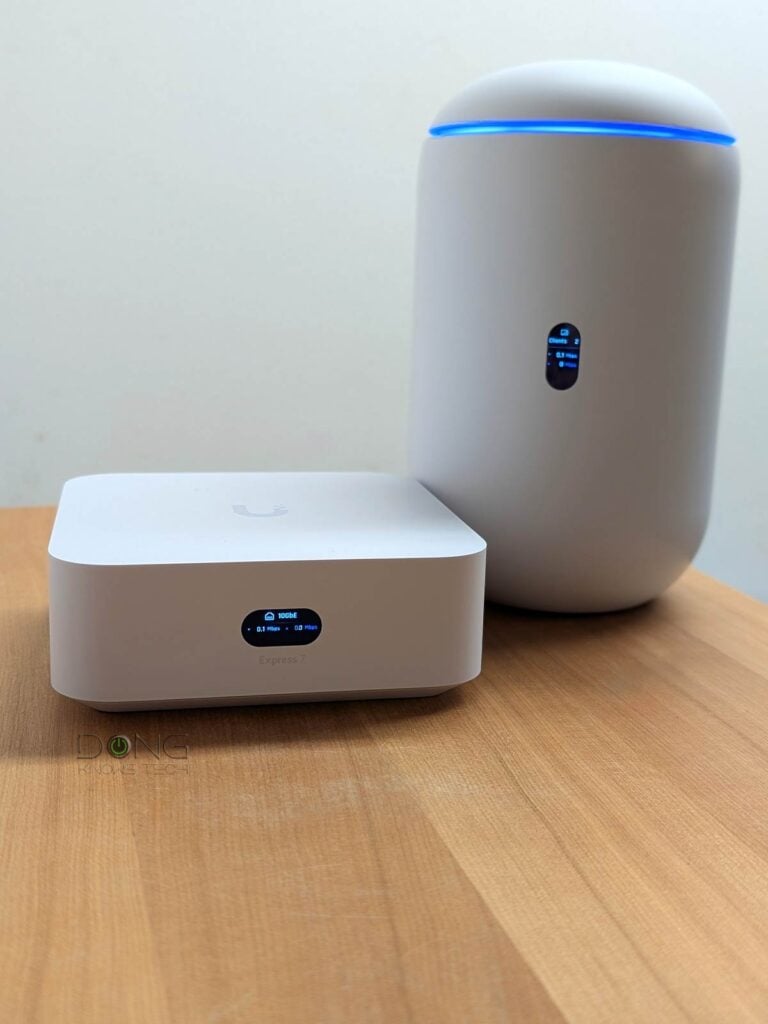
The UX7 is another Wi-Fi 7 “router” from Ubiquiti, and it’s pretty remarkable. It’s the only one on this list that can only work as a router (and not as the host of other applications, such as Protect). In return, it’s also the only one that can function as an access point or a wireless/wired mesh point.
As a result, you can use multiple UX7 units to form a Wi-Fi mesh network, or use one or a few units in conjunction with the UDR7 to extend Wi-Fi coverage, or one or a few units with another non-Wi-Fi UniFi console to create a Wi-Fi network.
Pros
Flexible enough to be the primary router or a satellite unit of a robust UniFi mesh system
Excellent throughput performance for the specs, reliable coverage
Tons of useful network-related features, including a mesh controller
Compact, fanless, and beautiful design, comprehensive web user interface with an optional mobile app
Affordable, quiet, and remains relatively cool during operation
Cons
Only two network ports, with only one being 10 Gbps, no PoE, support only the UniFi Network application
Convenient network-related features require a UI login account, not wall-mount-ready
Rigid backhaul as a mesh satellite unit; no AP mode when hosting a Wi-Fi system; the MLO feature could be better overall
Extra: UniFi Dream Machine Pro Max (UDM Pro Max)—The ultimate full-scale rackmount non-Wi-Fi router

The UDM Pro Max is a full-scale, non-Wi-Fi router designed for those with a network rack, though you can place it on a surface. Despite the immediate physical size, it’s home-friendly enough.
With two 10Gbps ports, one 2.5Gbps port, and numerous Gigabit PoE ports, it’s ready to host a wide range of devices. The console is the only one here to feature two hard drive bays to accommodate terabytes of RAID-1-Protected storage for other functions, such as its built-in UNVR, which can handle over a dozen high-res cameras for a robust Protect-based surveillance system.
Alternatively, you can also consider the similar UDM-SE, which has slightly lower hardware specifications and only a single drive bay.
There are a couple of things to note about the UDM Pro Max:
- The console has no PoE support. To use any PoE device with it, you’ll need to get an injector for each or a PoE switch of the same or higher PoE standard.
- Considering the console itself has only two 10Gbps SFP+ ports, the best switch to couple with it is the Pro XG 10 PoE or Pro XG 24 PoE among the 2025 XG lineup. However, the Pro XG 8 PoE will work as well.
- Depending on the switch or injector you have, you can use any of these UniFi Wi-Fi 7 access points with it.
Pros
Robust hardware to handle large-scale networks via multiple simultaneous enterprise-class applications; excellent overall performance
A complete set of useful networking features, including powerful security/web-filtering and WireGuard VPN; excellent web user interface; useful mobile apps
Dual drive support with RAID 1; no subscription required; runs relatively cool and quiet
Cons
Bulky design with only two SFP+ (10Gbps) and one 2.5GBASE-T ports, no 10GBASE-T port, no PoE support
A Ubiquiti login account is required for some useful features to work
The final tips on which UniFi Cloud Gateway is right for you
All of these UniFi consoles can work with all standard Wi-Fi access points. However, if you build a network from scratch, it’s best to use UniFi hardware, as you can control all of them as a system.
If you’re currently using a third-party mesh Wi-Fi system, such as those from TP-Link, Asus, or Netgear, you can select a non-Wi-Fi UniFi router and use your existing Wi-Fi system in access point (AP) mode on top of it. Now, you’ll still have a robust network with the Wi-Fi coverage you’ve been accustomed to.