
A big part of the questions I get daily is about Wi-Fi router or mesh recommendations for specific situations. Some readers even sent me a detailed sketch of their home or even personal information—you know who you are! Everyone wants to pick up that perfect “Wi-Fi machine”.
This post will lay out what a router is in simple terms, set the right expectations, and offer tips on picking the best Wi-Fi solution—all based on the questions I’ve received.
There’s no guarantee, but when you’re through, you will likely be able to choose the right one on your own on the first try, or you’ll know which party to blame.
Dong’s note: I first published this piece on May 17, 2020, and last updated it on March 9, 2026, to include the latest relevant information.
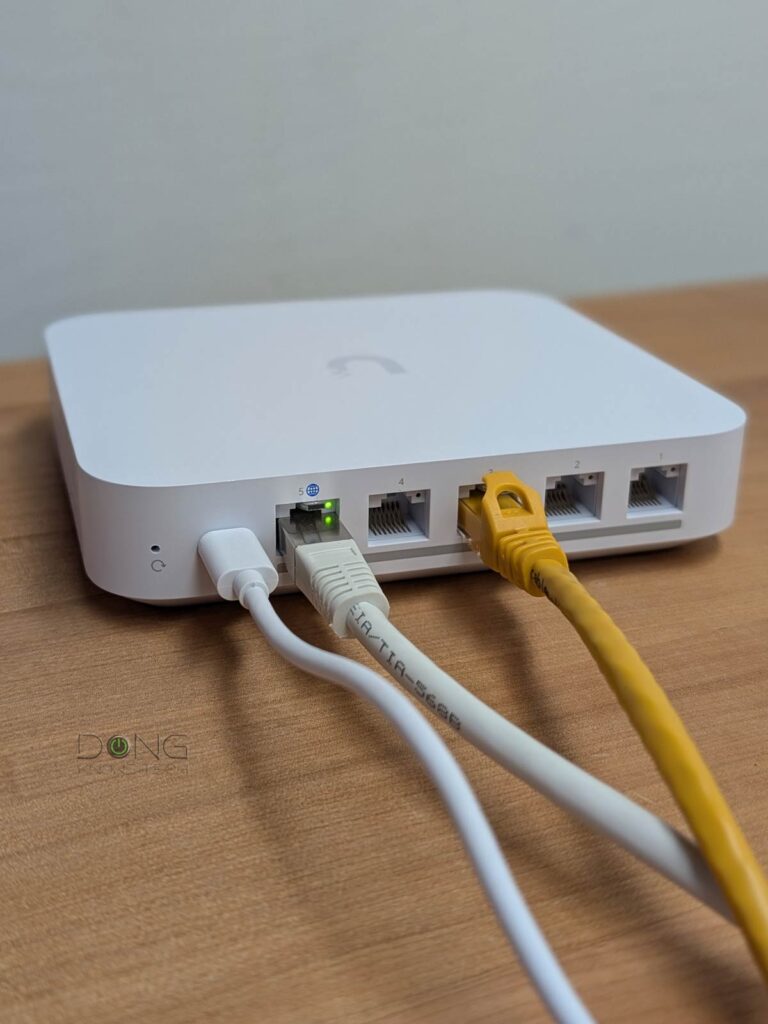
Wi-Fi router: What constitutes one and its bandwdith
A router is a networking device that generally includes a wide-area network (WAN) port to connect to the Internet source and a couple of local-area network (LAN) ports to host wired clients. It’s a device that creates a local network.
To put it another way: a computer network needs a router. Depending on the hardware, some routers can have two or more WAN ports for dual-WAN or multi-WAN options.
Switch vs. Firewall vs. Router
These devices are all “switches” and differ by the networking layers they support.
A switch always has multiple network ports, one of which is the uplink port for an incoming network connection, shared among the rest of the switch’s ports. A switch is a physical device that connects different network layers.
A firewall is a managed switch that can inspect data packets and regulate network traffic, such as blocking, filtering, or restricting it. The firewall function starts at the networking layer 2 and extends to the higher layers, depending on its level of sophistication. Nowadays, most firewalls can also serve as routers.
A router is a managed switch whose main job is to provide and guide (or “route”) the network traffic. A router’s uplink is the WAN port that connects to the Internet. The routing function starts with the network layer 3. Nowadays, all modern routers have built-in firewalls, and an advanced router generally includes a top-tier firewall.
Most home routers come with an integrated Wi-Fi access point, and with that, they are “Wi-Fi routers”. This practice is so common that to specify a traditional router, we need to put a “non-Wi-Fi” prefix or call it a “router without Wi-Fi”. That’s also how we operate for the rest of this post—”router” automatically means “Wi-Fi router”.
To pick the right Wi-Fi router, you first need to understand its capabilities and limitations. Most importantly, you need to use it as a router.
Tip
There is no such thing as the “best” routers or Wi-Fi systems for a particular Internet service provider or type—Fiber-optic, Cable, or whatever.
Any standard router, including the primary unit of a mesh Wi-Fi system, will work at its full potential with any standard Internet broadband terminal device—modem, Fiber-optic ONT, or others. That’s true as long as the two can connect via a network cable, which is almost always the case.
Compatibility is generally applicable only between a terminal device and the ISP. For example, certain modems or gateways work with Comcast Xfinity, while others might not.
In relatively rare non-standard cases, some Fiber-optic lines might require a router that supports VLAN tagging (a.k.a IPTV). The majority of Wi-Fi 6 and newer routers support this.
When a router is a router and when it’s not
Sometimes, a router is not a router. The cabinet below will explain that.
Possible roles of a home Wi-Fi router
Below is a breakdown of four typical router roles. Not all hardware supports all of these, but most will have at least the first one plus another.
Some routers have even more roles—those from ASUS, for example, also feature the proprietary AiMesh node role.
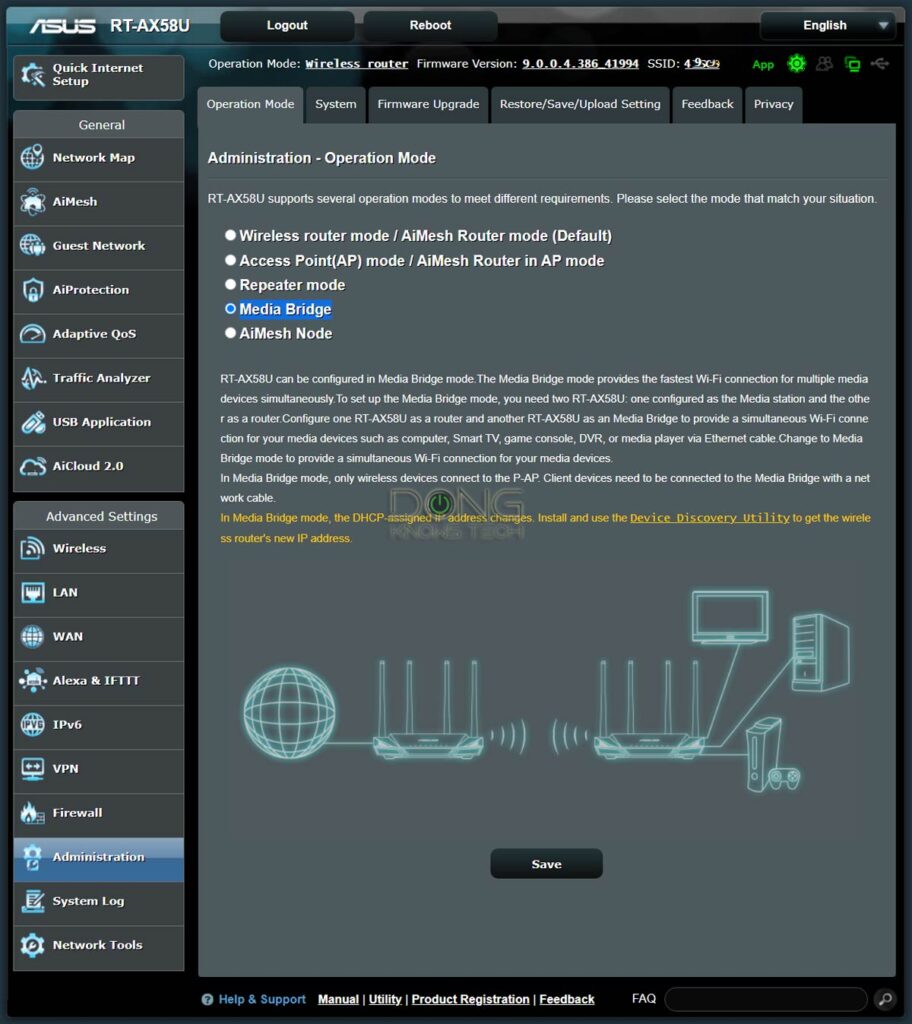
1. Wireless Router
This role is the default—the hardware will work as such unless you actively change that.
The hardware functions as a Wi-Fi router that obtains an Internet connection and distributes it to the rest of the network via wired and Wi-Fi connections.
In this role, you must use the router’s WAN port for the Internet source. It’s also the only role where the router’s routing and networking features (QoS, Parental Control, Dynamic DNS, VPN server, port-forwarding, etc.) are available.
Essentially, the hardware is now a standard routing box with a built-in managed switch and Wi-Fi access point(s).
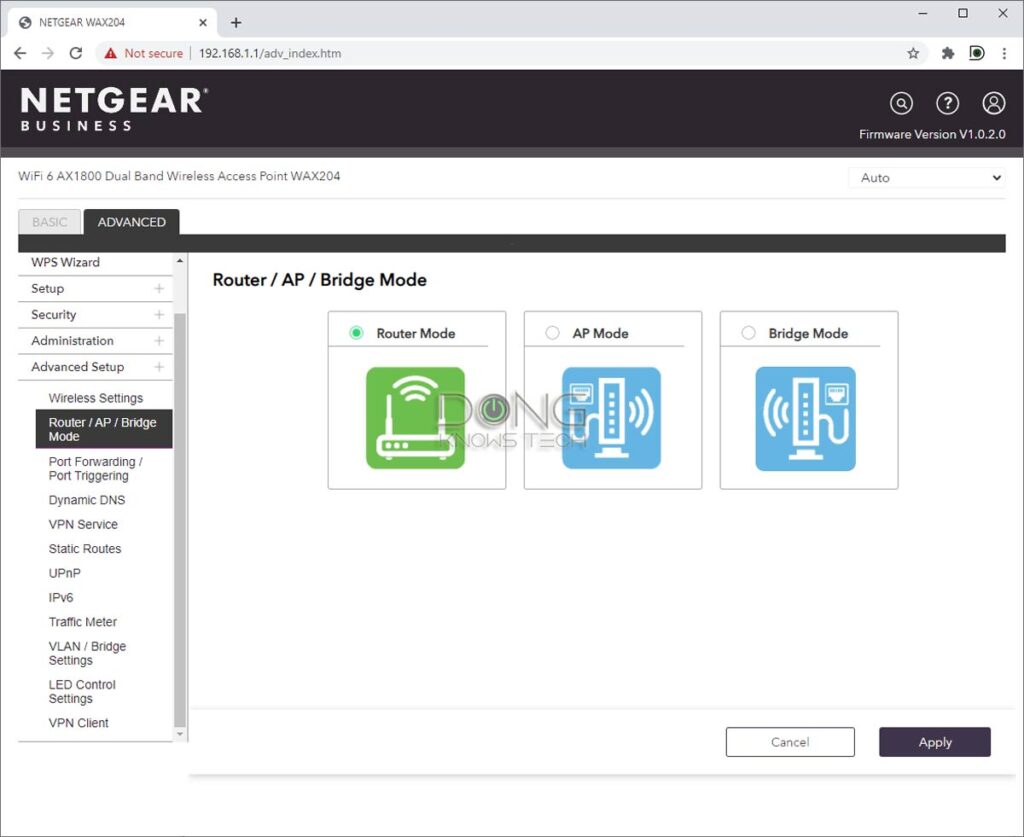
2. Access Point (AP)
Important note: Certain vendors call this role “Bridge.”
In this mode, the hardware now works as an access point. It connects to an existing router via a network cable and extends the network farther, both wired and wireless.
In this role, none of the routing and features are available. All of the device’s network ports function as LAN ports. Essentially, the router is now a network switch with built-in Wi-Fi access point(s).
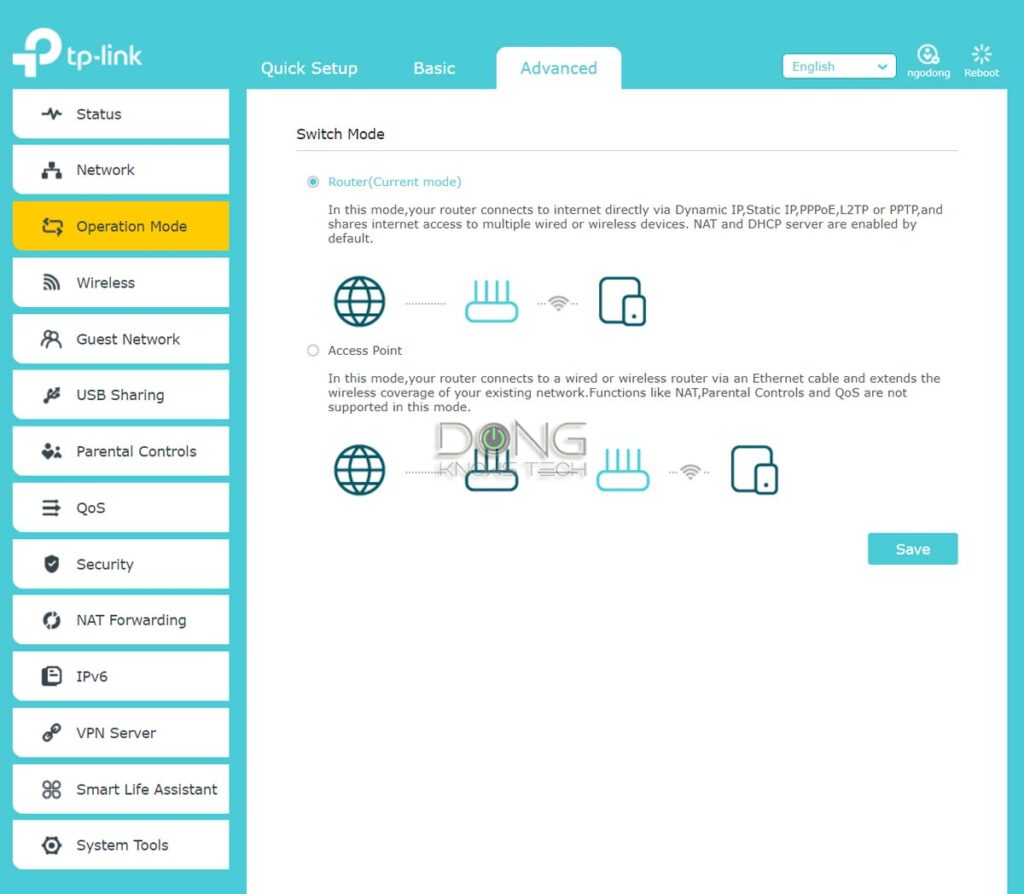
3. Repeater
The router now works as a Wi-Fi extender.
Specifically, you use one of its bands (2.4GHz, 5GHz, or 6GHz) to connect to an existing Wi-Fi network—this is the backhaul band. After that, you can configure one or all of its bands (including the backhaul band) with separate SSID(s) to serve clients.
In this mode, all of the router’s network ports will work as LAN ports of the existing network.
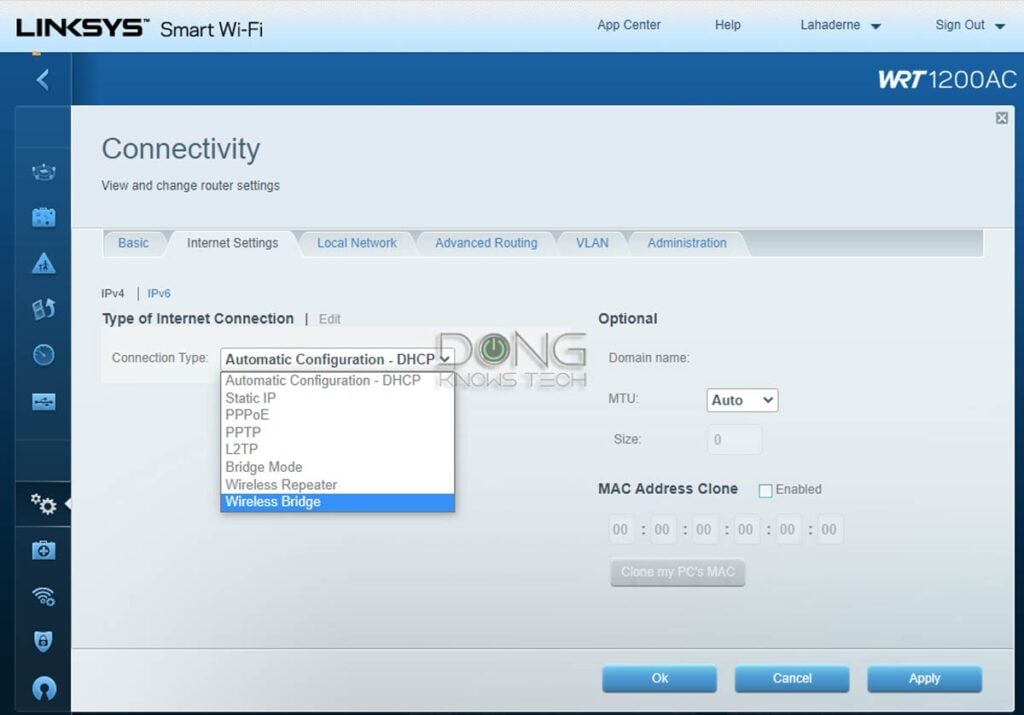
4. Bridge or Media Bridge
Important note: Certain vendors—those that use “Bridge” to refer to the “Access Point” role, as mentioned above—name this mode “Wireless Bridge.” There might be other arbitrary names for this role.
In this mode, the router essentially functions as a Wi-Fi-to-Ethernet adapter.
Specifically, you use one of its bands to connect to an existing Wi-Fi network. Now, you can connect wired devices to the router’s LAN ports to make them part of the network. (In most cases, you should leave the WAN port alone, but some routers turn this port into another LAN.)
In the Media Bridge mode, the rest of the router’s Wi-Fi bands are unavailable.
The bridge mode is a bit different in a gateway unit, which is a router + modem combo box.
That’s when the gateway will work solely as a modem and no longer have any router-related function.
You can read more about how to get the most out of ISP-supplied equipment in this post.
Clearly, for this post, we’re talking about the default router role. In this case, as mentioned above, all routers have this in common: Each creates a local network for multiple devices to work together. How many exactly?


The total devices a home Wi-Fi router supports: It’s wired vs. Wi-Fi bandwidth
A lot of folks shop for Wi-Fi routers by looking at the total number of devices they can support—they want something that can handle x phones and y computers, etc.
While that seems reasonable enough, it’s not how networking works. Generally, depending on the configuration, a router can host thousands of devices—in fact, the number is theoretically unlimited.
However, most home-grade routers are pre-configured with the popular 255.255.255.0/24 subnet mask to support up to 255 devices, including itself. After that, you can further limit the total number of devices via the IP pool.
The gist of it is that you generally can expect to connect up to 254 devices to any home router (or mesh system), which is more than most homes would need.
Tip
If you want to host more than 254 devices on a local network, the easiest way is to add more Wi-Fi routers using a double-NAT setup. Specifically, you connect a new router’s WAN port to an existing router’s LAN port. You can connect multiple routers to the existing one or daisy-chain them. Either way, each additional router can host another 254 devices.
While members of a local network hosted by one router can’t talk to those belonging to the network of another router, they can all share Internet access from the very first router.
Keep this trick in mind if you need to provide Internet access to a large group. Just make sure your broadband connection is fast enough for everyone.
However, realistically, the number of active devices is significantly lower. While the router’s processing power (CPU and RAM) plays a role in its routing capabilities, the bandwidth of its network ports and the built-in Wi-Fi access point determine how many simultaneous active clients a router can handle.
Wired bandwidth
Apart from the uplink WAN port, a home router typically has just a few (usually four) LAN ports. They are part of the router’s built-in switch and, therefore, function like a switch in terms of bandwidth.
Specifically, devices connected to these ports share the same incoming WAN (Internet) bandwidth determined by the WAN port (and the broadband plan). However, when communicating with each other, each will have full bandwidth on its port.
That said, if you choose to run network cables and are willing to add switches, your network can indeed host all 254 wired parties simultaneously, with each connecting (to one another) at their port’s maximum speed.
The wiring inside a cable is in a somewhat controlled environment, separate from the elements. As a result, a network cable can almost always deliver the connection’s standard speed with maximum efficiency.
A rough analogy: If your data is water, using network cables is like hooking a garden hose to a faucet to get water directly to an inflatable pool. You know for sure that 100 percent of the water coming out of the source will reach the destination.
The thing is, we don’t have that many wired devices. Nowadays, a home network includes mostly Wi-Fi clients, such as smartphones, laptops, and IP cameras.
And that’s where things get complicated.
Wi-Fi bandwidth
You can read more about Wi-Fi bandwidth in this post on Dual-band vs. Tri-band vs. Quad-band, but the gist is that each Wi-Fi access point’s ceiling speed (to a single client with the same specs and frequency band) is its total theoretical bandwidth, which is shared among all active connected clients.
As a result, a Wi-Fi band can handle only so many active wireless clients at a time, but the actual number varies depending on the band (5GHz, 6GHz, or 2.4GHz), its specs (Wi-Fi standards and number of streams), and the bandwidth requested by the clients in real-time.
Wi-Fi suffers significantly from the elements.
Reusing the inflatable pool example above: Wi-Fi is like hooking a spray nozzle into the hose and pumping water into a container through the air from a distance.
In this case, even with the most focused setting, you’ll likely lose some water to wind, splatter, and evaporation. But in return, you can use this technique to fill a few nearby containers simultaneously, albeit inefficiently.
The point is that it’s always a good idea to get a router with high Wi-Fi specs, even when you only have low-end clients or a “simple” use case. That’s especially true when you have fast Internet. More Wi-Fi bandwidth means you can support more concurrent active clients.
- This top Wi-Fi bandwidth applies when you use clients of the same standard. When legacy devices are present, the available bandwidth will be reduced because the hardware must operate in compatibility mode.
- The access point’s uplink network port (the WAN port on a router) limits its Wi-Fi bandwidth. The latter can’t exceed the former. Since network ports’ grades vary between Gigabit (1Gbps), 2.5Gbps, 5Gbps, and 10Gbps, the best Wi-Fi bandwdith an access point can have is 10Gbps.
- The theoretical Wi-Fi bandwidth of an access point is always either #1 or #2 above, whichever is lower. After that, keep in mind that Wi-Fi is inefficient. So, the actual real-world bandwidth will be significantly reduced due to signal loss and degradation.
In any case, the actual number of active devices a router can handle varies depending on many factors. Still, it’s safe to say a single Wi-Fi router can generally handle no more than 100 active wireless clients—most vendors recommend 50 or fewer. Note that only active devices use up the router’s wireless bandwidth, and not all connected devices are active at all times.
Specifically:
- If, for some reason, you have a single client that needs all of a router’s Wi-Fi bandwidth at all times, then ONE is the maximum number of Wi-Fi clients the router can support. (In reality, you generally must have a minimum of a few active clients per router’s band to max out its bandwidth.)
- On the other hand, if you want to connect a bunch of low-bandwidth or idle clients to a network, you can certainly use all 254 (or even more).
In reality, your case is always somewhere in between. The suggested maximum number of clients, if any, is always an estimate, and there’s no true fixed number on how many you can connect to a particular router.
Wi-Fi router: How to pick the best for your home
Now that we’re clear on Wi-Fi routers, let’s move on to figuring out precisely what you need. On this front, a reader, named Melissa, wrote me a while back:
“We don’t need a super-duper one. We’re basic users. We just surf the web, stream movies, kids play games, and make video calls once in a while. The usual stuff, nothing special.”
Well, Melissa, that’s almost all there is to home networking needs.
The router is one of the most, if not the most, essential tech gadgets in your home. Without a well-functioning one, all other fancy and expensive toys—TVs, tablets, laptops, etc.—are useless.
So, don’t be cheap! Compared with more fancy gadgets that rely on Wi-Fi to function, a good router (or Wi-Fi system) is really not that expensive.
After that, in terms of getting one, keep the following in mind:
- Don’t expect magic! I mean it. I’ve gotten a lot of questions about which router will “solve the dead zone issues” or “cover my entire place.” Some of us might have watched too many commercials or consumed too much AI- or clickbait-driven content.
- A new or different router is not necessarily better for coverage: Wi-Fi coverage is extremely tricky, but it has more to do with the frequency band (5 GHz vs. 2.4 GHz vs. 6GHz) than anything else. Since regulation determines the broadcasting power, the coverage of access points or routers varies only slightly across WiFi standards and hardware tiers.
- Better Wi-Fi won’t make your Internet better: Wi-Fi and the Internet are two different things. If you have a super-fast broadband connection—a Gigabit, multi-Gig, or the best yet 10Gbps—faster Wi-Fi will help to a certain degree. However, if you have a modest plan, something of 300Mbps or slower, chances are upgrading your Wi-Fi won’t bring about any difference in your online experience.
- A wireless connection takes two: You need devices of the same standard to enjoy a modern router’s performance grade. Hardware vendors always cite performance numbers when all devices involved are of the same Wi-Fi standard and tier. Even then, most of the time, that’s greatly exaggerated.
With that in mind, there are three things to consider when choosing a Wi-Fi router: coverage, bandwidth (speed), and features.
Picking a Wi-Fi router with the right coverage: How big is your place?
The bigger your shindig, the broader coverage you’ll need.
Small home
Suppose you live in a small home of 1000 ft² (93 m²) or so, well, congratulations! Your situation is super easy, since almost any router can blanket it. You likely won’t need to worry about where to place it, either.
Medium home
Things start to get complicated with a home twice the size, around 2000 ft² (186 m²). If there are not many walls and the house is somewhat round or square, a single router placed in the center will likely do.
But if there are thick walls or you have to place the router on one side of the home, perhaps it’s time to think of additional hardware units. Walls are hugely problematic for wireless signals.
Large home
If your home is 3000 ft² (279 m²) or larger, a Wi-Fi system is generally necessary. It’s now a question of which system or how fast you want the network to be.
Also, in this situation, running network cables is by far the best way to extend your network. It gives you a lot of hardware options and costs.
The shape and content of your home
Again, if a home is somewhat round or square, a single Wi-Fi broadcast placed in the middle can likely reach every corner.
But if the place is sprawling, L-shaped, or has a few floors, chances are you’ll need multiple hardware units.
Apart from walls, large objects are problematic, too. Generally, more walls and large objects mean reduced coverage, so you’ll need more Wi-Fi emitters (access points, mesh points, etc.).
By the way, again, there’s little to no difference in Wi-Fi coverage among Wi-Fi 5, Wi-Fi 6, and even Wi-Fi 7 when you use a single router of the same performance tier. As a mesh system, however, the higher the Wi-Fi standard, the better the coverage.
On this front, the buying guide linked below offers more tips on the finer points.
Picking the Wi-Fi router with the right Wi-Fi bandwidth: How fast is our Internet?
Once you’ve got the Wi-Fi coverage down, the next item is the Wi-Fi bandwdith. More specifically, the real-world Wi-Fi speeds you want to pay for, rather than taking out a loan to buy the latest and greatest “just in case”.
Since most of us use Wi-Fi as a convenient way to access the Internet, it makes sense to set the broadband connection as the baseline for this speed.
A couple of years ago, with a typical residential internet connection averaging around 150Mbps or slower, you didn’t have to worry much about Wi-Fi rates. Nowadays, with broadband connections available at hundreds of Mbps, or even multi-Gigabit, finding a Wi-Fi solution capable of delivering that speed can be a challenge.
Here’s the truth: you need a top-notch Wi-Fi 6 router paired with a top-tier Wi-Fi 6 client to achieve sustained Wi-Fi speeds of more than 1Gbps. Anything faster than that will require Wi-Fi 7 or a top-tier wired connection via Multi-Gig network ports.
How to figure out the Wi-Fi speed you need
So here’s the rough calculation: I’d set each device’s base required speed to 50 Mbps—that’s the rate needed to stream two 4K movies smoothly.
In this case, assume you have unlimited Internet bandwidth; your Wi-Fi needs to deliver 50 Mbps to each user in the house simultaneously. That said, if you have five people in the house, you’ll need 250Mbps of Wi-Fi bandwidth; 10 people, you now need 500 Mbps, and so on.
Of course, you can adjust the base speed to be higher or lower than 50 Mbps, depending on your situation. Now compare the required Wi-Fi speed with a router’s real-world Wi-Fi performance.
By the way, the performance rating of all reviews on this website is based on the hardware’s real-world sustained speeds. Each review will give you an idea of what you can expect from a Wi-Fi solution in terms of its bandwidth.
Wi-Fi routers’ features: What do you want from your network?
The final item is the features of Wi-Fi routers. Geeks like me probably like one with tons of features, while some home users want something they can plug in and forget about. The rest is somewhere in between.
Here’s the thing: you can get a feature-rich router and use it with the simple default settings. But if you get a Spartan one, there’s no way to add more features or settings when needed.
At a minimum, all Wi-Fi solutions allow you to change the Wi-Fi network name and password. After that, the following are popular features and settings to consider. They are not all you can collectively find in Wi-Fi routers, but they are relevant to most homes’ needs.
Wi-Fi routers’ essential features and settings
These settings will come in handy across all home networks. Most, though not all, routers have these.
- A web user interface: A web page that allows access to the router’s in-depth settings and features. Any routers that use a mobile app without a web interface will lack features and settings.
- User-accessible DHCP server: All routers have the DHCP function, but only some allow users to customize the IP address and address pool, as mentioned above.
- IP reservation: This allows a connected device to always get the same IP address. Some clients and applications need this to work correctly.
- In-depth Wi-Fi customization: Users can configure the router’s Wi-Fi network to their liking.
- Guest network: A type of virtual Wi-Fi network that has access to the Internet but not your local resources.
- Quality of Service (QoS): This feature allows users to prioritize Internet bandwidth.
Wi-Fi routers’ advanced and desirable features
These features are generally available in high-end routers.
- Dynamic DNS: A necessary tool for any remote access applications.
- Port forwarding: This allows users to open specific ports for individual clients or applications. It’s a must if you run any server in your home network, including certain types of IoT devices.
- Mesh-ready: This allows the router to be turned into a mesh system. The most prominent examples are Ubiquiti’s UniFi and ASUS’s AiMesh.
- VPN server: The ability to work as a VPN server. When coupled with Dynamic DNS, this feature is a boon for frequent travelers who want to dial home or want to keep their devices safe when using a public network.
- Web-filtering: Commonly known as Parental Controls, this feature allows users to filter certain types of websites for a group of computers. Most routers have some form of web filtering, but the level of robustness can vary widely from one to another.
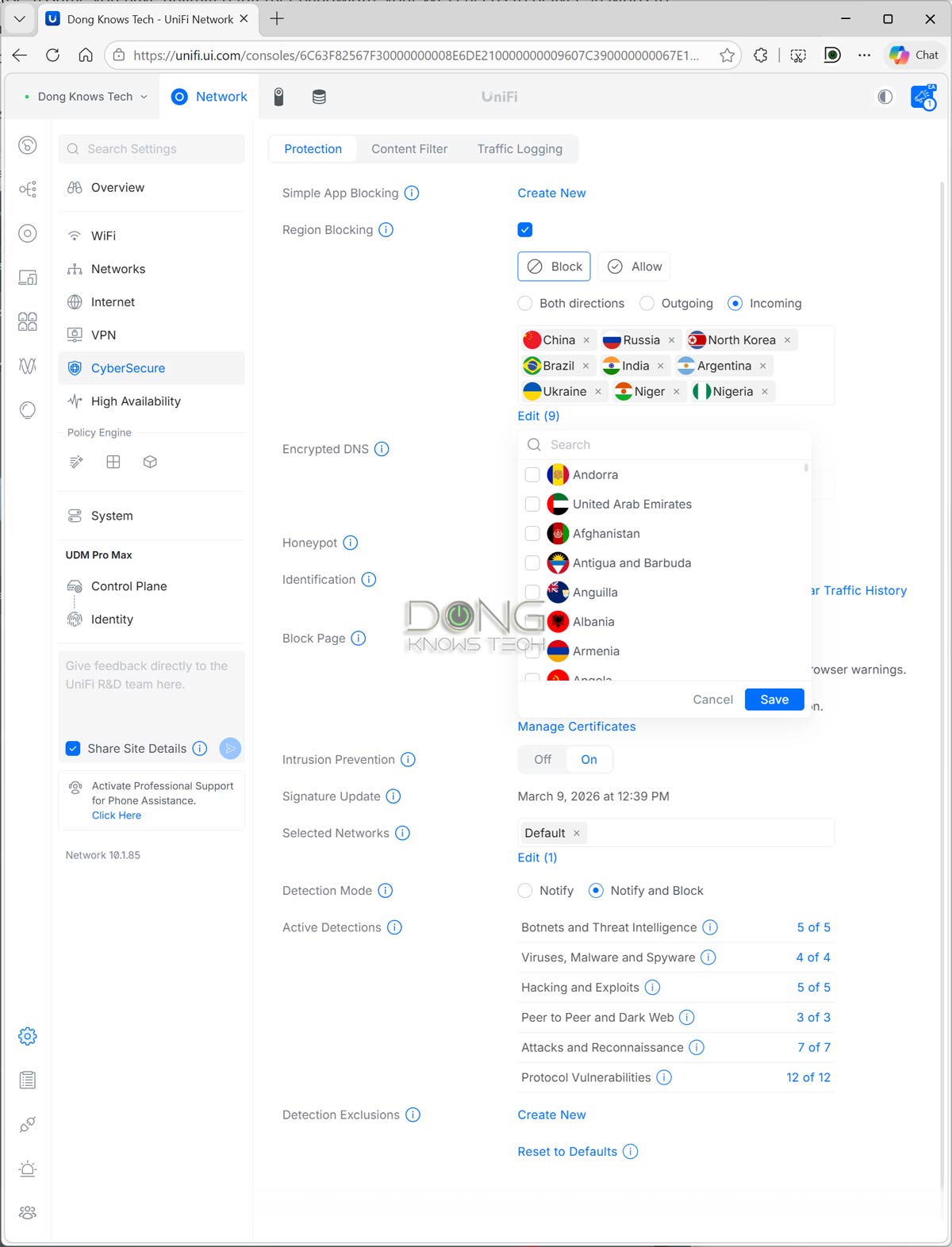
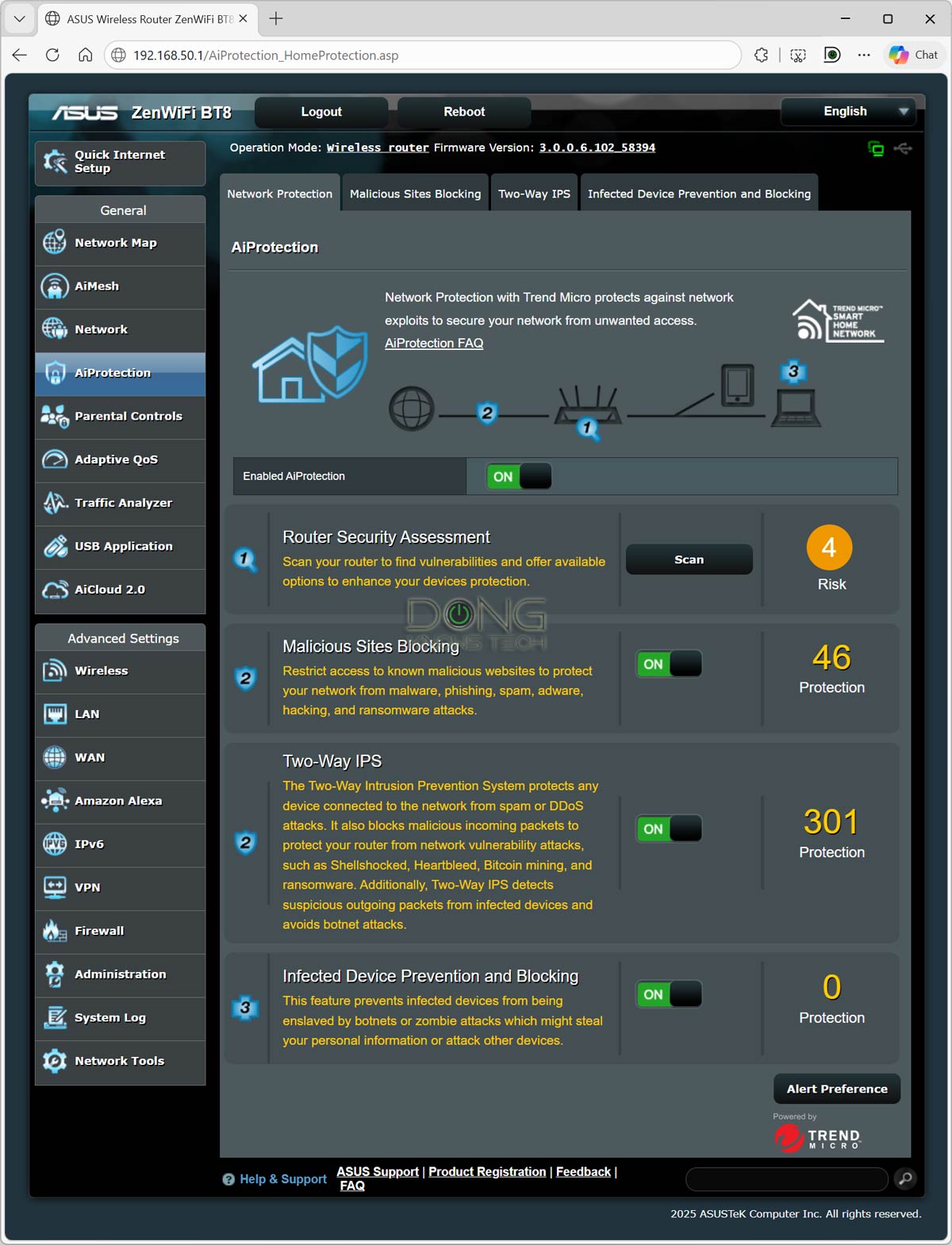
- Online protection: The ability to detect and filter out online threats (malware, phishing, viruses, etc.). Typical examples are UniFi’s CyberSecue or ASUS’s Network Protection (part of AiProtection). Other brands also offer premium options, such as Antivirus (part of HomeShield on TP-Link routers) or Armor (available on NETGEAR products).
- USB-related features: These features are available in routers with a USB port, including the ability to turn the router into a mini NAS server.
- Game-related features: You can play the game with any router, especially one with QoS. However, some routers have even more to give pro gamers an edge.
What you should avoid in Wi-Fi routers
Not all features and settings are helpful. The following are those I’d think twice before using.
Vendor-assisted remote management
This feature requires you to register an account with the vendor and attach your router to that account. In return, you can manage our home network when you’re out and about.
This type of remote access is becoming popular among mainstream networking vendors. For example, TP-Link, Linksys, and NETGEAR have it as an option.
Any time you have to log in using a vendor’s account, you face privacy risks. Also, you can get the same function via Dynamic DNS. That said, before you use one, make sure you trust the company’s privacy policy.
Vendor-dependent solutions
These devices are by far the worst in terms of features. They have very few of the above, if any. What makes them even less attractive is that you need a vendor-connected account and sign in before you can even use the router.
In other words, both your mobile device and your home network are connected to the vendor at all times, and you manage your home network through the vendor.
Privacy risks aside, this type of management means you do not truly own your router. When there’s no Internet connection, you can’t make changes to your home network. Or, if the vendor decides to stop supporting the device for some reason, you’ll lose access to it.
Examples include Google (Nest Wi-Fi) and Amazon (Eero). These happen to be among the easiest to use, however, so it’s your call.
Wi-Fi router: Frequently asked questions
Below are a few questions I often get about home Wi-Fi routers, along with my answers.
Does a mesh system have more bandwidth and client support than a single router?
No. Or, at least, not necessarily.
You can find out more about mesh systems in this detailed post, but generally, the acceptable total number of active devices depends on the mesh’s hardware and how you set it up.
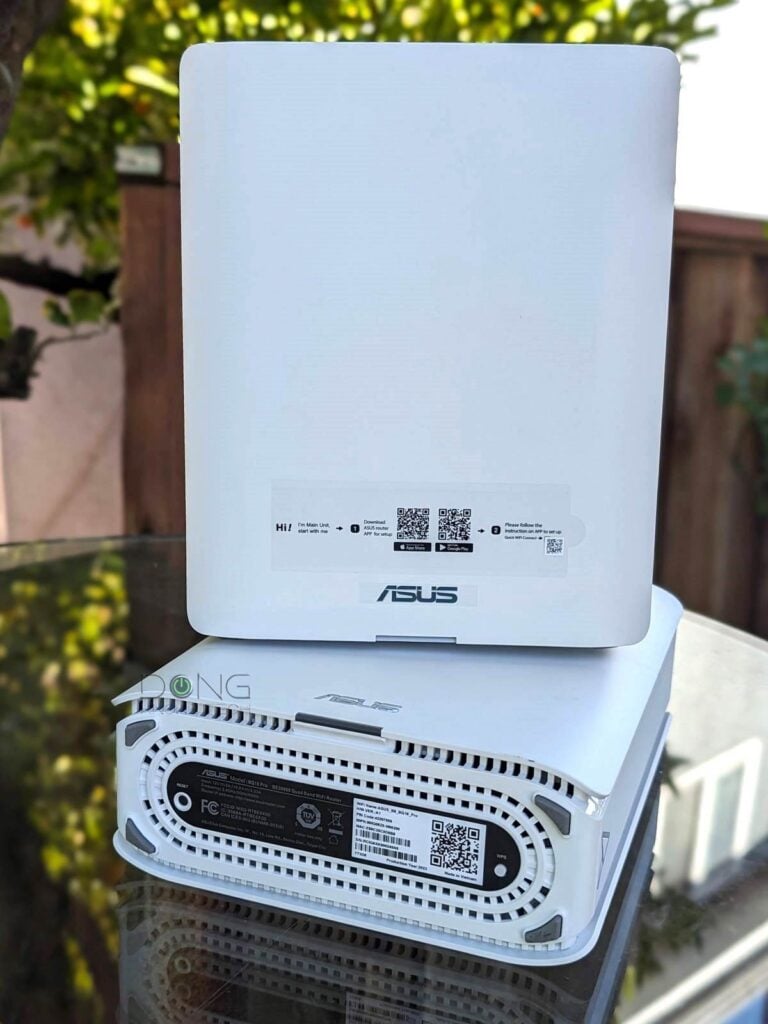
Similar to a switch, each mesh point has its own Wi-Fi bandwidth. However, all devices connected to a mesh unit share a single backhaul uplink to the network.
Backhaul vs. fronthaul
When you use multiple Wi-Fi access points—in a mesh Wi-Fi system or a combination of a Wi-Fi router and an extender—there are two types of connections: fronthaul and backhaul.
Fronthaul (or downlink) is the Wi-Fi signals broadcast outward to clients or to local area network (LAN) ports for wired devices. It’s what we generally expect from a Wi-Fi broadcaster.
Backhaul (a.k.a. backbone) or uplink, on the other hand, is the link between a Wi-Fi satellite unit and the network’s primary router, or between satellite units.
This link works behind the scenes to keep the hardware units together as a system. It also determines the ceiling bandwidth (and speed) of all devices connected to the particular Wi-Fi satellite unit.
- Hardware of Wi-Fi 6e, Wi-Fi 6, or Wi-Fi 5 standards always uses one of its bands (2.4GHz, 5GHz, or 6GHz) for the uplink. In this case:
- When a Wi-Fi band handles backhaul and fronthaul simultaneously, only half its bandwidth is available to either end.
- When a Wi-Fi band is used solely for backhauling, often available in tri-band hardware, the link is called a dedicated backhaul.
- Most Wi-Fi 7 satellite units can use multiple bands for the backhaul link thanks to the MLO feature.
For the best performance and reliability, network cables are recommended for the uplink or wired backhauling, an advantage of mesh Wi-Fi hardware with network ports. In this case, a Wi-Fi satellite unit can use its entire Wi-Fi bandwidth for the fronthaul.
Assuming we’re using Wi-Fi of the same grade and your clients are evenly distributed across the mesh points, your mesh network can support more concurrent clients than a single router.
However, keep in mind that, in this case, all clients still share the router unit’s connection to the Internet. Most importantly, a mesh system still has a 254-device cap, as mentioned above.
Dual-band vs. tri-band: If I combine two dual-band routers via a network cable, would that be the same as having a tri-band or quad-band router?
While this seems to make sense, unfortunately, it wouldn’t. In fact, you shouldn’t do that in most cases. That’s because the same Wi-Fi band uses the same channels.
In most cases, tri-band in Wi-Fi 5 or Wi-Fi 6 hardware, or quad-band in Wi-Fi 7, exists because one of the bands (often 5GHz or 6GHz) is split into two sub-bands, allowing two portions of the frequency to be used simultaneously. That sounds nice at first glance, but it is always at a great expense.
I detail band-splitting in this post on dual-band vs. tri-band vs. quad-band. If you need a crash course, the drawer below summarizes how that works with the popular 5GHz band.
Extra on the 5GHz frequency
Among existing Wi-Fi bands, namely 2.4GHz, 5GHz, and 6GHz (available in Wi-Fi 6E and Wi-Fi 7), 5GHz is the most popular and also the most complex, specifically:
Channel allocation, DFS, and band-splitting
A dual-band Wi-Fi 6 (or Wi-Fi 5) broadcaster (2.4GHz + 5GHz) has two distinctive sets of channels. One belongs to the 2.4GHz band, and the other to the 5GHz band.
In the US, the 2.4 GHz band includes 11 usable 20MHz channels (from 1 to 11) and has been that way since the birth of Wi-Fi. Things are simple in this band. The 2.4GHz band uses channels of 20MHz or 40MHz width. The wider the width, the fewer channels you can get out of the frequency—the entire band is only so wide.
On the 5GHz frequency, regardless of Wi-Fi standards, things are complex. We have DFS (restricted) and regular (non-DFS) channels and the UNII-4 portion. The 5GHz band uses 4 channel widths, including 20MHz, 40MHz, 80MHz, or 160MHz. Wider channels are desirable since they deliver more bandwidth or faster speeds.
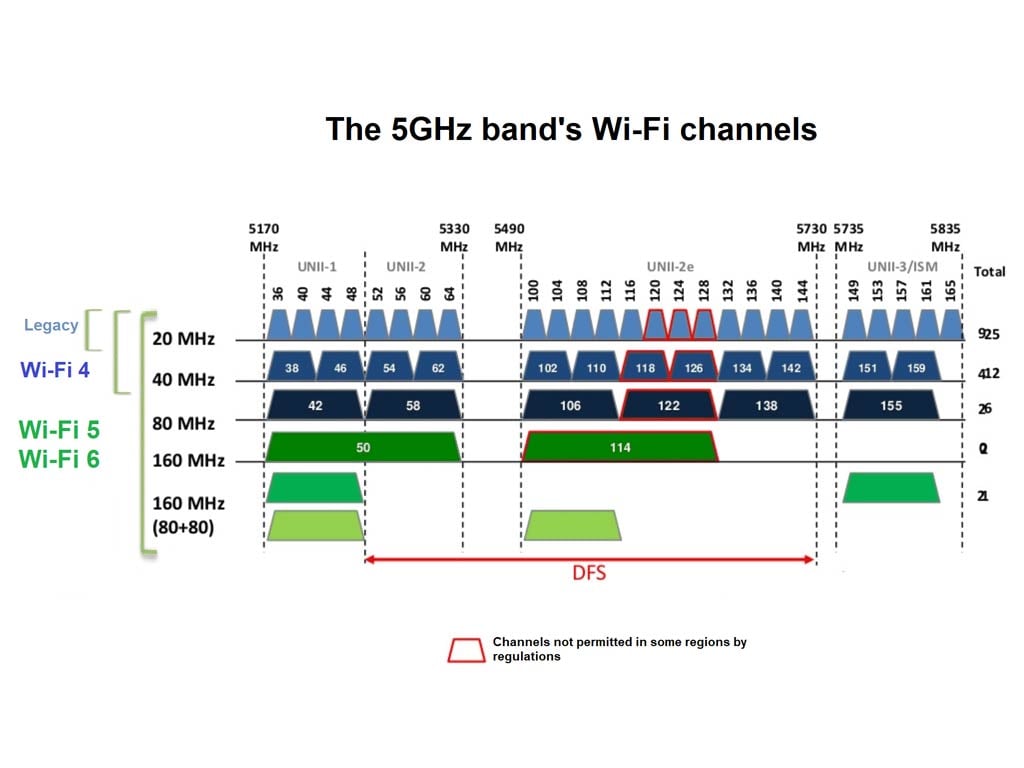
Below is the breakdown of the channels on the 5GHz frequency band at their narrowest form (20MHz):
- The lower part of the spectrum includes channels: 36, 40, 44, and 48.
- The upper portion contains channels: 149, 153, 161, and 165.
- In between the two, we have the following DFS channels: 52, 56, 60, 64, 100, 104, 108, 112, 116, 120, 124, 128, 132, 136, 140, and 144. (Channels from 68 to 96 are generally reserved exclusively for Doppler RADAR.)
In a dual-band (2.4GHz + 5GHz) broadcaster, the 5GHz band gets all the channels above (#1, #2). It’ll also get #3 if the broadcaster supports DFS.
In a traditional tri-band broadcaster (2.4GHz + 5GHz + 5GHz), the first 5GHz band (5GHz-1) will get the lower channels (#1), and the 2nd 5GHz band (5GHz-2) gets the upper channels (#2).
If the broadcaster supports DFS, the 5GHz-1 gets up to channel 64, and the rest (100 and up) goes to 5GHz-2. If the hardware also supports the new 5.9GHz portion of the 5GHz spectrum, it generally has three additional channels to its upper part, including 169, 173, and 177.
The splitting of the 5GHz spectrum ensures that the two narrower bands (5GHz-1 and 5GHz-2) do not overlap. So, here’s the deal with traditional tri-band (2.4GHz+ 5GHz+ 5GHz):
- The good: While the total width of the 5GHz spectrum remains the same, we can use two portions of this band simultaneously, theoretically doubling its real-world bandwidth.
- The bad: Each portion (5GHz-1 or 5GHz-2) has fewer channel-forming options, making it harder for them to use the 80MHz or 160MHz channel widths required for high bandwidth. Physically, the channel-width options are now more limited than when the entire 5GHz spectrum is utilized as a single band.
- The bottom line: Limited bandwidth for each sub-5GHz band. In an area crowded with 5GHz Wi-Fi broadcasters, practically everywhere these days, this band-splitting practice likely adds little in terms of extra real-world total bandwidth.
That said, putting two dual-band routers (or access points) close together is generally something we want to avoid. The only time it’s OK is when you can ensure they use different channels at any given time, which is not easy.

Do I need to care about Wi-Fi routers’ antennas?
The short answer is no.
All Wi-Fi routers—any radio broadcasters or receivers, for that matter—have antennas. If you don’t see them, that’s because they are hidden inside or blended into the device’s other hardware.
The antennas convert data signals into radio waves and vice versa. Without them, there’s no Wi-Fi. Generally, you only need to keep these little poles vertical.
And that’s likely all you need to know about them. If you want to learn more about this topic, check out my Wi-Fi dBi and high-gain antennas post.
I want to pick a router with the best range. What should I do?
The range doesn’t mean anything if you can’t connect a device to a router or if the connection is unusably slow.
So, in the end, it’s always how fast a router is that matters, not how far from it you can detect its signal. I discuss the range in detail in the piece on Wi-Fi as a whole, but the drawer below gives you a quick idea.
Extra: Wi-Fi range
Wi-Fi range in theory: It’s “clean” and generous
The way radio signals work is that the lower the frequency, the longer the wave can travel. AM and FM radios use frequencies measured in kilohertz and megahertz—you can listen to the same station in a vast area, like an entire region or a city.
Wi-Fi uses 2.4GHz, 5GHz, and 6GHz frequencies—all of which are incredibly high. As a result, it has much shorter ranges than radios. That’s especially true when considering that the broadcasting power of Wi-Fi broadcasters is limited by regulations.
But, regardless of Wi-Fi standards, these bands generally share the following: The higher the frequencies (in Hz), the higher the bandwidth (speeds), the shorter the ranges, and the more bandwidth progressively lost over increasing distance.
Generally, physically larger Wi-Fi broadcasters tend to have better ranges than smaller ones—they use all the allowed broadcasting power and have enough processing power to deliver the most bandwidth at the far end of the signal. Still, it’s impossible to accurately determine each’s actual coverage because it fluctuates wildly and depends heavily on the environment.
That said, here are my estimates of a home Wi-Fi broadcaster’s ranges in the best-case scenario, specifically:
- Outdoor environment
- On a sunny day
- No interference or broadcasters in close proximity
- Maximum broadcasting power (30 dBm)
- 2.4GHz: This band has the best range, up to 200 ft (≈ 60 m). However, it is the most popular band also used by non-Wi-Fi devices like cordless phones or TV remotes. Its real-world speeds suffer severely from interference and other factors. As a result, for years, this band has been considered a backup, applicable when range is more important than speed.
- 5GHz: This band has much faster speeds than the 2.4GHz band but shorter ranges, maxing out at around 150 ft (≈ 45 m).
- 6GHz: This is the latest band available. Two things to keep in mind:
- Wi-Fi 6E: The first standard supporting this band, which shares the same ceiling speed as the 5GHz. However, thanks to the less interference and overheads, its actual real-world rate is faster. In return, due to the higher frequency, it has just about 70% of the range, which maxes out at approximately 115 ft (≈ 35m).
- Wi-Fi 7: This is the latest standard where the 6GHz band’s channel width (and bandwidth) is doubled. Additionally, with a broadcaster that supports AFC, such as the Ubiquiti E7, this band gets a boost in broadcasting power to deliver the same range as that of the 5GHz.
Wi-Fi range in real life: The devil is in the little and big details
In real-world usage, Wi-Fi broadcasters in the same frequency band and broadcasting power generally deliver the same coverage. Specifically, they are all the same if you measure the signal reach alone.
What differentiates them is their sustained speeds and signal stability, or how the quality of their Wi-Fi signals changes as you increase the distance. And that generally varies from one model or Wi-Fi standard to another.
Your router’s Wi-Fi range is always much shorter than the theoretical number mentioned above. That’s because Wi-Fi signals are sensitive to interference and obstacles.
While the Wi-Fi range doesn’t depend on the channel width, the wider the channel and the higher the frequency, the less stable it becomes. It’s more susceptible to interference and obstacles, and its range is more acutely hindered. So, within the same standard, more bandwidth generally equals higher fragility.
Below are the items that will affect Wi-Fi ranges.
Common 2.4 GHz interference sources: Impossible to measure
- Other 2.4 GHz Wi-Fi broadcasters in the vicinity
- 2.4GHz cordless phones and other appliances
- Fluorescent bulbs
- Bluetooth devices
- Microwave ovens
Common 5 GHz interference sources: Impossible to measure
- Other nearby 5GHz Wi-Fi broadcasters
- 5GHz cordless telephones and other appliances
- Radars
- Digital satellites
Common signal blockage for all Wi-Fi bands: Measurable, albeit challenging, walls and large objects
Physical objects, such as appliances or elevators, hinder all Wi-Fi bands. However, walls are the most problematic obstacle since they are everywhere. Different types of wall blocks Wi-Fi signals differently, but no wall is good for Wi-Fi.
Here are my rough real-life estimations of how much a wall blocks Wi-Fi signals—generally use the low number for the 2.4GHz and the high one for the 5GHz, add another 10%-15% to the 5GHz for the 6GHz band:
- A thin, porous wall (wood, sheetrock, drywall, etc.) will block between 5% and 30% of Wi-Fi signals—a router’s range will be much shorter when placed next to it.
- A thick porous wall: 20% to 40%.
- A thin nonporous wall (concrete, metal, ceramic tile, brick with mortar, etc.): 30% to 50%.
- A thick nonporous wall: 50% to 90%.
Again, these numbers are just ballpark, but you can use them to know how far the signal will reach when you place a Wi-Fi broadcaster at a specific spot in your home. A simple rule is that more walls equal worse coverage, and generally, a single wall will reduce the signal by approximately 30%.
That said, in real life, when all adverse elements are taken into account, and depending on the situation and where you stand from the broadcaster, we need to discount the theoretical ranges mentioned above between 40% and 90% to get a broadcaster’s realistic coverage.
That said, a router’s range depends on its power, antennas, and, most of all, its Wi-Fi bands. As a rule, larger hardware tends to deliver a better range. But in the end, this is always case-by-case, and you have to read the reviews to find out.
My friend told me that I need a new router because my current one doesn’t support WPA3. Is that true?
That’s about as true as saying you need a new car because your current one doesn’t have a wireless key fob or satellite radio support—it’s up to you.
While WP3 is more secure than WPA2 or WPA, chances are you’d have no problem using the older standards. Even the legacy WEP is still applicable. In fact, you’re probably still OK when leaving your network open as long as you know how to secure each device individually.
Security is a matter of degree, and WP3 doesn’t make your network absolutely secure, either. Plus, it’s incompatible with most existing clients. So, it should not be the sole reason to get a new router.
What’s the best Wi-Fi router to buy today?
If you think the best Wi-Fi router to get today is one that supports Wi-Fi 7, you’d be both predictable and wrong. Believe it or not, the best Wi-Fi router to get is a non-Wi-Fi router.
The latest Wi-Fi standard is excellent, but keep in mind that Wi-Fi 8 is now on the horizon. So, in a year or so, Wi-Fi 7 will no longer be the “best”. To avoid this type of “forced” obsolescence, it’s best to get a standard non-Wi-Fi router, yes, a router without Wi-Fi.
That’s because adding a standalone Wi-Fi access point, of whichever Wi-Fi standard, to a non-Wi-Fi router gives you a true “Wi-Fi router” plus the flexibility to have the best Wi-Fi coverage.
Furthermore, if you get the access point(s) from the same ecosystem, such as Ubiquiti’s UniFi, which dominates the top-five list above, you’ll build by far the best Wi-Fi network.
However, sure, if you only need a single access point, i.e., if you live in a small home, a Wi-Fi 7 router will be a sensible choice. In that case, here are the current top five to consider. However, keep in mind that, all things considered, Wi-Fi 6 is still the safest and most practical option.
The takeaway
There you go. Above are the answers to the most common questions I’ve received over the past half-decade about choosing the right Wi-Fi router.
In a way, looking for a router is somewhat like looking for love—both are networking. To succeed, you need to juggle two things: yourself (your situation, what you need, your expectations, etc.) and what you can afford (financially and whatnot).
Just like looking for a life partner, some of us might end up with a couple of wrong choices before getting lucky. One thing is for sure: it’s OK to take chances. That’s especially true in Wi-Fi and routers since this type of networking incurs relatively painless consequences should you need to make a complete replacement.