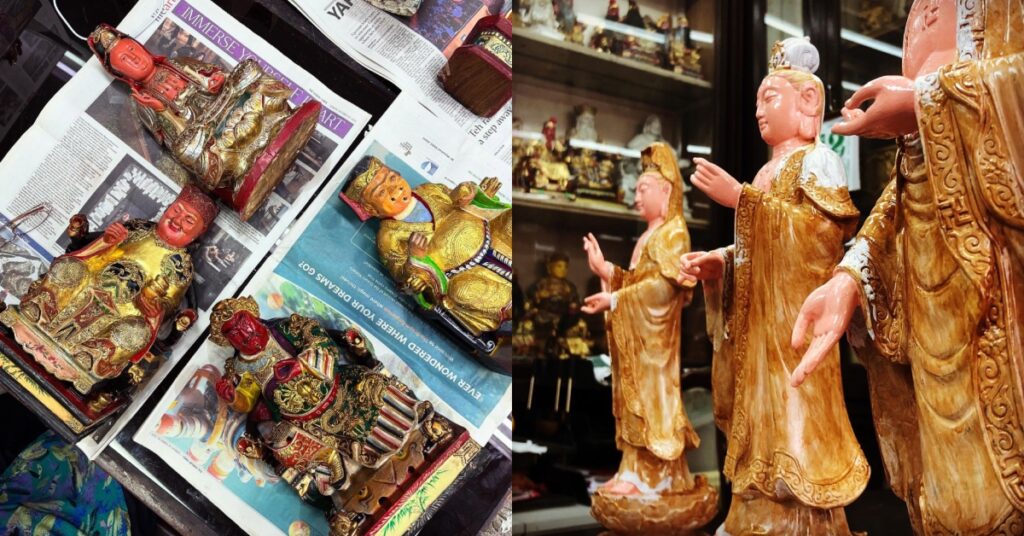
Taoist sculpture maker Say Tian Hng has been around for 130 years, but it’s now facing steeper competition
“It’s all disappearing.”
The words come out matter-of-factly from Ng Tze Yong, the sixth-generation practitioner at Say Tian Hng.
He’s referring to the heritage businesses in Singapore quietly closing their doors—a harsh reality that he, too, could confront at Say Tian Hng, the last remaining family-run craft houses of Taoist and Buddhist deities in Singapore.
But for Tze Yong, that ending is unacceptable. “I don’t want [Say Tian Hng] to pass,” he says. “I want it to survive. I want it to thrive.”
Faced with an industry transformed by machines that can carve statues in hours and flood the market at a fraction of the cost, the business, which has been around for 130 years, has been exploring various strategies to survive and stay relevant.
One path, it seems, lies beyond Singapore’s shores: bringing its handcrafted wooden deities to overseas audiences who value craftsmanship, stories, and culture.
Exploring overseas partnerships

Last Jul, Tze Yong travelled to London on a scouting trip to test whether Say Tian Hng’s handcrafted statues could find an audience overseas. He approached independent shops to explore consignment partnerships and found strong interest in the cultural and philosophical aspects of the craft.
That interest has since led to Say Tian Hng’s first overseas partnership. The business is now working with a bookshop in London’s Leicester Square, where its statues are on display. Visitors can scan a QR code to learn more about the deities, the craft process, and place an order directly with the workshop in Singapore.
This model allows Say Tian Hng to manage demand despite its long production timeline. Each statue takes about four months to complete, making it impractical to hold inventory overseas.
Orders placed in London are made-to-order, crafted in Singapore, and shipped directly to customers, enabling the heritage business to expand internationally without compromising its handcrafted process.
It’s a painstaking one at that, but one the business is incredibly proud of. Each deity is carved from blocks of camphor wood, reinforced to prevent cracking, and layered with protective coatings.

Using a technique called thread sculpture (qī xiàn/ 漆线), artisans decorate robes with dragons, phoenixes, and auspicious symbols made from holy incense ash.
The ash is collected, washed, kneaded into a dough, and laboriously beaten into fine threads with a spatula. These threads are then carefully twirled and coiled onto the statue using bamboo sticks to form the intricate motifs.
Then, statues are then gilded with gold leaf, painted in meticulous detail—from fingernails to eyes—and fitted with accessories such as beards, weapons, and hair. The final step is consecration: invoking the presence of the deity and transforming the piece into an object of worship.
Only after these processes are the statues shipped to overseas customers.
Demand is “recession-proof”

When asked how the partnership in London is performing, Tze Yong said it is still in its early stages and the business “is still building it out.” If it goes well, Say Tian Hng aims to explore similar arrangements across other European cities in the coming years.
But that’s not to say the business is neglecting the Singapore market.
“We’re not abandoning the local market, that is our core and our biggest market at the moment, we just think that there is a need to diversify our [customer] base,” shared Tze Yong.
Locally, Say Tian Hng continues to serve temples and households across Singapore. While Tze Yong declined to share exact figures, he noted that demand has remained stable over the years.
“The demand is, in a way, recession-proof,” he said. “It’s not a trend, it’s the same object painted the same way for generations.”
“Tastes haven’t changed much, so there’s no need to overhaul the supply chain. And if you’re one of the last few standing, people will come to you.”

However, Tze Yong acknowledged that the market now has more options than ever—anyone can now buy a new statue off the shelf or online at much lower prices.
He shared that Say Tian Hng’s handcrafted pieces are typically five times more expensive than these mass-produced alternatives, which are often carved by computer numerical control (CNC) machines.
These automated manufacturing tools are directed by pre-programmed computer software, allowing them to carve wood with high precision, producing identical statues quickly and efficiently.
But for Say Tian Hng, the value lies in what mass production cannot replicate. “If you want a custom statue, or need to repair an old, beloved piece, there aren’t many options,” Tze Yong said. “You can’t send your old statue back to Taobao, nobody is repairing it for you.”
Over the past two decades, restoration has become a key part of the business, which now derives roughly 50% of its work from new commissions and 50% from restoring old statues.
Breathing life into a 130-year-old business
Exploring consignment partnerships overseas is only the latest in a series of experiments Say Tian Hng has undertaken to breathe new life into the 130-year-old business. Over the years, it has tested different ways to engage new audiences, with mixed results.
One such effort has been workshops and guided tours, which the business has been running for about a decade.

There are two formats: one offers visitors a tour of the shop itself, while the other leads participants through the back alleys of Singapore’s central business district. There, they encounter Taoist street shrines tucked beside dumpsters and beneath air-conditioning compressors—weathered statues still tended to with fresh fruit offerings.
Each session typically hosts around 10 people, and Tze Yong notes that participants are often locals rather than tourists, drawn by a desire to discover overlooked layers of Singapore’s cultural landscape.
Still, the workshops are not something the business “pushes hard on,” nor are they held regularly. “It’s more like a CCA,” he said. “We don’t really market it, it’s on our website, but we don’t run Google ads or anything like that. There’s just no bandwidth.”
That same constraint led Say Tian Hng to discontinue another experiment: a foray into NFTs. The idea was never launched publicly, but Tze Yong said it began as a way to think about how the business could document provenance and preserve long-term value in a digital age.
The concept was to use NFTs as certificates of authenticity for handcrafted statues, similar to how digital tokens are sometimes used to verify artworks.

In theory, this could offer customers stronger assurance that a piece was made by Say Tian Hng—a sixth-generation family business—and potentially position the statues as heirlooms with lasting value. However, the idea ultimately did not progress beyond the exploratory stage.
The question of succession
But the challenge for Say Tian Hng runs deeper than bandwidth. The lack of “warm bodies” constrains it far more than marketing or digital experiments—finding skilled artisans willing to commit years to mastering the craft is essential to succession.
“That’s the toughest thing. Once you can find one person, you buy yourself 30 years. But if you don’t have that one body, even if you have the greatest social media account alive, you’re still gonna disappear overnight.”
Currently, most of the work is handled by Tze Yong’s father, Ng Yeow Hua, assisted by three part-timers.
Tze Yong only comes in once a week, balancing the studio with his work in cultural heritage and philanthropy. He gradually built up his skills over the years and only began working on actual customer statues about three years ago.
While he is committed to the craft, Tze Yong is uncertain whether his two teenage daughters will be interested in continuing the business—and he is careful not to base future plans on that possibility.
“I can’t build the business on the chance that maybe one day [they’ll] join the family business,” said Tze Yong. But what if they don’t? Then that becomes a single point of failure, and then you go extinct.”
Instead, Tze Yong is planning for a future that does not depend on family members running the studio. “They can still own the business, and I would like that to be the case. They can hire a team to run it, and if they choose to step in, they can do so at the right time and in the right way.”
With a skilled team in place, and efforts to grow the business beyond its core local market, he hopes Say Tian Hng’s craft can continue, knowledge can be passed on, and the business can survive, and even thrive, for generations to come.
- Find out more about Say Tian Hng here.
- Read other articles we’ve written on Singaporean businesses here.
Featured Image Credit: Nicky Loh/ Say Tian Hng via Instagram