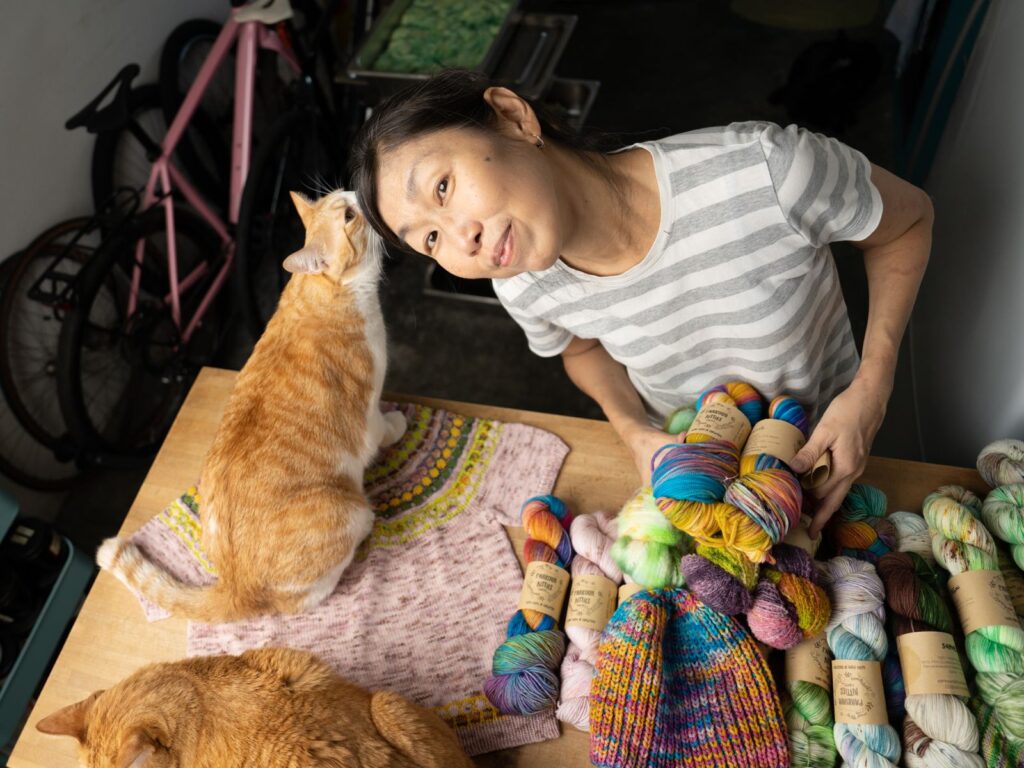
Parkour Kitties Fibers claims to be one of the first hand-dyed yarn businesses in Singapore
Mentioning “parkour” to anyone generally evokes a mental image of a particularly athletic individual, overcoming barriers and obstacles with ease. Or, maybe that specific scene from The Office may come to mind.
For 55-year-old Lois Teo, however, parkour is simply what her three relentlessly playful rescue cats were constantly up to. Their states of perpetual motion led Lois to label her felines as “parkour kitties”.
As an homage, Lois decided to name her business Parkour Kitties Fibers. Like the kittens, the brand would come to embody curiosity and a refusal to stay within rigid boundaries. Today, Parkour Kitties Fibers is recognised as one of Singapore’s earliest hand-dyed yarn businesses, operating in a niche that barely existed locally previously.
We spoke with indie yarn dyer Lois to find out what it means to be one of Singapore’s first hand-dyers.
Stitching through recovery

Since her teenage years, Lois had knitted and crocheted, learning from a knitting book she inherited from her sister. Over time, knitting became a quiet ritual—something she returned to whenever she needed calm.
In 2016, Lois took a one-year sabbatical from a stressful corporate job after suffering from a medical emergency during a business trip. During this period, knitting shifted from hobby to therapy. The repetitive motions, textures, and focus offered comfort at a time when her body and life felt uncertain.
When the overseas posting she was slated for offered no possibility of a part-time arrangement, Lois made the difficult decision to leave her corporate role entirely in 2017.
The following year was spent recovering, knitting, and learning to live at a slower pace. It was during this limbo that Parkour Kitties Fibres began to take shape—long before it had a name or customers.
During her usual shopping for yarns online, Lois discovered art of hand-dyed yarn, where the fibres saturated with layered colours, speckles, and gradients that felt alive.
“I realised a lot of them dye the yarn at home, in a home studio or garage,” Lois said. “I was like, ‘Oh, I can do that at home too’ and started converting my kitchen into a home studio!”
The founder shared that previously, there was only one other person hand-dyeing yarn in Singapore at that time, and it was limited to a hobby.
Lois began researching the process, watching YouTube tutorials and learning about acid dyes—how they work, and how they can be safely used on natural fibres. Through much practice, what started as curiosity quickly turned into passion and eventually a business.
Learning the ropes and rinses

In 2019, Lois officially began dyeing yarn and selling it online. The earliest offerings were simple, basic colourways that were listed on Etsy. Unexpectedly, there were many customers from the US and Canada, who were willing to pay international shipping for yarn hand-dyed halfway across the world.
Her strong Etsy presence caught the attention of a local Etsy team, who encouraged Lois to take part in her first pop-up at its annual Etsy Craftivist, a crafter’s market held at Esplanade in 2019.
That moment marked Parkour Kitties Fibers’ transition from a quiet online presence into a visible part of Singapore’s small but passionate yarn scene.
Today, Lois has expanded into novelty yarns, including bases embellished with sequins and beads. When dyed black, these yarns can become garments that feel classy and semi-formal.
Lois had also noticed that many customers treat her yarn as a “special occasion” material due to its uniqueness in colourways compared to mass-dyed yarn.
“I’ve observed that many customers don’t use my yarn immediately but save it for more intricate projects,” Lois shared.
Years later, customers would reach out to Lois with their finished projects, proudly sharing sweaters, shawls, and cardigans made from Parkour Kitties yarn. Sometimes, these posts spark renewed demand for past colourways, which Lois happily accommodates.
A single skein starts at S$32, a price point Lois maintains to reflect the reality of local production costs.
However, Lois is persistent in making natural fibre, especially hand-dyed ones, more accessible and affordable.
To lower the barrier of entry, she also produces mini-skeins, allowing customers to experiment with smaller projects like headscarves and socks. These smaller quantities also let people feel the difference in texture and quality when knitting or crocheting with natural fibre, compared to synthetic ones.
Lois is also part of knitting groups where she and other knitters share their love, inspirations, and techniques for creating new works.
The craft behind the colours

Lois works primarily with animal fibres such as merino wool and cashmere, while synthetic fibres like polyester are avoided as much as possible. Such synthetic materials may be cheaper, but they do not retain warmth and durability over time in the same way natural fibres do, Lois emphasised.
“If you buy synthetic, it’s $10 compared to $20 for a natural fibre. It depends on whether you are looking for value or quality.” Lois said.
While knitting with natural fibre is undeniably more expensive than synthetic ones, Lois believes natural yarn is worth it for its craftsmanship and longevity. A store-bought knitted sweater made from natural fibre, she estimated, would retail for S$500 to S$600.
Outside of formal collections, Lois draws inspiration from the world around her: the colours and patterns of insects, birds, and flowers, as well as visual culture such as animations. These influences have even been translated into one to two colourways released a month, and even bundled skein colourways, where multiple colours tell a cohesive story.

“My Studio Ghibli-inspired skeins have surprisingly sold quite well and usually sell out as fast as I can produce them.” Lois reflected.
Each dye batch usually yields around six skeins in five different yarn weights per colourway. The full dyeing process—cooking the yarn with acid dye, allowing it to cool, rinsing, and drying—takes about two days. During rainy periods, drying time can stretch even longer, depending on the yarn weights involved.
Occasionally, the final hue turns out differently than expected because various yarn bases absorb the dye in diverse ways—a natural quirk of hand-dyeing that always offers Lois a fresh lesson in her art.
“No two skeins are identical, that’s the beauty of hand-dyed yarn,” Lois reflected on her craft.
Binding off Etsy

As Etsy grew more expensive and prone to imitators, Parkour Kitties moved fully to sell on her website through Shopify in 2024.
Later that year, a customer-turned-friend opened a knitting shop, Cast On Yarn Shop, which gave Parkour Kitties Fibers a physical retail spot to stock yarn regularly. Lois now drops by often, functioning almost like an in-house dyer.
As part of her love for knitting and the community, she also spends considerable time helping customers estimate how much yarn is needed for their projects, like sweaters—typically three to four skeins for a small to medium size, depending on yarn weight.
Moreover, that year, as part of a collaboration with the National Heritage Board and weaving and fibrecraft studio Craft Atelier, Lois created a yarn featuring a vibrant orange, green, and purple palette inspired by the culture and history of Geylang Serai. The yarn was offered in several blends, including merino and mulberry silk.
Besides stocking at Cast On Yarn Shop and Craft Atelier, Parkour Kitties Fibers has also found international stockists in Australia, Indonesia, and Japan, driven by interest in Lois’ novelty yarns—particularly her bold offerings like neon colourways amongst her other creations. Lois noticed that her core customers tend to be working adults ranging from their 20s to 60s, most of whom knit garments such as sweaters and cardigans.
At pop-ups, Lois offers ready-made products alongside her hand-dyed skeins, and the offerings shift according to the audience. High-end events like Boutique Fair feature large shawls, while festivals aimed at younger, budget-conscious crowds, such as Mercury Festival, will see Lois’ smaller bandanas, beanies and headscarves for sale.
Custom dye requests are increasingly common. One recent order involved “chill colours” in blues and greens for a very large shawl, beginning with five skeins and later asked for an additional three skeins to complete the piece.
The pressure behind the palette

Among the usual creative challenges Lois has faced, the latest Peranakan Heritage 2025 Advent Calendar stands out as the most demanding, but also one of the most fulfilling ones.
Her friend from Cast On Yarn Shop asked Lois to come up with 24 entirely new colourways. Lois got to work and decided on a Peranakan culture theme, where some colourways were inspired by butterflies and pink lotus in Peranakan motifs.
Initially hesitant, Lois only decided to go ahead with it later and had two weeks ahead of a Dec 1 delivery deadline to deliver the colourways. Nonetheless, she managed to do it with intense discipline, research and trial-and-error. Moreover, Lois visited the Peranakan Museum to ensure the heritage-inspired colourways were accurate and respectfully represented.
Operational challenges have also emerged, particularly in international shipping. Severe restrictions and high flat fees introduced by SingPost for US-bound parcels has forced Lois to find slightly more affordable shipping companies.
To manage still high shipping costs, Parkour Kitties lists shipping fees transparently on its website and offers refunds for any difference.
“Despite the higher shipping prices, US customers continue to place orders and are willing to pay for it!” Lois shared.
Picking up the next stitch

Besides personal milestones in launching the Peranakan Heritage 2025 Advent Calendar, popular Studio Ghibli bundles and becoming a near-resident dyer at a friend’s yarn shop, Lois’ SG60-themed colourways inspired by Peranakan Kebaya prints also marked a new phase of visibility and collaboration.
Looking ahead, Lois hopes to develop more kits and curated sets. New colourways frequently sell out upon release—sometimes before they even reach physical shelves—necessitating frequent dyeing sessions.
In terms of scale, Lois has been increasingly receiving a rising number of custom requests, apart from creating over 100 colourways so far.
One of the most ambitious ideas on the horizon emerged from a conversation with her yarn shop–owning friend: the possibility of opening a yarn shop in the airport. Lois believes tourists would be drawn to locally hand-dyed yarn as a meaningful gift or a portable souvenir.
For others considering turning their love for craft into a business, Lois offered a firm piece of advice: “Do not under-sell your craft just because everybody’s doing it. Do not under-sell the time you spend on your craft.”
In every skein of Parkour Kitties Fibers’ yarn lies not just colour, but care, labour, and the conviction that slow, intentional making is worth every effort in this fast-paced world.
- Learn more about Parkour Kitties Fibers here.
- Read more stories we’ve written on Singaporean businesses here.
Featured Image Credit: Parkour Kitties Fibers