
If you’re still wondering whether it’s time to upgrade to Wi-Fi 7, do that now! You only have a few months left to enjoy the standard as a novelty.
Today, TP-Link—that popular “I’m-no-Chinese” networking vendor—announced its comprehensive Wi-Fi 8 portfolio, along with a relatively concrete release timeline. Among them is a standalone router called Archer 8, set to ship as soon as this October, though, for now, it’s still very much a tease.
In any case, from the looks of it, there will soon be plenty of routers and mesh systems featuring the latest Wi-Fi standard in the US market, contrary to the concerns caused by the US’s ban on foreign-made routers earlier this year.
TP-Link Wi-Fi 8 lineups and expected availability
The main notion of the announcement is that TP-Link plans to adopt Wi-Fi 8 across its entire consumer-grade lineup. As a result, it’s safe to say that there will be Wi-Fi 8 versions of any existing TP-Link Wi-Fi 7 hardware.
Specifically, according to TP-Link, you can expect the following:
- Archer 8: Wi-Fi 8 router, part of TP-Link’s standalone router lineup, to be released in October 2026.
- Deco 8: Wi-Fi 8 mesh system of the Deco ecosystem, to be released in the first quarter of 2027.
- Roam 8: Wi-Fi 8 travel router—the upgrade and better-named version of the TL-WR3602BE—to be released in the second quarter of 2027.
- Wi-Fi 8 range extenders and add-on adapters will also be available in the second quarter of 2027. These are the updates of existing TP-Link EasyMesh extenders.
As shown, the most exciting news is that the Archer 8 router is set to arrive this October, well before CES 2027, when real Wi-Fi 8 routers are expected to be announced or showcased.
The question remains: What is the Archer 8?
Archer 8: A Wi-Fi 8 router with an entirely new design
Details of the Archer 8 are still sketchy, to put it mildly.
However, judging from TP-Link’s prevoius releases of Wi-Fi 6 and Wi-Fi 7 routers, it’s my educated guess that the Archer 8 will likely be a flagship model with EasyMesh support. What’s clear is that it’ll come in an entirely new (and, of course, “cool”) look.
Specifically, TP-Link touts that the Archer 8 “sets a new standard in router design, blending refined craftsmanship with precision engineering” and “balances refined aesthetics with performance-focused engineering”. The new router will come with “micro ridge texturing, precision contours, and a soft front-facing emissive light create a tactile and visual experience intended to feel sophisticated, modern, and distinctly premium.”
On the inside, TP-Link adds that the Archer 8 “combines advanced thermal engineering, antenna architecture, RF optimization, and AI-assisted network intelligence into a platform engineered for more stable real-world performance across increasingly demanding home environments.”
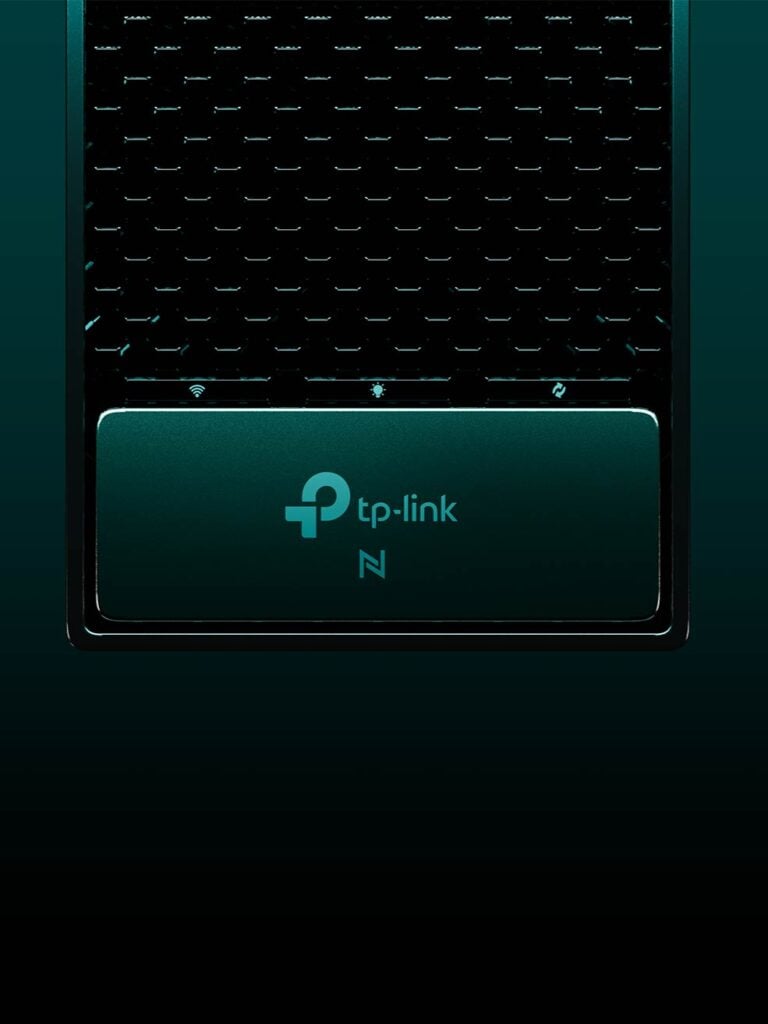
And that’s all I managed to get from TP-Link about the new routers. Indeed, the company is still tight-lipped, even about what the Archer 8 actually looks like, releasing only close-ups of its purported front or, possibly, part of the chassis, as shown in the photos.
The point is that while the Acher 8 Wi-Fi 8 router may land this October, and it will likely be “great”, we’ll have to wait to see what it’s really going to be in all aspects, from the hardware specs, the number of ports, and even its actual appearance.
As of right now, that tantalizing router is like a baby months before the due date. We know we’re all (supposed to) going to love it, and we likely will because it has Wi-Fi 8.
TP-Link’s take on Wi-Fi 8: Improvement all around over Wi-Fi 7
What TP-Link was more willing to share with me is that its Wi-Fi 8 hardware offerings, likely powered by Broadcom chips, have shown noticeable improvements over its Wi-Fi 7 counterparts in real-world conditions. The company reached that conclusion through controlled internal lab testing.
Specifically, TP-Link found that, compared to Wi-Fi 7, its Wi-Fi 8 hardware offers:
- Up to 33% higher throughput through enhanced modulation and coding improvements, helping maintain faster and more stable speeds at longer range
- Up to 24% higher throughput through unequal modulation technologies designed to improve consistency when signal quality varies across spatial streams
- Up to 15% throughput improvement between multiple access points operating under interference-heavy conditions through enhanced spatial reuse coordination
- Up to 30% signal-performance improvement in multi-floor environments for single-device connections, and 10–20% improvement in multi-device environments through TP-Link’s advanced antenna architecture and AI-assisted optimization
- A 1–3 dB improvement in receive sensitivity on 5 GHz and 6 GHz bands through advanced RF optimization, supporting stronger and more reliable coverage throughout the home
As a result, users can expect TP-Link’s Wi-Fi 8 hardware to reduce major speed drops over distance, improve multi-device stability, strengthen mesh performance, and maintain lower latency under challenging network conditions. To be clear, all that is part of the Wi-Fi 8’s general appeal.
What’s significant, though, is that TP-Link told me some of its Wi-Fi 8 products would come with smart flexible dBi configuration, purportedly allowing them to automatically focus signals to match the environment’s shape, similar to current enterprise-class access points. Specifically, an access point (router/mesh node) can slightly adjust its signal coverage depending on where you place it in a home.
Now, that’d be a real novelty.

The takeaway
While it was disappointing that TP-Link didn’t reveal more about its Wi-Fi 8 hardware, that’s quite understandable.
The latest Wi-Fi standard is still in its very early stages, and it’s generally safer and better to keep fewer hardware details public than to showcase cool devices that turn out to be vaporware. On this front, TP-Link might have learned from its own Archer AXE200 Omni, whose “auto-rotating antennas” made a huge splash in early 2022, only to never materialize.
That said, it’s safe to say you will soon see tangible Wi-Fi 8 routers in the US market, with TP-Link likely among the first vendors, if not the very first, to introduce them. And that seems to be the main point of the company’s largely superficial announcement today, which is slightly better than the pending case of the ASUS NeoCore.
So, check back for more. I’ll put these cutting-edge routers through their paces when possible.
In the meantime, if you’re new to Wi-Fi 8, it’s essentially an improved version of Wi-Fi 7. It shares the same bandwidth and major features (AFC, MLO, etc.) and is fully backward-compatible. Hardware vendors, TP-Link and whatnot, would want you to believe that it’s miles better than Wi-Fi 7, just as Wi-Fi 7 is the game-changer compared to Wi-Fi 6, and so on. And there’s some truth to all that.
Still, if you need a new Wi-Fi router or device, it’s totally fine to get one with Wi-Fi 7 or even Wi-Fi 6 today. They are plenty fast enough, and the arrival of Wi-Fi 8 only makes them more affordable, especially if you want to get a TP-Link.