
The Omada Access Pro 8-Port 2.5G and 2-Port 10GE SFP+ Switch with 8-Port PoE+ (model SG2210XMP-M2) is completely different from the previous TP-Link switch, the TL-SX1008. It features PoE+ and is designed to work as a standalone switch for any network or, as the name suggests, part of the Omada ecosystem.
In more ways than one, the SG2210XMP-M2 is similar to the Ubiquiti 8-Port Flex 2.5G, which is built for the UniFi ecosystem.
Here’s the bottom line: If you want to power up to eight PoE+ devices at a 2.5Gbps connection each, at the friendly price tag of around $250, the TP-Link SG2210XMP-M2 is an excellent investment. And for those needing to manage a few Wi-Fi Omada access points with 2.5GbE PoE uplink, it’s a must-have. Get one today!
Pros
Eight 2.5GbE PoE+ Multi-Gig ports and two 10GbE SFP+ ports
Plug-n-play for any network with advanced features, Omada integration
Fanless, compact design, runs cool
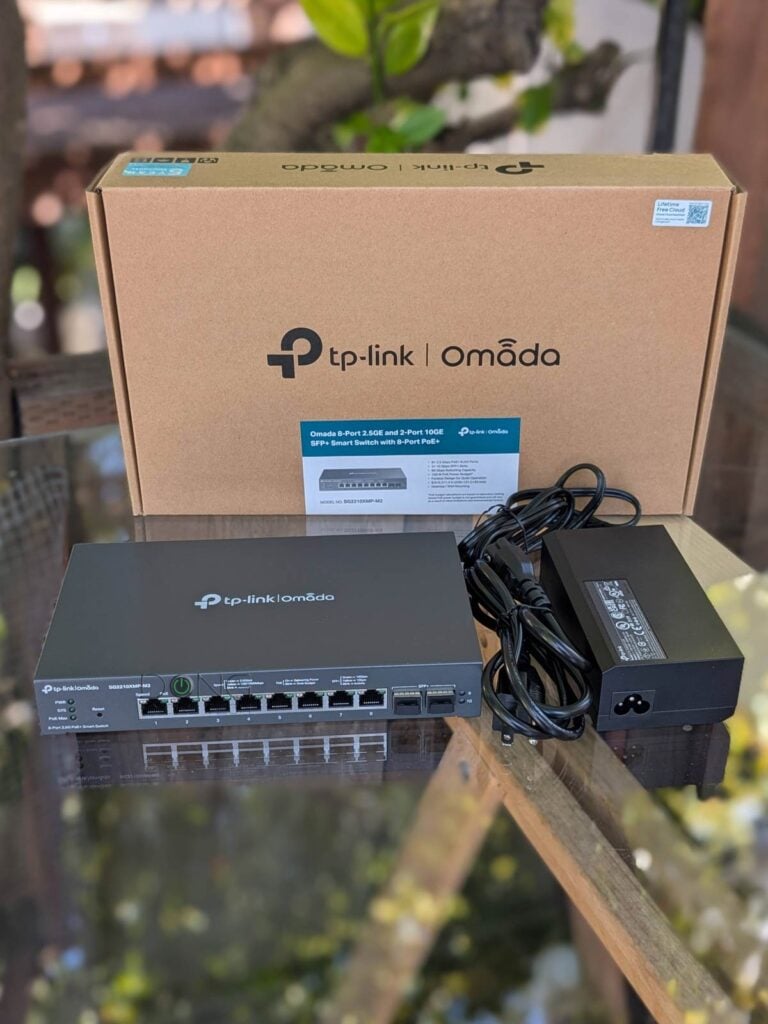
TP-Link Omada SG2210XMP-M2: An advanced managed switch that’s plug-and-play
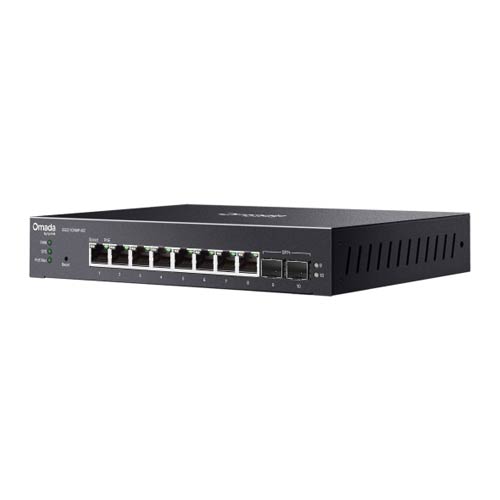
Out of the box, the TP-Link Omada SG2210XMP-M2 shapes like a typical 10-port switch with all the network ports on the front and the power port on the back.
There are two 10GbE SFP+ ports and eight 2.5GbE BASE-T ports, each with PoE+ (up to 30W of power output). The switch is accompanied by a large 180.3W power adapter, providing up to a 160W PoE budget.
Unfortunately, the switch lacks a 10GBASE-T port, but you can use a transceiver to convert one of its SFP+ ports to an RJ45 connection.
It is worth noting that the SG2210XMP-M2 is fanless, a huge improvement over the TL-SX1008, which has a noisy fan, and it is similar to the Ubiquiti 8-Port Flex 2.5G.
The table below shows the hardware specs of the TP-Link Omada SG2210XMP-M2 compared to the Ubiquiti counterpart.
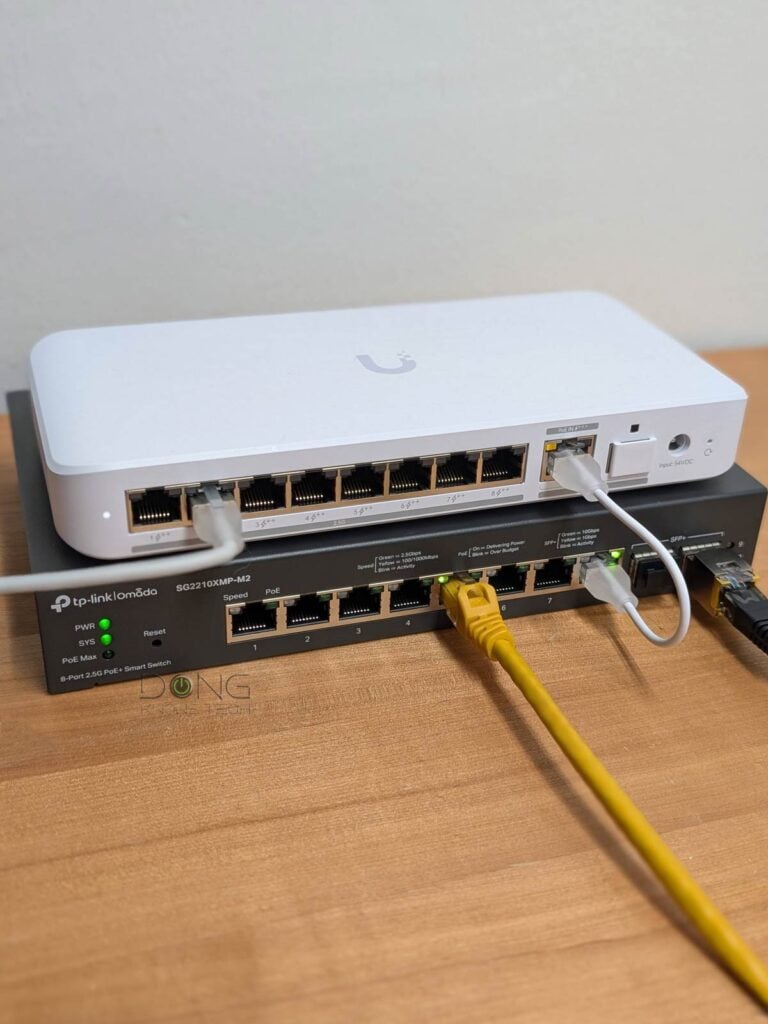
Hardware specifications: TP-Link SG2210XMP-M2 vs. Ubiquiti USW-Flex-2.5G-8-PoE
 |
 |
|
|---|---|---|
| Full Name | TP-Link Omada 8-Port 2.5GBASE-T and 2-Port 10GE SFP+ Smart Switch with 8-Port PoE+ |
Ubiquiti 8-Port Flex 2.5G PoE Switch |
| Model | SG2210XMP-M2 | USW-Flex-2.5G-8-PoE |
| Dimensions (W x D x H) |
8.9 × 5.2 × 1.4 in (226 × 131 × 35 mm) |
8.4 x 3.9 x 1.3 in (212.9 x 99.4 x 33.5 mm) |
| Weight | 2.2 lb (1kg) | 20 oz (567 g) |
| Accessories | None | Wall mounting accessories |
| Gigabit Port | None | |
| Multi-Gig Port | 8x 2.5Gbps Multi-Gig, 2x SFP+/ |
8x 2.5Gbps Multi-Gig, 1x SFP+/10Gbps Multi-Gig |
| PoE-out Port | 8x IEEE 802.3bt (PoE+) | 8x IEEE 802.3bt (PoE++) |
| PoE Power Forwarding | No | Yes |
| PoE-in Port | N/A | 1x 10Gbps Multi-Gig PoE+++ |
| Max Available PoE Power Budget (for clients) |
160W | Via PoE+++ input: 76W Via PoE++ input: 46W Via PoE+ input: 16W Via 210W AC adapter input: 196W |
| Max. PoE Wattage per port as a PSE (allowed by the power budget) |
PoE: 15.4W PoE+: 30W |
PoE: 15.4W PoE+: 30W PoE++: 60W |
| Switching Capacity | 80Gbps | 60Gbps |
| Touchscreen | None | |
| Management | Local web-based UI, Omada controller |
UniFi-OS Controller |
| Power Supply | 180.3 W power supply | External AC/DC adapter (not included), PoE++ switch or injector (not included) |
| Firmware (version at review) |
1.0.26 Build 20260509 Rel.24803 | 2.1.5 |
| Power Consumption (per 24 hours—no PoE devices) |
≈ 370 Wh | N/A (tested via PoE-in port) |
| US Launch Price (street prices) |
249.99 | $199 |


A versatile managed Omada switch
Designed as a “smart” (managed) switch, the TP-Link SG2210XMP-M2 functions as an unmanaged switch out of the box. Specifically, connect it to power and hook one of its ports to an existing router (or switch), and it’ll work, allowing you to connect up to 9 wired devices.
Ideally, though, use one of its SFP+ ports as the uplink port, since it offers the most bandwidth and supports up to 8 PoE devices. In any case, if all you want is to add more devices, the SG2210XMP-M2 is fully plug-and-play.
However, it also comes with many advanced features of a managed switch, accessible via its local web-based user interface at its IP address, assigned by the network’s router.
In this case, the SG2210XMP-M2 comes with many layer 2 and layer 3 features, allowing you to manage its ports, QoS, routing, PoE, and more.
Additionally, the SG2210XMP-M2 can be added to an Omada controller—hardware, software, or online. In this case, it automatically picks up the system settings, or you can manage them individually.


That said, overall, in terms of features and management, the TP-Link Omada SG2210XMP-M2 proved to be a versatile switch that will make all user demographics happy, from novice home users to advanced users, to those running an Omada system.
TP-Link Omada SG2210XMP-M2: Excellent performane
The TP-Link Omada SG2210XMP-M2 delivers excellent performance in my testing. The switch passed my 3-day stress test with zero issues and was completely silent during operation. It didn’t get hot, either, just slightly warm to the touch, even when hosting multiple PoE and PoE+ devices.
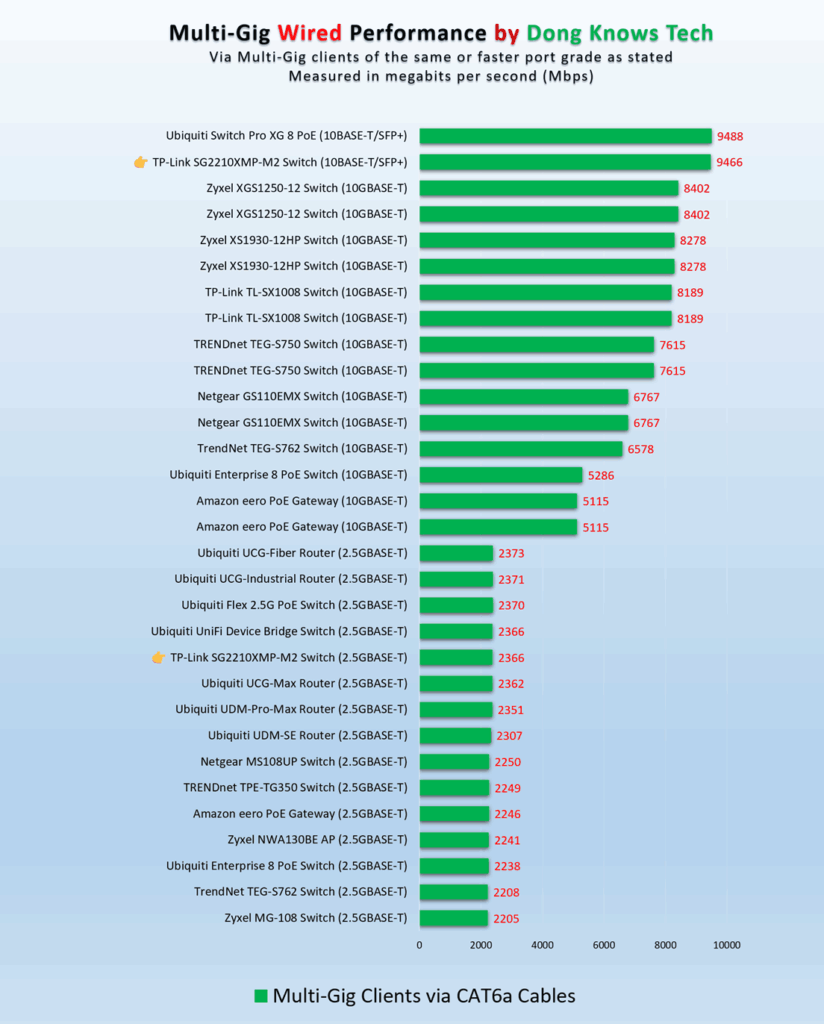
In terms of throughput, it proved formidable as well. In my testing, its SFP+ and 2.5GbE ports sustained as the standards’ top data rates after overhead, even during long operations.
Overall, there’s nothing to complain about this switch in terms of performance.
Conclusion
The TP-Link Omada SG2210XMP-M2 is a versatile PoE+ 2.5Gbps Multi-Gig switch. If you need to expand your wired network with fast connections, including PoE needs, consider one today! Make sure you get your home wired first.